Appendix E – Evaluation Forms
Rotation Evaluation in New Innovations
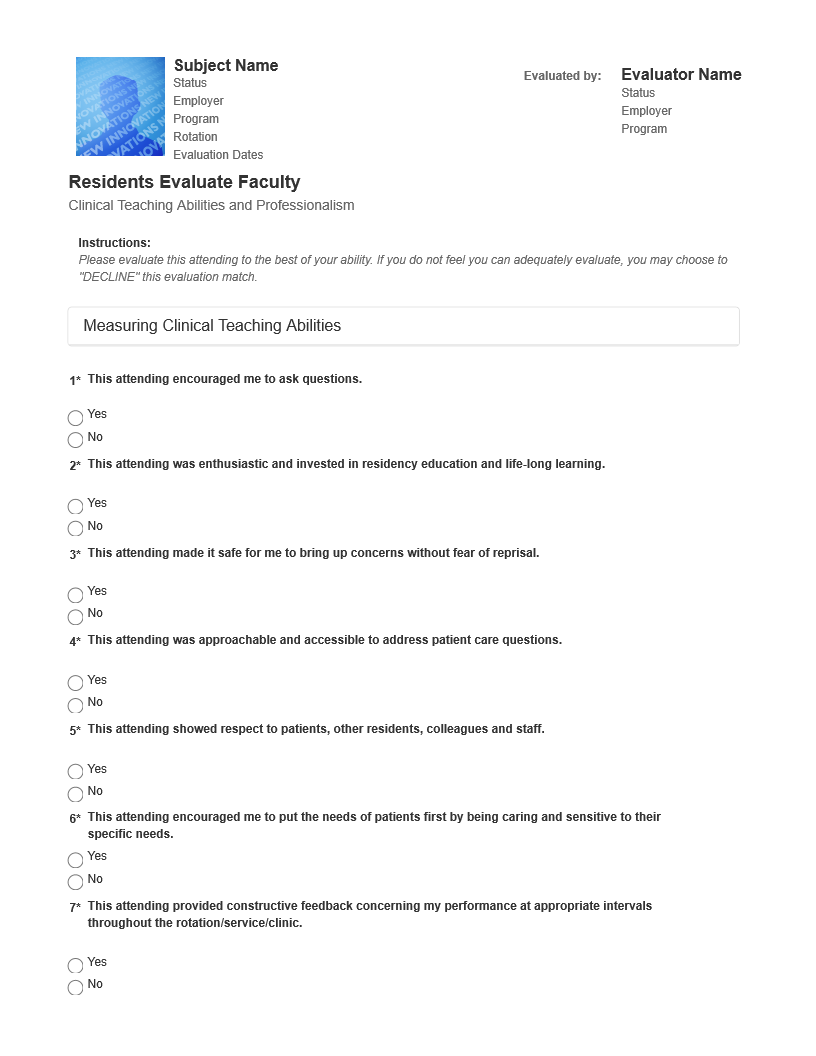
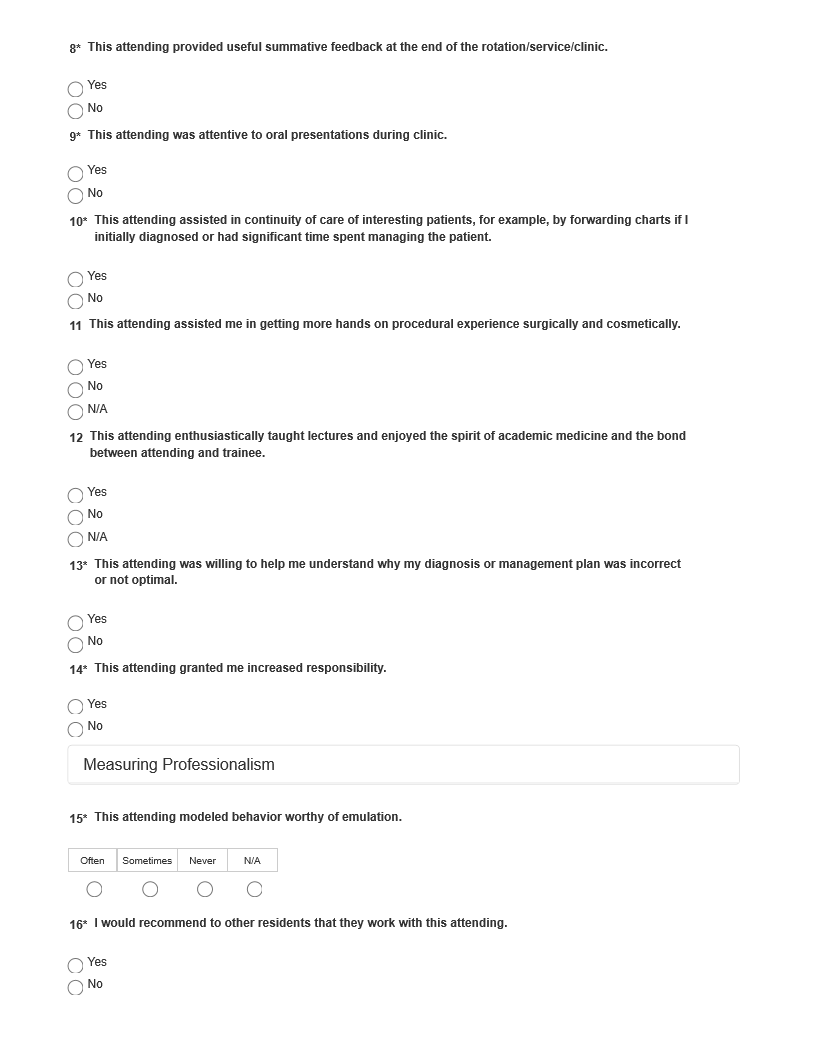
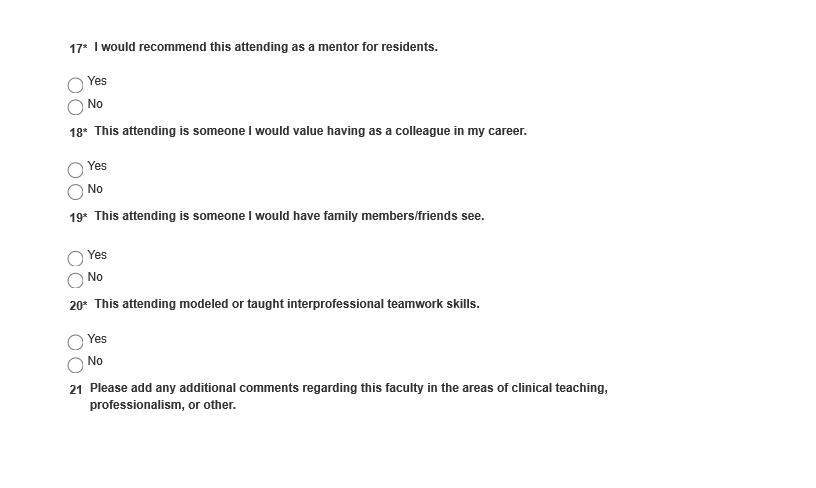
Text from this document (searchable)
Page 1
Subject Name
Status
Employer
Program
Rotation
Evaluation Dates
Residents Evaluate Faculty
Clinical Teaching Abilities and Professionalism
Evaluated by:
Evaluator Name
Status
Employer
Program
Instructions:
Please evaluate this attending to the best of your ability. If you do not feel you can adequately evaluate, you may choose to
”DECLINE” this evaluation match.
Measuring Clinical Teaching Abilities
1* This attending encouraged me to ask questions.
O Yes
• NO
2* This attending was enthusiastic and invested in residency education and life-long learning.
O Yes
• NO
3* This attending made it safe for me to bring up concerns without fear of reprisal.
O Yes
O NO
4* This attending was approachable and accessible to address patient care questions.
O Yes
• NO
5* This attending showed respect to patients, other residents, colleagues and staff.
O Yes
O NO
6* This attending encouraged me to put the needs of patients first by being caring and sensitive to their
specific needs.
O Yes
• NO
7* This attending provided constructive feedback concerning my performance at appropriate intervals
throughout the rotation/service/clinic.
• Yes
• NO
Page 2
g* This attending provided useful summative feedback at the end of the rotation/service/clinic.
Yes
• NO
g* This attending was attentive to oral presentations during clinic.
O Yes
• NO
10* This attending assisted in continuity of care of interesting patients, for example, by forwarding charts if I
initially diagnosed or had significant time spent managing the patient.
• Yes
• NO
11 This attending assisted me in getting more hands on procedural experience surgically and cosmetically.
• Yes
• NO
O NA
12 This attending enthusiastically taught lectures and enjoyed the spirit of academic medicine and the bond
between attending and trainee.
O Yes
• NO
O NA
13* This attending was willing to help me understand why my diagnosis or management plan was incorrect
or not optimal.
O Yes
O NO
14* This attending granted me increased responsibility.
O Yes
O NO
Measuring Professionalism
15* This attending modeled behavior worthy of emulation.
Often
Sometimes
Never
N/A
16* I would recommend to other residents that they work with this attending.
• Yes
O NO
Page 3
17× I would recommend this attending as a mentor for residents.
O Yes
• NO
18* This attending is someone I would value having as a colleague in my career.
O Yes
• NO
19* This attending is someone I would have family members/friends see.
O Yes
• NO
20* This attending modeled or taught interprofessional teamwork skills.
O Yes
• NO
21 Please add any additional comments regarding this faculty in the areas of clinical teaching,
professionalism, or other.
Faculty Evaluation in New Innovations
Medical Student Evaluation in OASIS
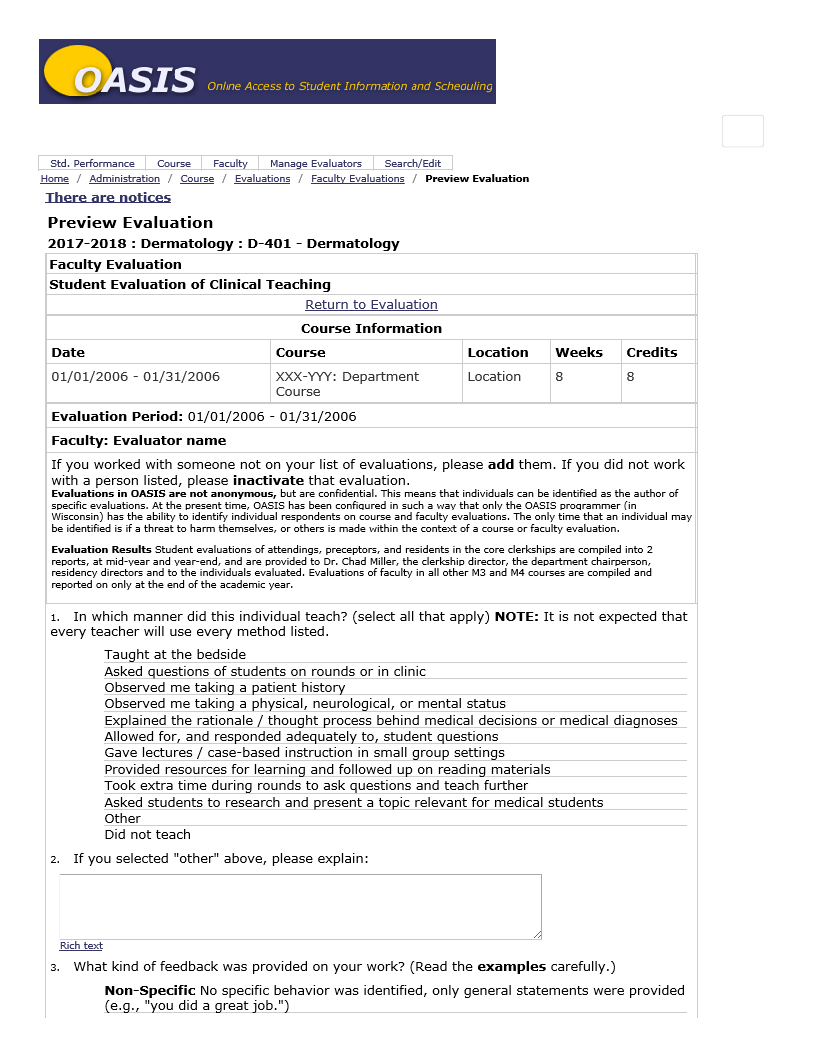
Text from this document (searchable)
OASIS Online Access to Student Intormation and Scheuling
Std. Performance
Faculty
Manage Evaluators
Search/Edit
Home / Administration / Course / Evaluations /
Faculty Evaluations / Preview Evaluation
There are notices
Preview Evaluation
2017-2018 : Dermatology: D-401 - Dermatology
Faculty Evaluation
Student Evaluation of Clinical Teaching
Return to Evaluation
Course Information
Date
01/01/2006 - 01/31/2006
Course
XXX-YYY: Department
Location
Location
Weeks
8
Credits
Course
Evaluation Period: 01/01/2006 - 01/31/2006
Faculty: Evaluator name
If you worked with someone not on your list of evaluations, please add them. If you did not work
with a person listed, please inactivate that evaluation.
Evaluations in OASIS are not anonymous, but are confidential. This means that individuals can be identified as the author of
specific evaluations. At the present time, OASIS has been confiqured in such a way that only the OASIS programmer (in
be identified is if a threat to harm themselves, or others is made within the context of a course or faculty evaluation.
Evaluation Results Student evaluations of attendings, preceptors, and residents in the core clerkships are compiled into 2
reports, at mid-year and year-end, and are provided to Dr. Chad Miller, the clerkship director, the department chairperson,
residency directors and to the individuals evaluated. Evaluations of faculty in all other M3 and M4 courses are compiled and
reported on only at the end of the academic year.
- In which manner did this individual teach? (select all that apply) NOTE: It is not expected that
every teacher will use every method listed.
Taught at the bedside
Asked questions of students on rounds or in clinic
Observed me taking a patient history
Observed me taking a physical, neurological, or mental status
Explained the rationale/ thought process behind medical decisions or medical diagnoses
Allowed for, and responded adequately to, student questions
Gave lectures / case-based instruction in small group settings
Provided resources for learning and followed up on reading materials
Took extra time during rounds to ask questions and teach further
Asked students to research and present a topic relevant for medical students
Other
Did not teach - If you selected “other” above, please explain:
Rich text - What kind of feedback was provided on your work? (Read the examples carefully.)
Non-Specific No specific behavior was identified, only general statements were provided
(e.g.,
“you did a great job.”)
Program Evaluation in New Innovations
Text from this document (searchable)
Page 1
Preview Evaluation Form
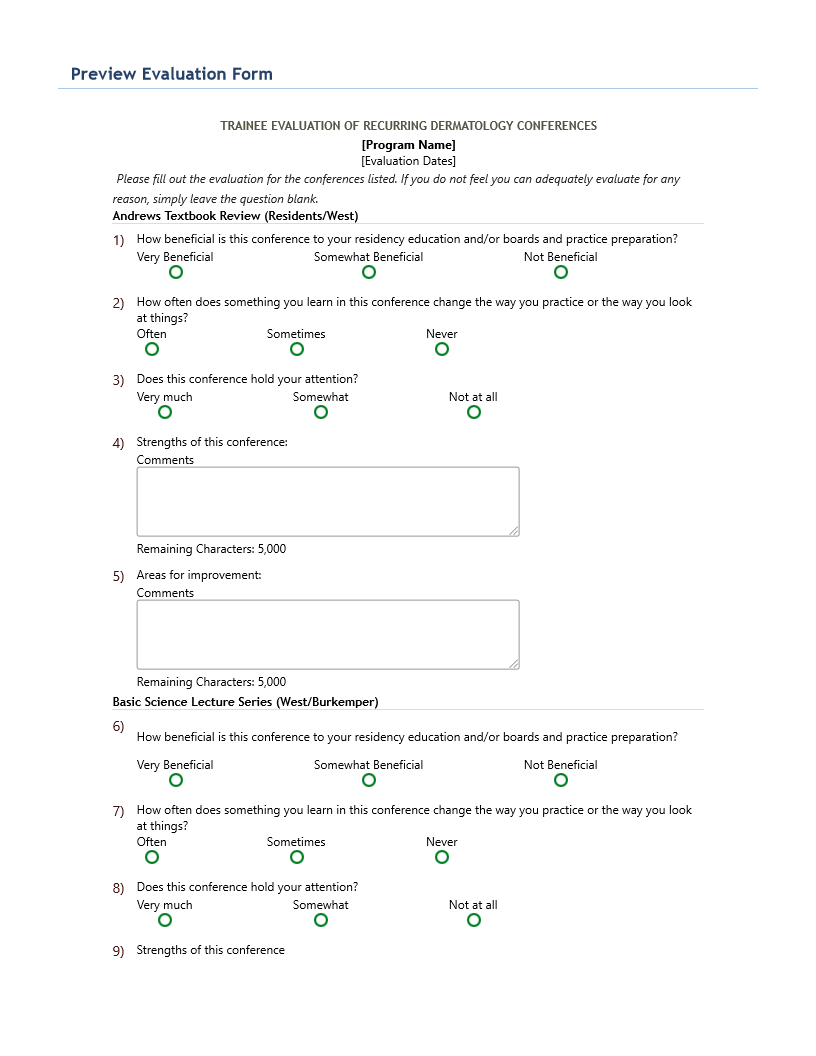
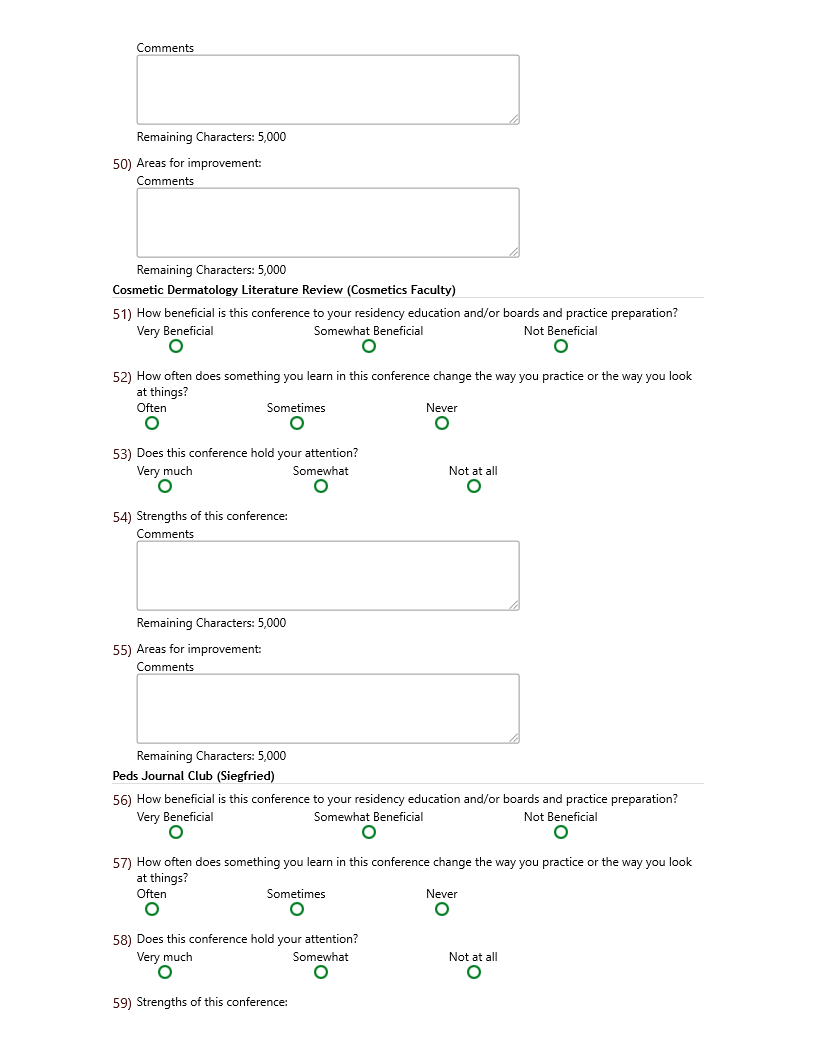
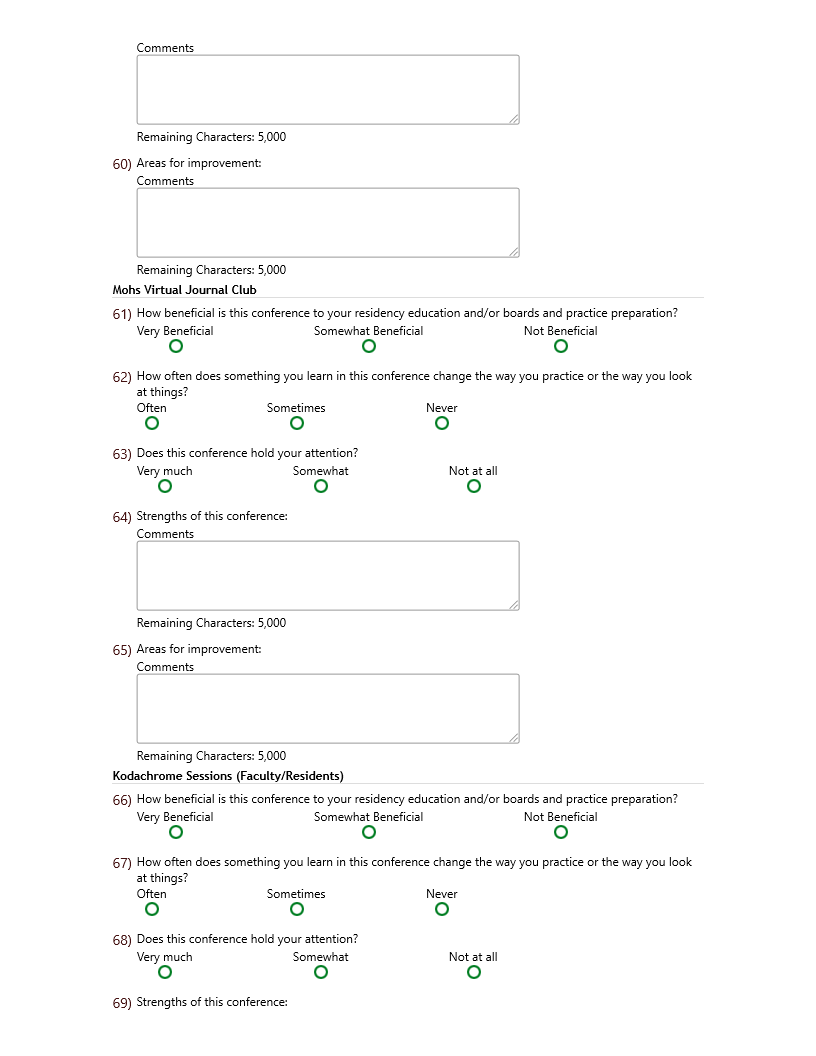
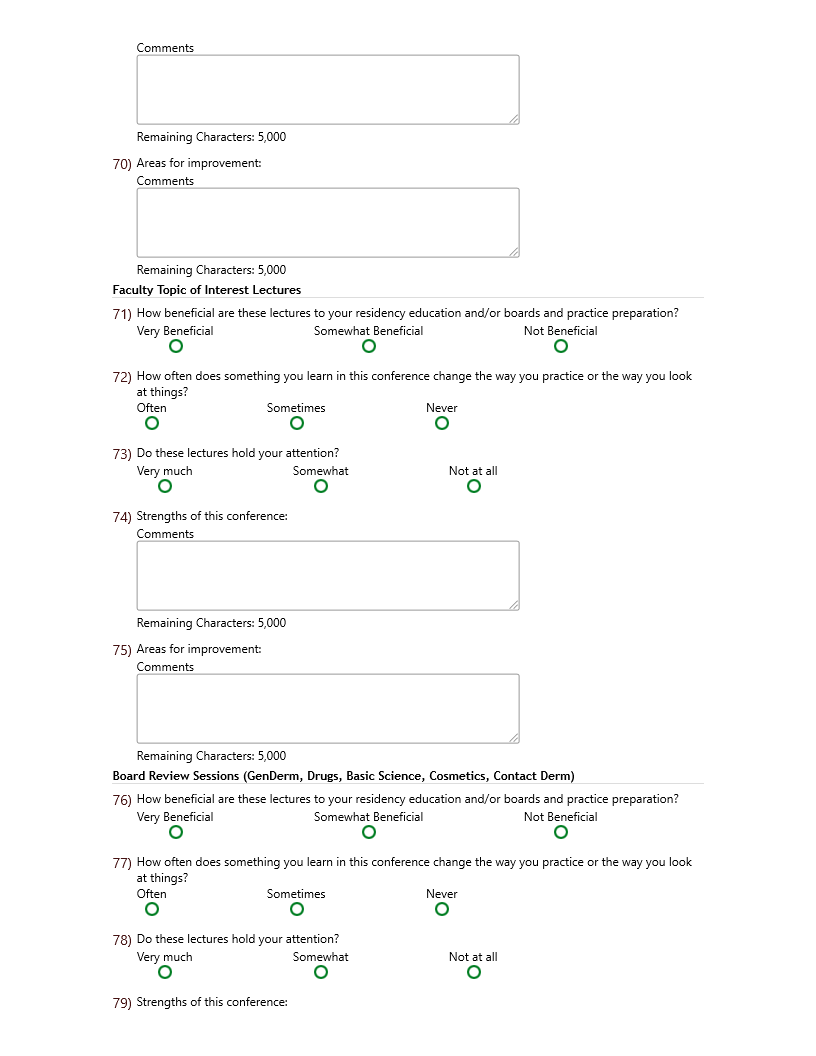
TRAINEE EVALUATION OF RECURRING DERMATOLOGY CONFERENCES
[Program Name]
[Evaluation Dates]
Please fill out the evaluation for the conferences listed. If you do not feel you can adequately evaluate for any
reason, simply leave the question blank.
Andrews Textbook Review (Residents/West)
- How beneficial is this conference to your residency education and/or boards and practice preparation?
Very Beneficial
Somewhat Beneficial
Not Beneficial
How often does something you learn in this conference change the way you practice or the way you look
at things?
Often
Sometimes
Does this conference hold your attention?
Very much
Somewnat
Never
Not at all
4) Strengths of this conference:
Comments
Remaining Characters: 5,000
5)
Areas for improvement:
Comments
Remaining Characters: 5,000
Basic Science Lecture Series (West/Burkemper)
How beneficial is this conference to your residency education and/or boards and practice preparation?
Very Beneficial
Somewhat Beneficial
Not Beneficial
8)
9)
How often does something you learn in this conference change the way you practice or the way you look
at things?
Often
Sometimes
Does this conference hold your attention?
Very much
Somewnat
Strengths of this conference
Never
Not at all
Page 2
Comments
Remaining Characters: 5,000
20) Areas for improvement:
Comments
Remaining Characters: 5,000
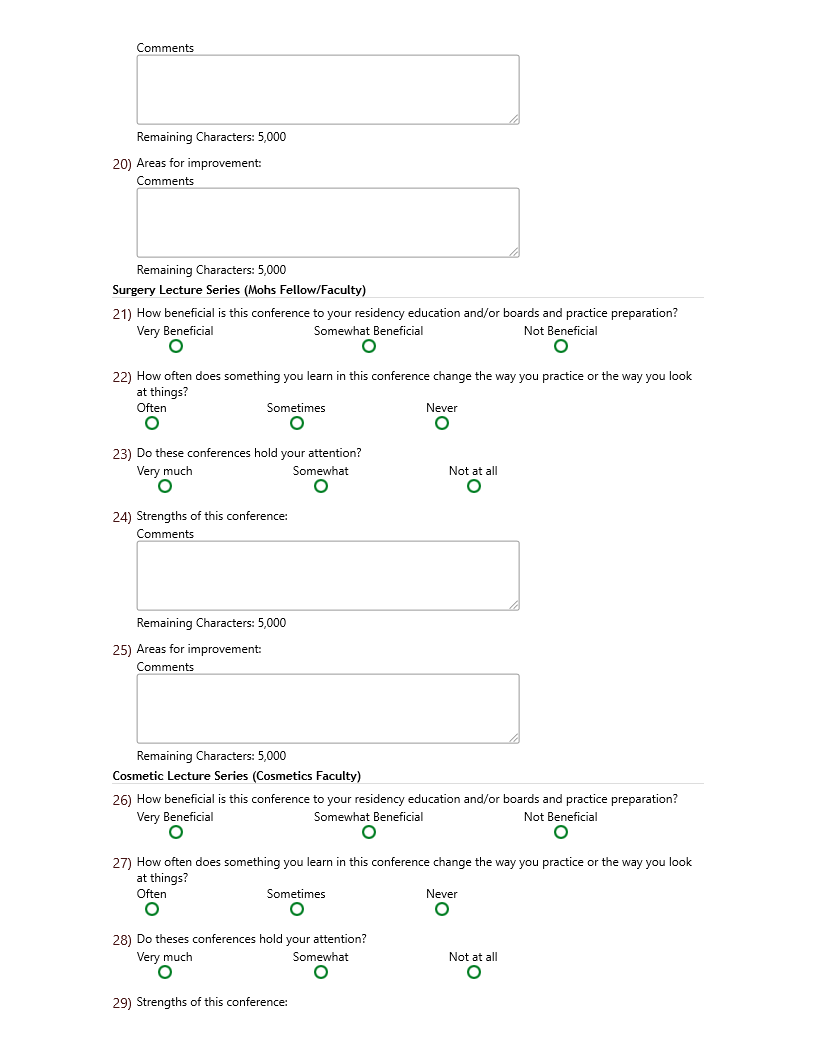
Surgery Lecture Series (Mohs Fellow/Faculty)
21) How beneficial is this conference to your residency education and/or boards and practice preparation?
Very Beneficial
Somewhat Beneficial
Not Beneficial
22) How often does something you learn in this conference change the way you practice or the way you look
at things?
Often
Sometimes
Never
23) Do these conferences hold your attention?
Very much
Somewhat
24) Strengths of this conference:
Comments
Not at all
Remaining Characters: 5,000
25) Areas for improvement:
Comments
Remaining Characters: 5,000
Cosmetic Lecture Series (Cosmetics Faculty)
26) How beneficial is this conference to your residency education and/or boards and practice preparation?
Very Beneficial
Somewhat Beneficial
Not Beneficial
27) How often does something you learn in this conference change the way you practice or the way you look
at things?
Often
Sometimes
28) Do theses conferences hold your attention?
Very much
Somewhat
Never
Not at all
29) Strengths of this conference:
Page 3
Comments
Remaining Characters: 5,000
30) Areas for improvement:
Comments
Remaining Characters: 5,000
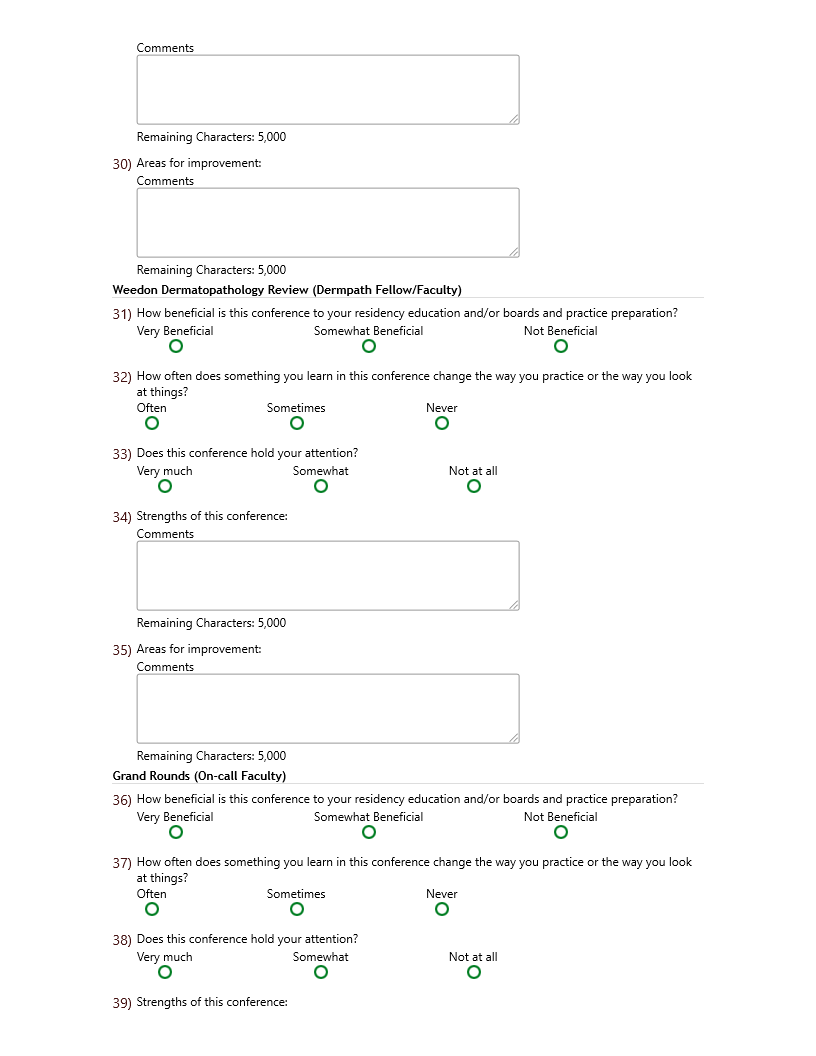
Weedon Dermatopathology Review (Dermpath Fellow/Faculty)
31) How beneficial is this conference to your residency education and/or boards and practice preparation?
Very Beneficial
Somewhat Beneficial
Not Beneficial
32) How often does something you learn in this conference change the way you practice or the way you look
at things?
Often
Sometimes
Never
33) Does this conference hold your attention?
Very much
Somewhat
Not at all
34) Strengths of this conference:
Comments
Remaining Characters: 5,000
35) Areas for improvement:
Comments
Remaining Characters: 5,000
Grand Rounds (On-call Faculty)
36) How beneficial is this conference to your residency education and/or boards and practice preparation?
Very Beneficial
Somewhat Beneficial
Not Beneficial
37) How often does something you learn in this conference change the way you practice or the way you look
at things?
Often
Sometimes
Never
38) Does this conference hold your attention?
Very much
Somewnat
39) Strengths of this conference:
Not at all
Page 4
Comments
Remaining Characters: 5,000
40) Areas for improvement:
Comments
Remaining Characters: 5,000
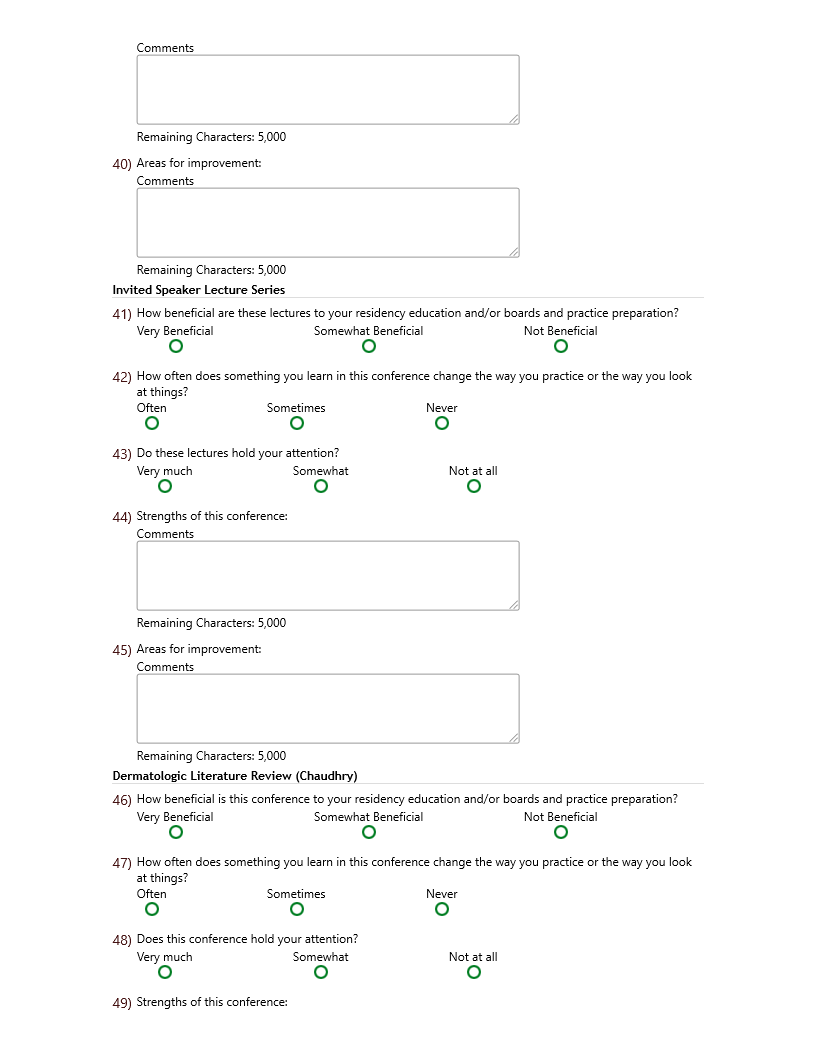
Invited Speaker Lecture Series
41) How beneficial are these lectures to your residency education and/or boards and practice preparation?
Very Beneficial
Somewhat Beneficial
Not Beneficial
42) How often does something you learn in this conference change the way you practice or the way you look
at things?
Often
Sometimes
Never
43) Do these lectures hold your attention?
Very much
Somewhat
44) Strengths of this conference:
Comments
Not at all
Remaining Characters: 5,000
45) Areas for improvement:
Comments
Remaining Characters: 5,000
Dermatologic Literature Review (Chaudhry)
46) How beneficial is this conference to your residency education and/or boards and practice preparation?
4) brail this rate our den anu aim and o bord and patie pesosion.
47) How often does something you learn in this conference change the way you practice or the way you look
at things?
Often
Sometimes
Never
48) Does this conference hold your attention?
Very much
Somewnat
Not at all
49) Strengths of this conference:
Page 5
Comments
Remaining Characters: 5,000
50) Areas for improvement:
Comments
Remaining Characters: 5,000
Cosmetic Dermatology Literature Review (Cosmetics Faculty)
51) How beneficial is this conference to your residency education and/or boards and practice preparation?
Very Beneficial
Somewhat Beneficial
Not Beneficial
52) How often does something you learn in this conference change the way you practice or the way you look
at things?
Often
Sometimes
Never
53) Does this conference hold your attention?
Very much
Somewhat
Not at all
54) Strengths of this conference:
Comments
Remaining Characters: 5,000
55) Areas for improvement:
Comments
Remaining Characters: 5,000
Peds Journal Club (Siegfried)
56) How beneficial is this conference to your residency education and/or boards and practice preparation?
Very Beneficial
Somewhat Beneficial
Not Beneficial
57) How often does something you learn in this conference change the way you practice or the way you look
at things?
Often
Sometimes
Never
58) Does this conference hold your attention?
Very much
Somewnat
59) Strengths of this conference:
Not at all
Page 6
Comments
Remaining Characters: 5,000
60) Areas for improvement:
Comments
Remaining Characters: 5,000
Mohs Virtual Journal Club
61) How beneficial is this conference to your residency education and/or boards and practice preparation?
Very Beneficial
Somewhat Beneficial
Not Beneficial
62) How often does something you learn in this conference change the way you practice or the way you look
at things?
Often
Sometimes
Never
63) Does this conference hold your attention?
Very much
Somewhat
64) Strengths of this conference:
Comments
Not at all
Remaining Characters: 5,000
65) Areas for improvement:
Comments
Remaining Characters: 5,000
Kodachrome Sessions (Faculty/Residents)
66) How beneficial is this conference to your residency education and/or boards and practice preparation?
Very Beneficial
Somewhat Beneficial
Not Beneficial
67) How often does something you learn in this conference change the way you practice or the way you look
at things?
Often
Sometimes
Never
68) Does this conference hold your attention?
Very much
Somewnat
Not at all
69) Strengths of this conference:
Page 7
Comments
Remaining Characters: 5,000
70) Areas for improvement:
Comments
Remaining Characters: 5,000
Faculty Topic of Interest Lectures
71) How beneficial are these lectures to your residency education and/or boards and practice preparation?
Very Beneficial
Somewhat Beneficial
Not Beneficial
72) How often does something you learn in this conference change the way you practice or the way you look
at things?
Often
Sometimes
Never
73) Do these lectures hold your attention?
Very much
Somewhat
74) Strengths of this conference:
Comments
Not at all
Remaining Characters: 5,000
75) Areas for improvement:
Comments
Remaining Characters: 5,000
Board Review Sessions (GenDerm, Drugs, Basic Science, Cosmetics, Contact Derm)
76) How beneficial are these lectures to your residency education and/or boards and practice preparation?
Very Beneficial
Somewhat Beneficial
77) How often does something you learn in this conference change the way you practice or the way you look
at things?
Often
Sometimes
Never
78) Do these lectures hold your attention?
Very much
Somenat
Not at all
79) Strengths of this conference:
Page 8
Comments
Remaining Characters: 5,000
80) Areas for improvement:
Comments
Remaining Characters: 5,000
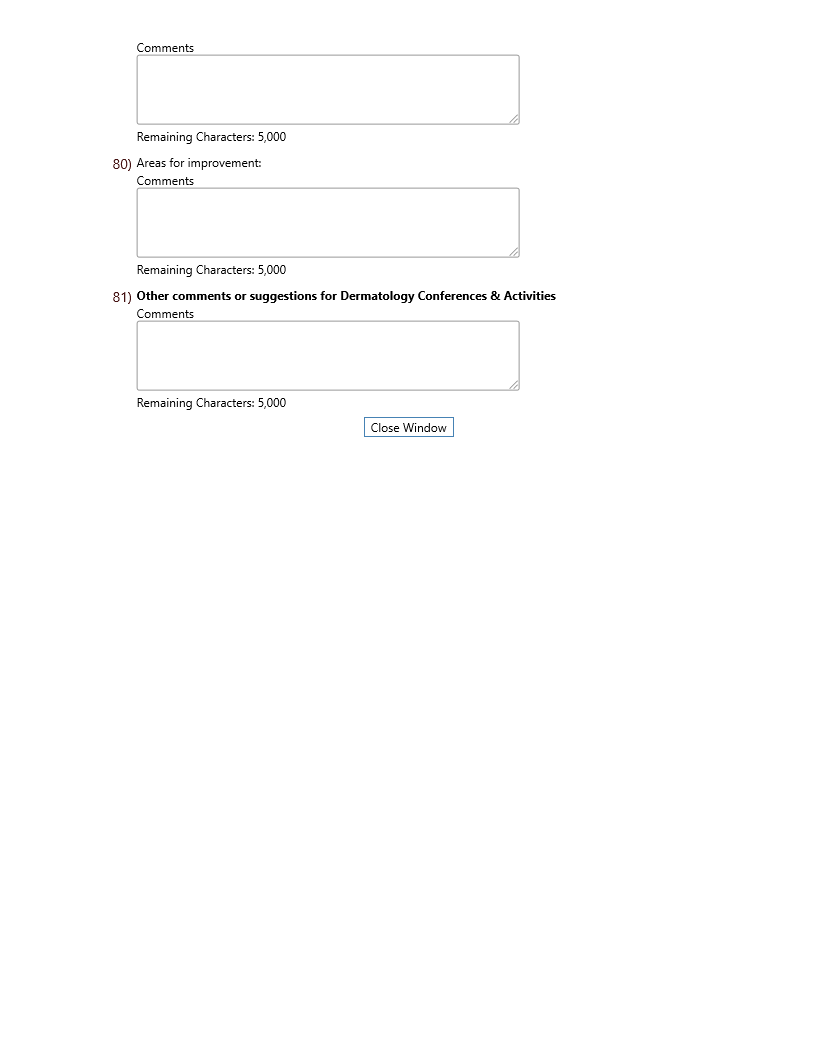
81) Other comments or suggestions for Dermatology Conferences & Activities
Comments
Remaining Characters: 5,000
Close Window
Page 9
Subject Name
Status
Employer
W INNO
Program
Rotation
•Evaluation Dates
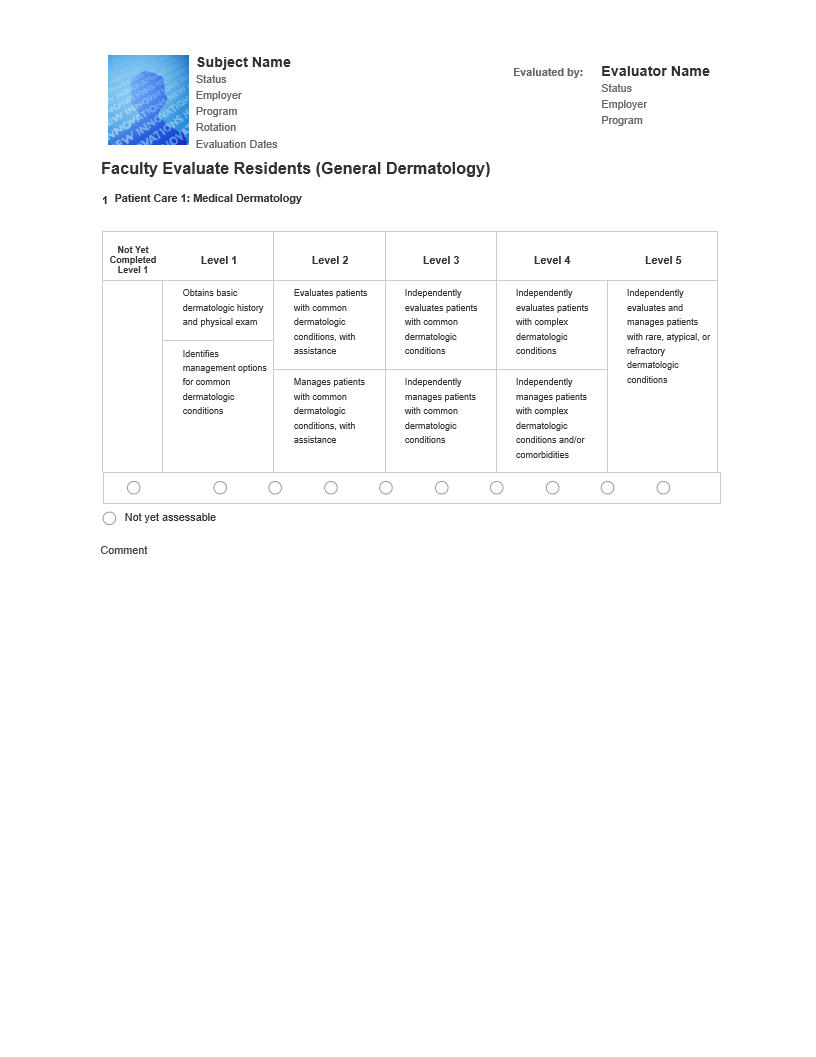
Faculty Evaluate Residents (General Dermatology)
1 Patient Care 1: Medical Dermatology
Not Yet
Completed
Level 1
Level 1
Obtains basic
dermatologic history
and physical exam
Identifies
management options
for common
dermatologic
conditions
Level 2
Evaluates patients
with common
dermatologic
conditions, with
assistance
Manages patients
with common
dermatologic
conditions, with
assistance
Level 3
Independently
evaluates patients
with common
dermatologic
conditions
Independently
manages patients
with common
dermatologic
conditions
• Not yet assessable
Comment
Evaluated by: Evaluator Name
Status
Employer
Program
Level 4
Independently
evaluates patients
with complex
dermatologic
conditions
Independenty
manages patients
with complex
dermatologic
conditions andlor
comorbidities
Level 5
Independently
evaluates and
manages patients
with rare, atypical, or
refractory
dermatologic
conditions
Page 10
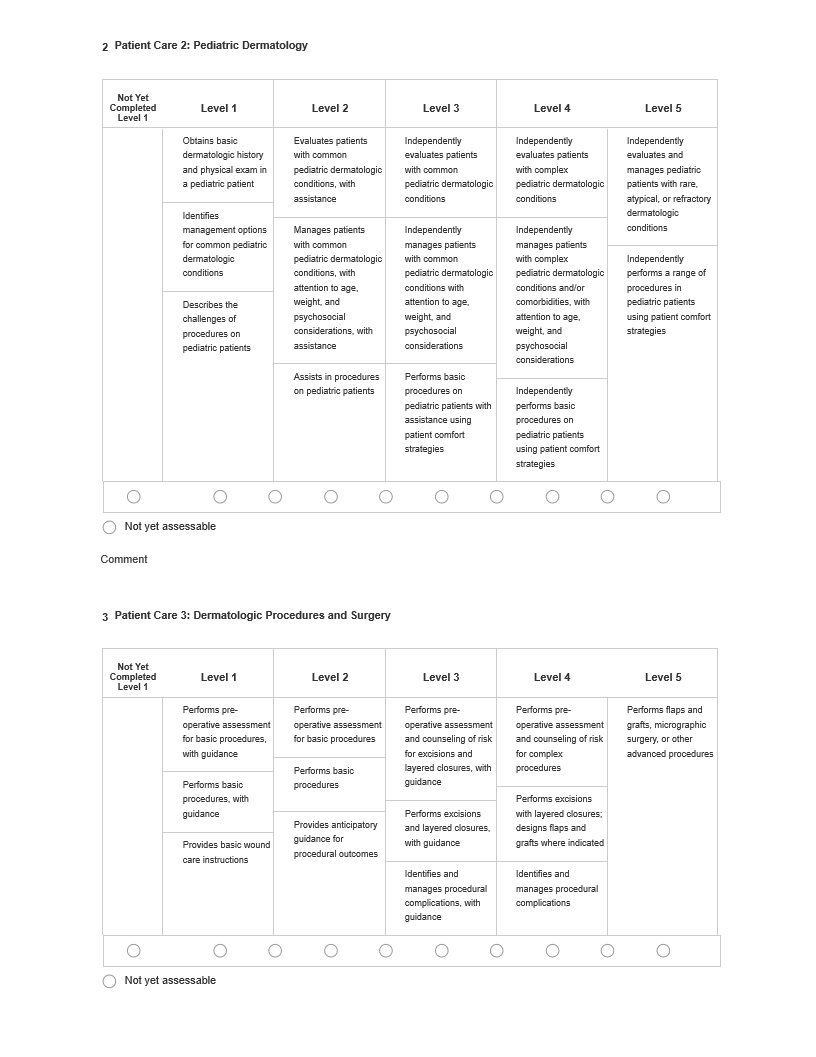
2 Patient Care 2: Pediatric Dermatology
Not Yet
Completed
Level 1
Level 1
Obtains basic
dermatologic history
and physical exam in
a pediatric patient
Identifies
management options
for common pediatric
dermatologic
conditions
Describes the
challenges of
procedures on
pediatric patients
Level 2
Evaluates patients
with common
pediatric dermatologic
conditions, with
assistance
Manages patients
with common
pediatric dermatologic
conditions, with
attention to age,
weight, and
psychosocial
considerations, with
assistance
Assists in procedures
on pediatric patients
Not yet assessable
Comment
3 Patient Care 3: Dermatologic Procedures and Surgery
Not Yet
Completed
Level 1
Level 1
Level 2
Performs pre-
operative assessment
for basic procedures.
with guidance
Performs pre-
operative assessment
for basic procedures
Performs basic
procedures
Performs basic
procedures, with
guidance
Provides basic wound
care instructions
Provides anticipatory
guidance for
procedural outcomes
• Not yet assessable
Level 3
Independently
evaluates patients
with common
pediatric dermatologic
conditions
Independently
manages patients
with common
pediatric dermatologic
conditions with
attention to age.
weight, and
psychosocial
considerations
Performs basic
procedures on
pediatric patients with
assistance using
patient comfort
strategies
Level 3
Performs pre-
operative assessment
and counseling of risk
for excisions and
layered closures, with
guidance
Performs excisions
and layered closures,
with guidance
Identifies and
manages procedural
complications, with
guidance
Level 4
Independentiy
evaluates patients
with complex
pediatric dermatologic
conditions
Independently
manages patients
with complex
pediatric dermatologic
conditions and/or
comorbidities, with
attention to age.
weight, and
psychosocial
considerations
Independently
performs basic
procedures on
pediatric patients
using patient comfort
strategies
Level 4
Performs pre-
operative assessment
and counseling of risk
for complex
procedures
Performs excisions
with layered closures:
designs flaps and
grafts where indicated
Identifies and
manages procedural
complications
Level 5
Independently
evaluates and
manages pediatric
patients with rare,
atypical, or refractory
dermatologic
conditions
Independently
performs a range of
procedures in
pediatric patients
using patient comfort
strategies
Level 5
Performs flaps and
grafts, micrographic
surgery, or other
advanced procedures
Page 11
Comment
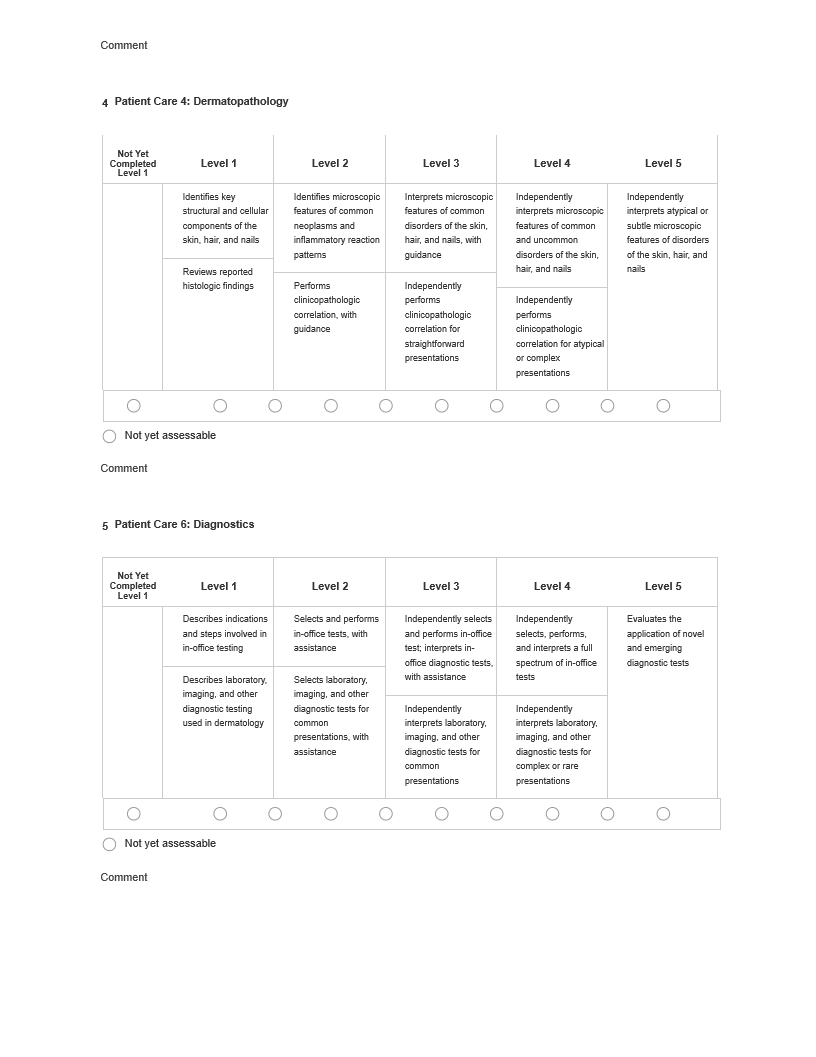
4 Patient Care 4: Dermatopathology
Not Yet
Completed
Level 1
Level 1
Identifies key
structural and cellular
components of the
skin, hair, and nails
Reviews reported
histologic findings
Level 2
Identifies microscopic
features of common
neoplasms and
inflammatory reaction
Performs
clinicopathologic
correlation, with
guidance
• Not yet assessable
Comment
5 Patient Care 6: Diagnostics
Not Yet
Completed
Level 1
Level 1
Describes indications
and steps involved in
in-office testing
Describes laboratory.
imaging, and other
diagnostic testing
used in dermatology
Level 2
Selects and performs
in-office tests, with
assistance
Selects laboratory,
imaging, and other
diagnostic tests for
presentations, with
• Not yet assessable
Comment
Level 3
Interprets microscopic
features of common
disorders of the skin,
hair, and nails, with
Independently
performs
clinicopathologic
correlation for
straightforward
presentations
Level 3
Independently selects
and performs in-office
test; interprets in.
office diagnostic tests,
Independently
interprets laboratory,
imaging, and other
diagnostic tests for
presentations
Level 4
interprets microscopic
features of common
disorders of the skin.
hair, and nails
Independently
performs
clinicopathologic
correlation for atypical
or complex
presentations
Level 4
selects, performs.
and interprets a full
spectrum of in-office
Independently
interprets laboratory.
diagnostic tests for
complex or rare
presentations
Level 5
Independently
interprets atypical or
subtle microscopic
features of disorders
of the skin, hair, and
nails
Level 5
application of novel
and emerging
diagnostic tests
Page 12
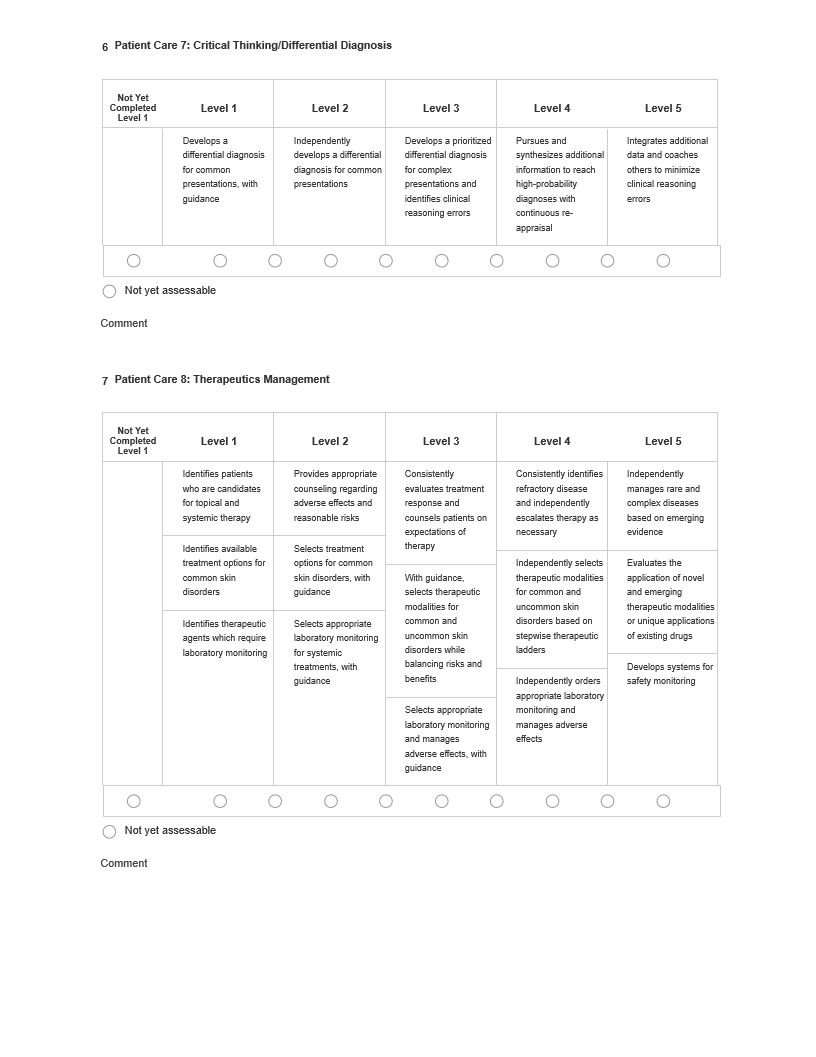
6 Patient Care 7: Critical Thinking/Differential Diagnosis
Not Yet
Completed
Level 1
Level 1
Develops a
differential diagnosis
for common
presentations, with
guidance
Level 2
Independently
develops a differential
diagnosis for common
presentations
Level 3
Develops a prioritized
differential diagnosis
for complex
presentations and
identifies clinical
reasoning errors
• Not yet assessable
Comment
7 Patient Care 8: Therapeutics Management
Not Yet
Completed
Level 1
Level 1
Identifies patients
who are candidates
for topical and
systemic therapy
Identifies available
treatment options for
common skin
disorders
Identifies therapeutic
agents which require
laboratory monitoring
Level 2
Provides appropriate
counseling regarding
adverse effects and
reasonable risks
options for common
skin disorders, with
guidance
Selects appropriate
laboratory monitoring
for systemic
treatments, with
guidance
Level 3
Consistently
evaluates treatment
response and
counsels patients on
expectations of
With guidance,
selects therapeutic
modalities for
common and
uncommon skin
disorders while
balancing risks and
Selects appropriate
laboratory monitoring
and manages
adverse effects, with
guidance
• Not yet assessable
Comment
Level 4
Pursues and
synthesizes additional
information to reach
high-probability
diagnoses with
continuous re-
appraisal
Level 4
Consistently identifes
refractory disease
and independently
escalates therapy as
Independently selects
therapeutic modalities
for common and
uncommon skin
disorders based on
stepwise therapeutic
ladders
Independently orders
appropriate laboratory
monitoring and
manages adverse
effects
Level 5
Integrates additional
data and coaches
others to minimize
clinical reasoning
errors
Level 5
Independently
manages rare and
complex diseases
based on emerging
Evaluates the
application of novel
and emerging
therapeutic modalities
or unique applications
of existing drugs
Develops systems for
safety monitoring
Page 13
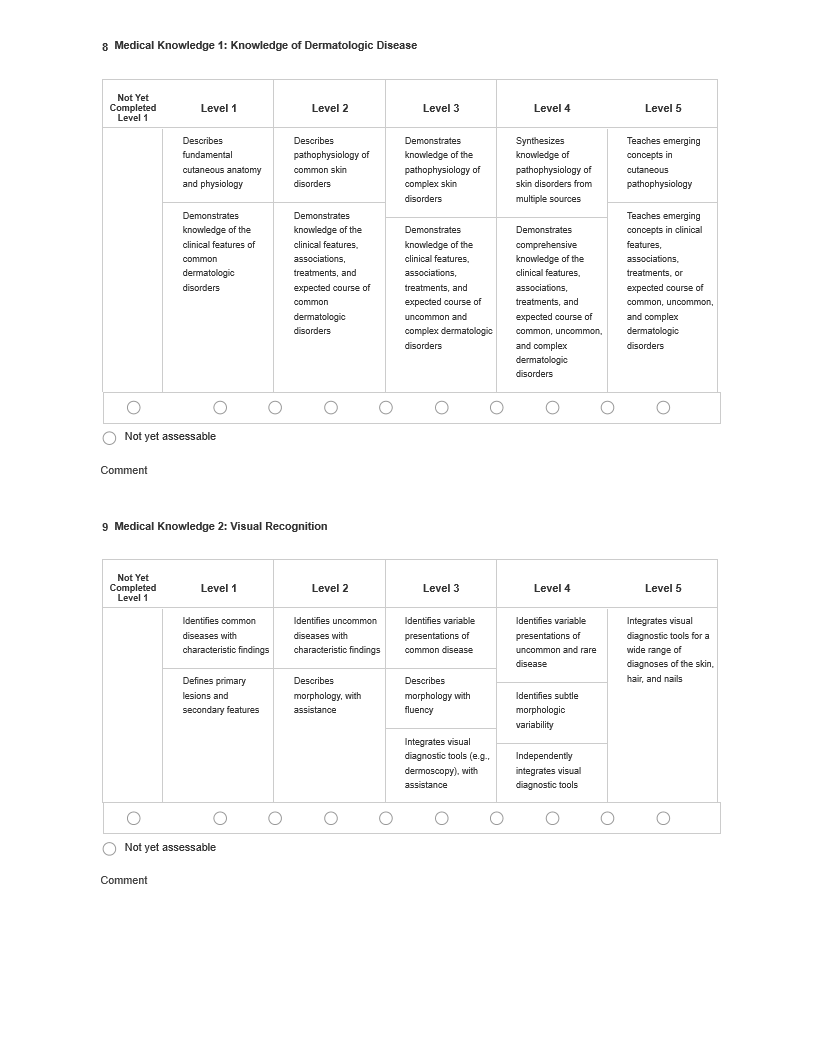
8 Medical Knowledge 1: Knowledge of Dermatologic Disease
Not Yet
Completed
Level 1
Level 1
Level 2
Describes
fundamental
cutaneous anatomy
and physiology
Describes
pathophysiology of
common skin
disorders
common
Level 3
Demonstrates
knowiedge of the
pathophysiology of
complex skin
disorders
Demonstrates
knowledge of the
clinical features.
associations,
treatments, and
expected course of
uncommon and
complex dermatologic
disorders
• Not yet assessable
Comment
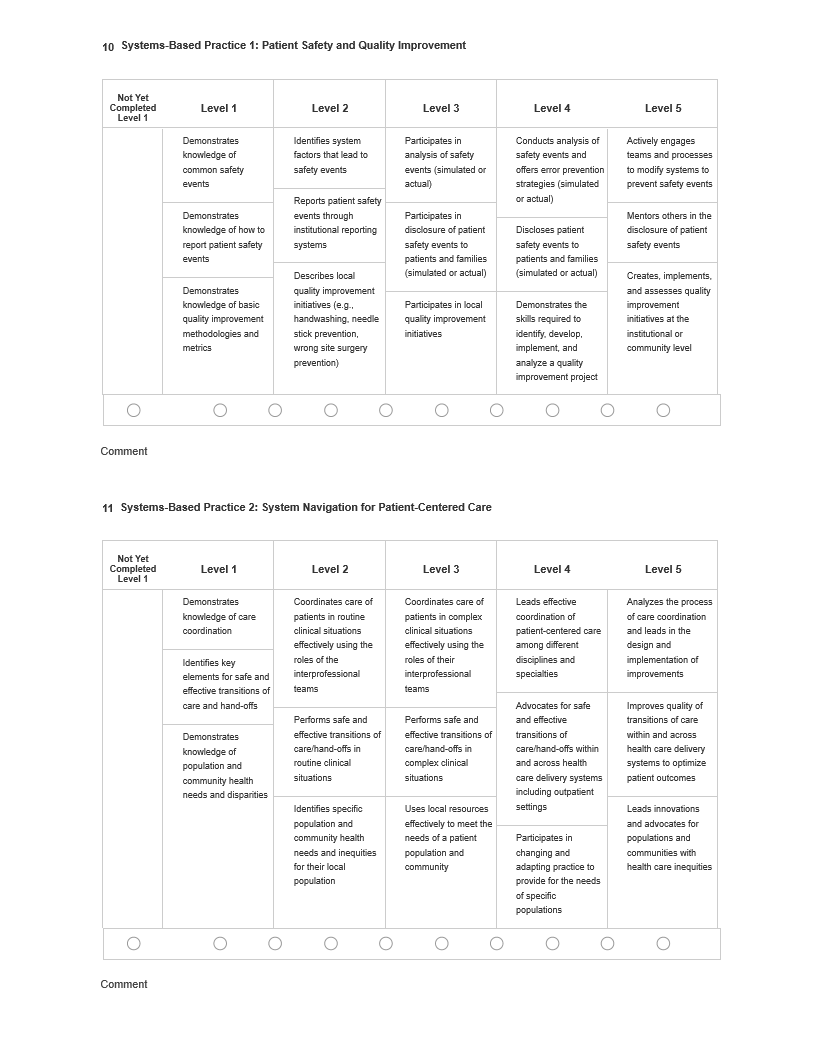
9 Medical Knowledge 2: Visual Recognition
Not Yet
Completed
Level 1
Level 1
Identifies common
diseases with
characteristic findings
Defines primary
lesions and
secondary features
Level 2
Identifies uncommon
diseases with
characteristic findings
Describes
morphology. with
assistance
Level 3
Identifies variable
presentations of
common disease
Describes
morphology with
fluency
Integrates visual
diagnostic tools (eg.
dermoscopy), with
assistance
• Not yet assessable
Comment
Level 4
Synthesizes
knowiedge of
pathophysiology of
skin disorders from
multiple sources
Level 4
Identifies variable
presentations of
uncommon and rare
disease
Identifies subtle
morphologic
variability
Independently
integrates visual
diagnostic tools
Level 5
Teaches emerging
concepts in
cutaneous
pathophysiology
features,
Millin
disorders
Level 5
Integrates visual
diagnostic tools for a
wide range of
diagnoses of the skin.
hair, and nails
Page 14
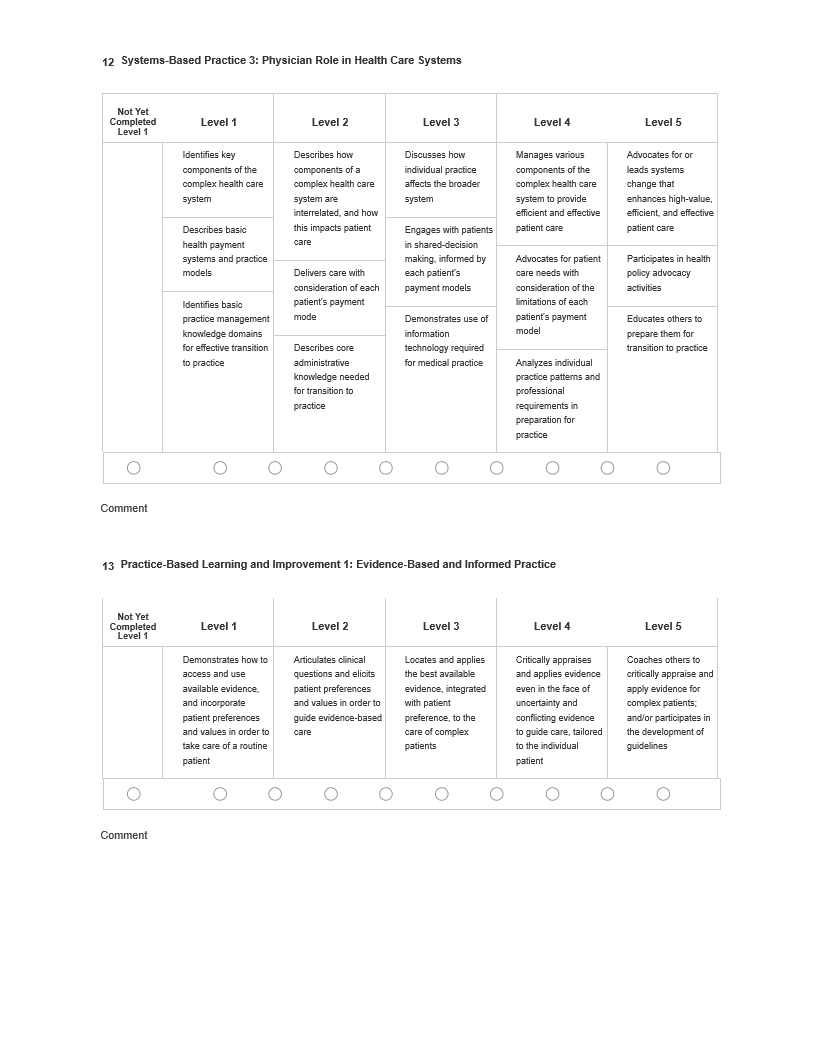
10 Systems-Based Practice 1: Patient Safety and Quality Improvement
Not Yet
Completed
Level 1
Level 1
Demonstrates
knowledge of
common safety
events
Demonstrates
knowledge of how to
report patient safety
events
Demonstrates
knowledge of basic
quality improvement
methodologies and
metrics
Level 2
Identifes system
factors that lead to
safety events
Reports patient safety
events through
institutional reporting
systems
Describes local
quality improvement
initiatives (e.g..
handwashing, needle
stick prevention.
wrong site surgery
prevention)
Level 3
Participates in
analysis of safety
events (simulated or
actual)
Participates in
disclosure of patient
safety events to
patients and families
(simulated or actual)
Participates in local
quality improvement
initiatives
Comment
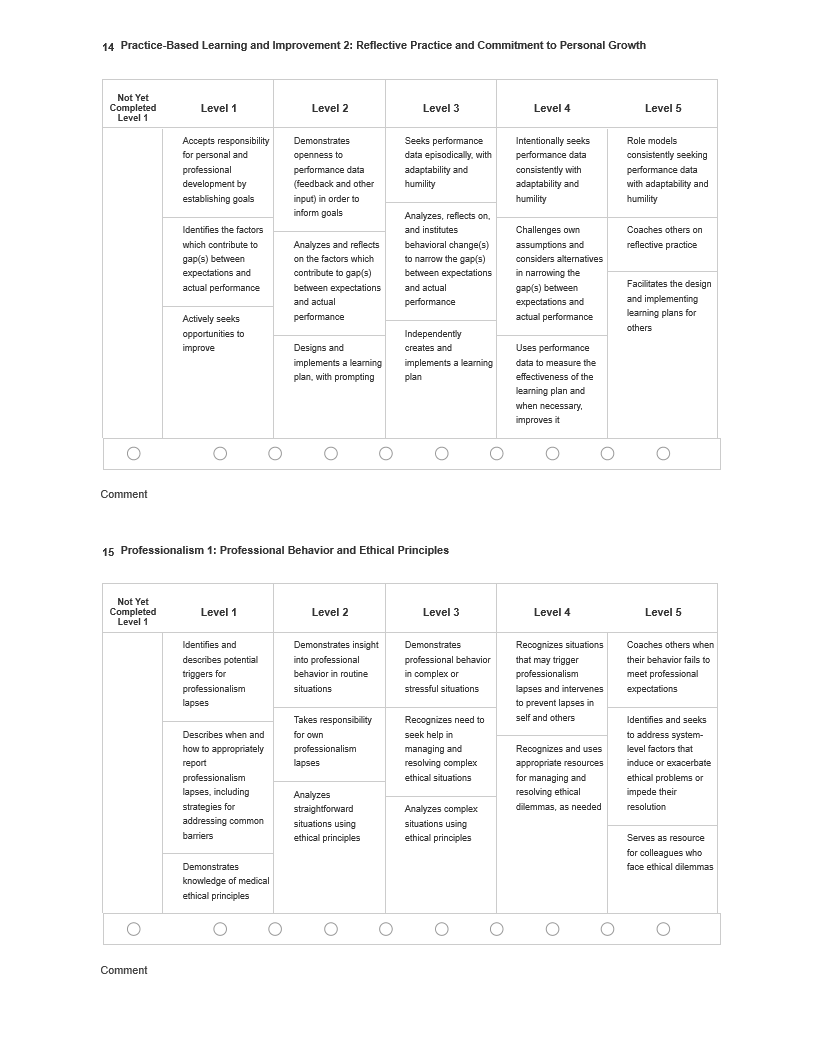
11 Systems-Based Practice 2: System Navigation for Patient-Centered Care
Not Yet
Completed
Level 1
Level 1
Demonstrates
knowledge of care
coordination
Identifies key
elements for safe and
effective transitions of
care and hand-offs
Demonstrates
knowledge of
population and
community health
needs and disparities
Level 2
Coordinates care of
patients in routine
clinical situations
effectively using the
roles of the
interprofessional
teams
Performs safe and
effective transitions of
care/hand-offs in
routine clinical
situations
Identifies specific
population and
community health
needs and inequities
for their local
population
Level 3
Coordinates care of
patients in complex
clinical situations
effectively using the
roles of their
interprofessional
teams
Performs safe and
effective transitions of
care/hand-offs in
complex clinical
situations
Uses local resources
effectively to meet the
needs of a patient
population and
community
Comment
Level 4
Conducts analysis of
safety events and
offers error prevention
strategies (simulated
or actual)
Discloses patient
safety events to
patients and families
(simulated or actual)
Demonstrates the
skills required to
identify, develop.
implement, and
analyze a quality
improvement project
Level 4
Leads effective
coordination of
patient-centered care
among different
disciplines and
specialties
Advocates for safe
and effective
transitions of
care/hand-offs within
and across health
care delivery systems
including outpatient
settings
Participates in
changing and
adapting practice to
provide for the needs
of specific
populations
Level 5
Actively engages
teams and processes
to modify systems to
prevent safety events
Mentors others in the
disclosure of patient
safety events
Creates, implements,
and assesses quality
improvement
initiatives at the
institutional or
community level
Level 5
Analyzes the process
of care coordination
and leads in the
design and
implementation of
improvements
Improves quality of
transitions of care
within and across
health care delivery
systems to optimize
patient outcomes
Leads innovations
and advocates for
populations and
communities with
health care inequities
Page 15
12 Systems-Based Practice 3: Physician Role in Health Care Systems
Not Yet
Completed
Level 1
Level 1
Identifies key
components of the
complex health care
system
Describes basic
health payment
systems and practice
models
Identifies basic
practice management
knowledge domains
for effective transition
to practice
Level 2
Describes how
components of a
complex health care
system are
interrelated, and how
this impacts patient
care
Delivers care with
consideration of each
patient’s payment
mode
Describes core
administrative
knowledge needed
for transition to
practice
Level 3
Discusses how
individual practice
affects the broader
system
Engages with patients
in shared-decision
making, informed by
each patient’s
payment models
Demonstrates use of
information
technology required
for medical practice
Level 4
Manages various
components of the
complex health care
system to provide
efficient and effective
patient care
Advocates for patient
care needs with
consideration of the
limitations of each
patient’s payment
model
Analyzes individual
practice patterns and
professional
requirements in
preparation for
practice
Comment
13 Practice-Based Learning and Improvement 1: Evidence-Based and Informed Practice
Not Yet
Completec
-evel
Level 1
Demonstrates how to
access and use
available evidence.
and incorporate
patient preferences
and values in order to
take care of a routine
patient
Level 2
Articulates clinical
questions and elicits
patient preferences
and values in order to
guide evidence-based
care
Level 3
Locates and applies
the best available
evidence, integrated
with patient
preference, to the
care of complex
patients
Level 4
Critically appraises
and applies evidence
even in the face of
uncertainty and
conflicting evidence
to guide care, tailored
to the individual
patient
Comment
Level 5
Advocates for or
leads systems
change that
enhances high-value,
efficient, and effective
patient care
Participates in health
policy advocacy
activities
Educates others to
prepare them for
transition to practice
Level 5
Coaches others to
critically appraise and
apply evidence for
complex patients;
and/or participates in
the development of
guidelines
Page 16
14 Practice-Based Learning and Improvement 2: Reflective Practice and Commitment to Personal Growth
Not Yet
Completed
Level 1
Level 1
Accepts responsibility
for personal and
professional
development by
establishing goals
Identifies the factors
which contribute to
gap(s) between
expectations and
actual performance
Actively seeks
opportunities to
improve
Level 2
Demonstrates
openness to
performance data
(feedback and other
input) in order to
inform goals
Analyzes and reflects
on the factors which
contribute to gap(s)
between expectations
and actual
performance
Designs and
implements a learning
plan, with prompting
Level 3
Seeks performance
data episodically, with
adaptability and
humility
Analyzes, reflects on.
and institutes
behavioral change(s)
to narrow the gap(s)
between expectations
and actual
performance
Independently
creates and
implements a learning
plan
Level 4
Intentionally seeks
performance data
consistently with
adaptability and
humility
Challenges own
assumptions and
considers alternatives
in narrowing the
gap(s) between
expectations and
actual performance
Uses performance
data to measure the
effectiveness of the
learning plan and
when necessary.
improves it
Level 5
Role models
consistently seeking
performance data
with adaptability and
humility
Coaches others on
reflective practice
Facilitates the design
and implementing
learning plans for
others
Comment
15 Professionalism 1: Professional Behavior and Ethical Principles
Not Yet
Completed
Level 1
Level 1
Identifies and
describes potential
triggers for
professionalism
lapses
Describes when and
how to appropriately
report
professionalism
lapses, including
strategies for
addressing common
barriers
Demonstrates
knowledge of medical
ethical principles
Level 2
Demonstrates insight
into professional
behavior in routine
situations
Takes responsibility
for own
professionalism
lapses
Analyzes
straightforward
situations using
ethical principles
Level 3
Demonstrates
professional behavior
in complex or
stressful situations
Recognizes need to
seek help in
managing and
resolving complex
ethical situations
Analyzes complex
situations using
ethical principles
Level 4
Recognizes situations
that may trigger
professionalism
lapses and intervenes
to prevent lapses in
self and others
Recognizes and uses
appropriate resources
for managing and
resolving ethical
dilemmas, as needed
Level 5
Coaches others when
their behavior fails to
meet professional
expectations
Identifies and seeks
to address system-
level factors that
induce or exacerbate
ethical problems or
impede their
resolution
Serves as resource
for colleagues who
face ethical dilemmas
Comment
Page 17
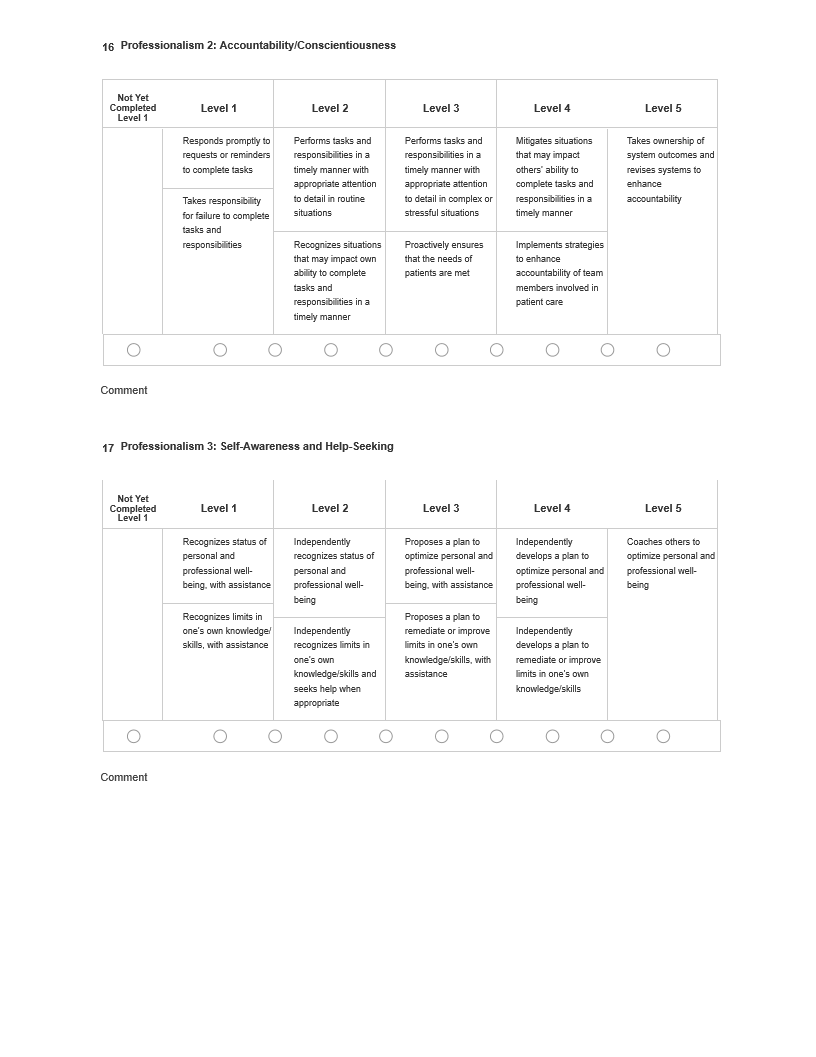
16 Professionalism 2: Accountability/Conscientiousness
Not Yet
Completed
Level 1
Level 1
Responds promptly to
requests or reminders
to complete tasks
Takes responsibility
for failure to complete
tasks and
responsibilties
Level 2
Performs tasks and
responsibilities in a
timely manner with
appropriate attention
to detail in routine
Recognizes situations
that may impact own
ability to complete
tasks and
responsibilities in a
timely manner
Level 3
Performs tasks and
responsibilities in a
timely manner with
appropriate attention
to detail in complex or
stressful situations
Proactively ensures
that the needs of
patients are met
Comment
17 Professionalism 3: Self-Awareness and Help-Seeking
Not Yet
Completed
Level 1
Level 1
professional well.
being, with assistance
Recognizes limits in
one’s own knowledge!
skills, with assistance
Level 2
Independently
recognizes status of
personal and
professional well.
being
Independently
recognizes limits in
one’s own
knowledge/skills and
seeks help when
appropriate
Level 3
professional well.
being. with assistance
Proposes a plan to
remediate or improve
limits in one’s own
knowledge/skills, with
assistance
Comment
Level 4
Mitigates situations
that may impact
others’ ability to
complete tasks and
responsibilities in a
timely manner
Implements strategies
to enhance
accountability of team
members involved in
patient care
Level 4
Independently
develops a plan to
optimize personal and
professional well.
being
Independently
develops a plan to
remediate or improve
limits in one’s own
knowledge/skills
Level 5
Takes ownership of
system outcomes and
revises systems to
enhance
accountability
Level 5
Coaches others to
optimize personal and
professional well-
being
Page 18
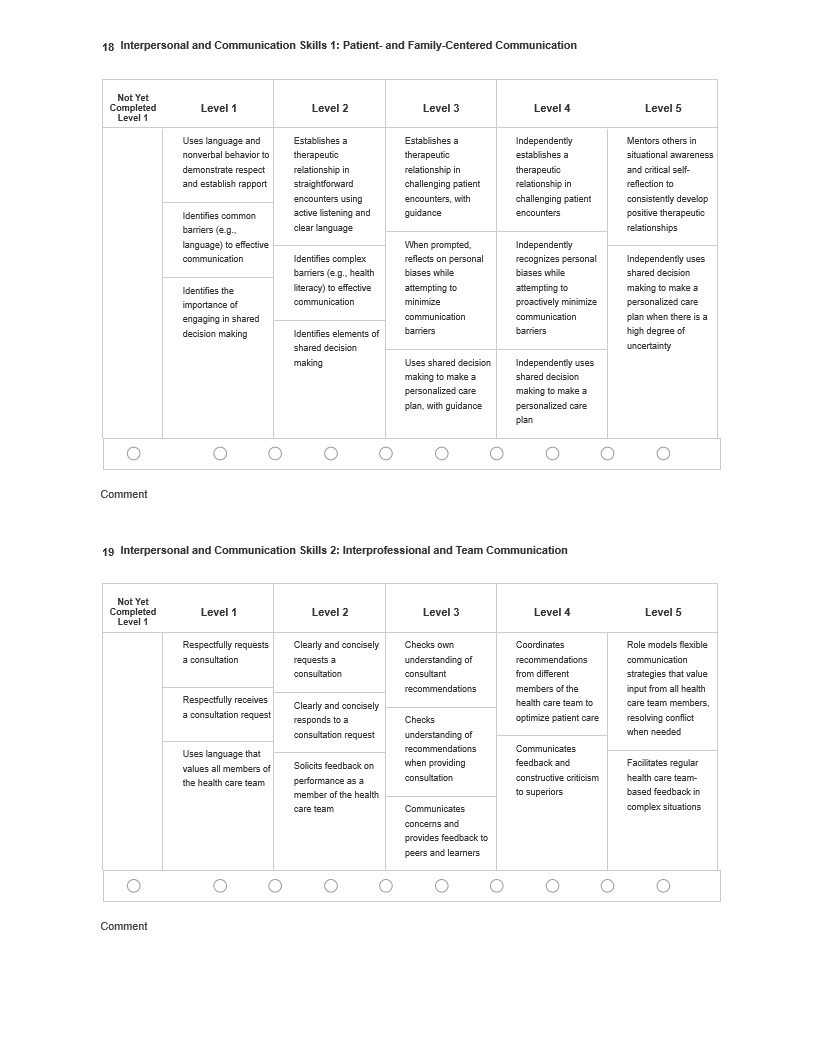
18 Interpersonal and Communication Skills 1: Patient- and Family-Centered Communication
Not Yet
Completed
Level 1
Level 1
Uses language and
nonverbal behavior to
demonstrate respect
and establish rapport
Identifies common
barriers (eg.
language) to effective
communication
Identifies the
importance of
engaging in shared
decision making
Level 2
Establishes a
therapeutic
relationship in
straightforward
encounters using
active listening and
clear language
Identifies complex
barriers (eg. health
literacy) to effective
communication
Identifies elements of
shared decision
making
Level 3
Establishes a
therapeutic
relationship in
challenging patient
encounters, with
guidance
When prompted,
reflects on personal
biases while
attempting to
minimize
communication
barriers
Uses shared decision
making to make a
personalized care
plan, with guidance
Level 4
Independently
establishes a
therapeutic
relationship in
challenging patient
encounters
Independentiy
recognizes personal
biases while
attempting to
proactively minimize
communication
barriers
Independently uses
shared decision
making to make a
personalized care
plan
Comment
19 Interpersonal and Communication Skills 2: Interprofessional and Team Communication
Not Yet
Completed
Level 1
Level 1
Respectfully requests
a consultation
Respectfully receives
a consultation request
Uses language that
values all members of
the health care team
Level 2
Clearly and concisely
requests a
consultation
Clearly and concisely
responds to a
consultation request
Solicits feedback on
performance as a
member of the health
care team
Level 3
Checks own
understanding of
consultant
recommendations
Checks
understanding of
recommendations
when providing
consultation
Communicates
concerns and
provides feedback to
peers and learners
Level 4
Coordinates
recommendations
from different
members of the
health care team to
optimize patient care
Communicates
feedback and
constructive criticism
to superiors
Comment
Level 5
Mentors others in
situational awareness
and critical self-
reflection to
consistently develop
positive therapeutic
relationships
Independently uses
shared decision
making to make a
personalized care
plan when there is a
high degree of
uncertainty
Level 5
Role models flexible
communication
strategies that value
input from all health
care team members,
resolving conflict
when needed
Facilitates regular
health care team-
based feedback in
complex situations