Appendix EE –Mohs Bleeder Protocol
In the event of a Mohs Bleeder:
- First off, reassure the patient that most skin bleeding stops with pressure. That being said, the patient does occasionally need to come to the office for evaluation
- Ask the patient to quantify the bleeding (i.e. staining the bandage, dripping out (teaspoons), streaming out from the bandage). If the bandage is mostly dry, pressure through the bandage is sufficient.
- If the bandage is wet, ask the patient to take off their bandage to see where the bleeding is coming from along the suture line.
- Request a photograph (if the patient is comfortable sending via text or email) to determine the severity of bleeding and share with the fellow. Regardless of whether there is a photo, inform the fellow at this point (early!)
- Tell the patient to lie down and apply firm pressure to the bleeding area with ice (or frozen vegetables) for 20 minutes. They should do this for 2 rounds. NO PEEKING!!! If they peek, then the 20 minutes starts over again. This must be reinforced with a little bit of fear (i.e. you will tear off the clot and the bleeding will start again)
- If they are still bleeding after the second round of 20 minutes of cold pressure, they should call you back. If you haven’t heard back, contact the patient
- The fellow will determine if it is appropriate to meet the patient at the Des Peres or CSM location. Do NOT send the patient to the ER under these circumstances, if possible.
- If the fellow is out of town or unable to come in, make sure the attending is contacted by CALLING them (only text, if not available by telephone). They are probably not on call, and may not check a text message at night. If the patient’s attending is not available, contact the other attending.
- If neither attending is not available, make sure that your senior resident is aware. If a straightforward case of bleeding, it is appropriate for you to meet the patient as a pair. If it is a complicated case, then sending the patient to the ER may be appropriate.
- For after hours, the CSM is available at all hours. The Des Peres location closes at 8, but can be accessed afterwards through the exterior side entrance of Des Peres (nearest the Mohs clinic space) which has a metal key pad to the right of the outside door with code. The doors at Des Peres are also open on the weekends until about noon or so. Please ask Dr. Behshad for the door code
- There is a small grey filing cabinet between the two nursing bays at the Mohs CSM clinic where there are labelled keys in the top drawer to open the cabinets for sutures etc.
Text from this document (searchable)
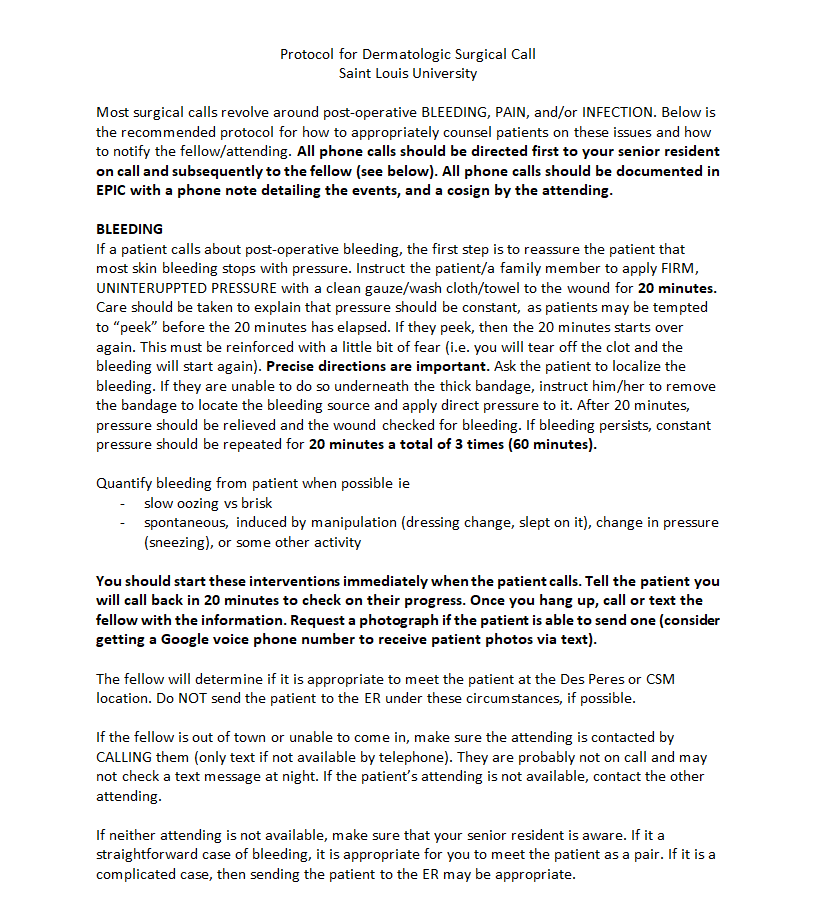
Protocol for Dermatologic Surgical Call
Saint Louis University
Most surgical calls revolve around post-operative BLEEDING, PAIN, and/or INFECTION. Below is
the recommended protocol for how to appropriately counsel patients on these issues and how
to notify the fellow/attending. All phone calls should be directed first to your senior resident
on call and subsequently to the fellow (see below). All phone calls should be documented in
EPIC with a phone note detailing the events, and a cosign by the attending.
BLEEDING
If a patient calls about post-operative bleeding, the first step is to reassure the patient that
most skin bleeding stops with pressure. Instruct the patient/a family member to apply FIRM,
UNINTERUPPTED PRESSURE with a clean gauze/wash cloth/towel to the wound for 20 minutes.
Care should be taken to explain that pressure should be constant, as patients may be tempted
to “peek” before the 20 minutes has elapsed. If they peek, then the 20 minutes starts over
again. This must be reinforced with a little bit of fear (i.e. you will tear off the clot and the
bleeding will start again). Precise directions are important. Ask the patient to localize the
bleeding. If they are unable to do so underneath the thick bandage, instruct him/her to remove
the bandage to locate the bleeding source and apply direct pressure to it. After 20 minutes,
pressure should be relieved and the wound checked for bleeding. If bleeding persists, constant
pressure should be repeated for 20 minutes a total of 3 times (60 minutes).
Quantify bleeding from patient when possible ie
- slow oozing vs brisk
- spontaneous, induced by manipulation (dressing change, slept on it), change in pressure
(sneezing), or some other activity
You should start these interventions immediately when the patient calls. Tell the patient you
will call back in 20 minutes to check on their progress. Once you hang up, call or text the
fellow with the information. Request a photograph if the patient is able to send one (consider
getting a Google voice phone number to receive patient photos via text).
The fellow will determine if it is appropriate to meet the patient at the Des Peres or CSM
location. Do NOT send the patient to the ER under these circumstances, if possible.
If the fellow is out of town or unable to come in, make sure the attending is contacted by
CALLING them (only text if not available by telephone). They are probably not on call and may
not check a text message at night. If the patient’s attending is not available, contact the other
attending.
If neither attending is not available, make sure that your senior resident is aware. If it a
straightforward case of bleeding, it is appropriate for you to meet the patient as a pair. If it is a
complicated case, then sending the patient to the ER may be appropriate.
Text from this document (searchable)
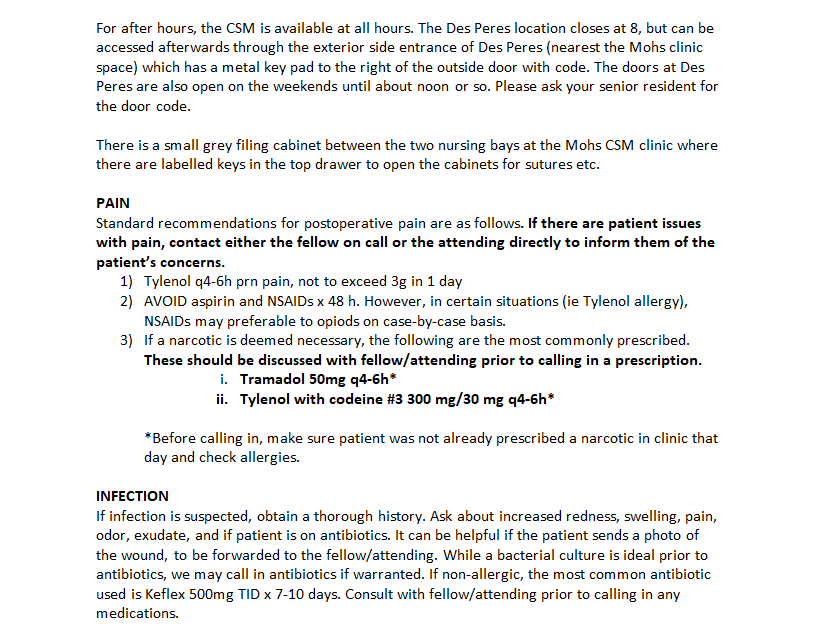
For after hours, the CSM is available at all hours. The Des Peres location closes at 8, but can be
accessed afterwards through the exterior side entrance of Des Peres (nearest the Mohs clinic
space) which has a metal key pad to the right of the outside door with code. The doors at Des
Peres are also open on the weekends until about noon or so. Please ask your senior resident for
the door code.
There is a small grey filing cabinet between the two nursing bays at the Mohs CSM clinic where
there are labelled keys in the top drawer to open the cabinets for sutures etc.
PAIN
Standard recommendations for postoperative pain are as follows. If there are patient issues
with pain, contact either the fellow on call or the attending directly to inform them of the
patient’s concerns.
- Tylenol q4-6h prn pain, not to exceed 3g in 1 day
- AVOID aspirin and NSAIDs x 48 h. However, in certain situations (ie Tylenol allergy),
NSAIDs may preferable to opiods on case-by-case basis. - If a narcotic is deemed necessary, the following are the most commonly prescribed.
These should be discussed with fellow/attending prior to calling in a prescription.
i. Tramadol 50mg q4-6h*
ii. Tylenol with codeine #3 300 mg/30 mg q4-6h*
*Before calling in, make sure patient was not already prescribed a narcotic in clinic that
day and check allergies.
INFECTION
If infection is suspected, obtain a thorough history. Ask about increased redness, swelling, pain,
odor, exudate, and if patient is on antibiotics. It can be helpful if the patient sends a photo of
the wound, to be forwarded to the fellow/attending. While a bacterial culture is ideal prior to
antibiotics, we may call in antibiotics if warranted. If non-allergic, the most common antibiotic
used is Keflex 500mg TID x 7-10 days. Consult with fellow/attending prior to calling in any
medications.
HOW TO CONTACT THE FELLOW
-
Text or call the fellow (Nasro Isaq, 763-528-8227) during daytime hours with all patient calls.
-
After 10pm, text messages are OK to quickly convey consult information but do not assume it will wake up the recipient.
-
Call fellow. If no answer, wait 5 minutes then call back two more times.
-
Wait 10 minutes.
-
If no response, contact attending. If the issue is non-urgent (ie; bandage fell off, there’s no bleeding) then use judgement in calling the attending in the middle of the night vs. Waiting until morning. However, for any emergent situation, contact the attending immediately (bleeding won’t stop with pressure; chest pain; shortness of breath; mental status changes/ seizures, etc.).
Text from this document (searchable)
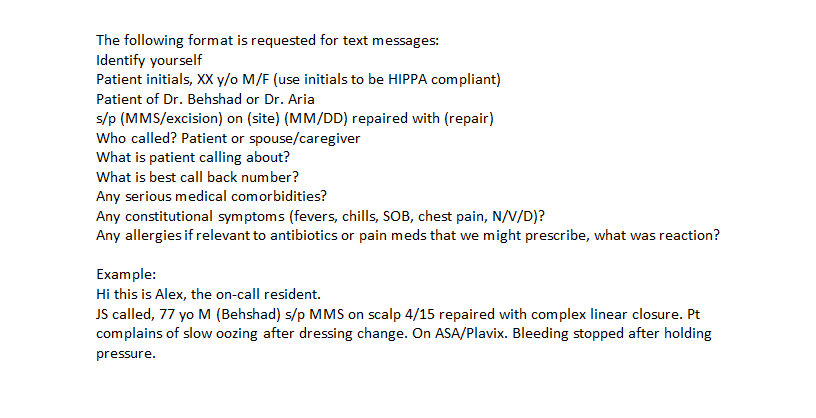
The following format is requested for text messages:
Identify yourself
Patient initials, XX y/o M/F (use initials to be HIPPA compliant)
Patient of Dr. Behshad or Dr. Aria
s/p (MMS/excision) on (site) (MM/DD) repaired with (repair)
Who called? Patient or spouse/caregiver
What is patient calling about?
What is best call back number?
Any serious medical comorbidities?
Any constitutional symptoms (fevers, chills, SOB, chest pain, N/V/D)?
Any allergies if relevant to antibiotics or pain meds that we might prescribe, what was reaction?
Example:
Hi this is Alex, the on-call resident.
JS called, 77 yo M (Behshad) s/p MMS on scalp 4/15 repaired with complex linear closure. Pt
complains of slow oozing after dressing change. On ASA/Plavix. Bleeding stopped after holding
pressure.