Dermatopathology PGY-2
Text from this document (searchable)
Page 1
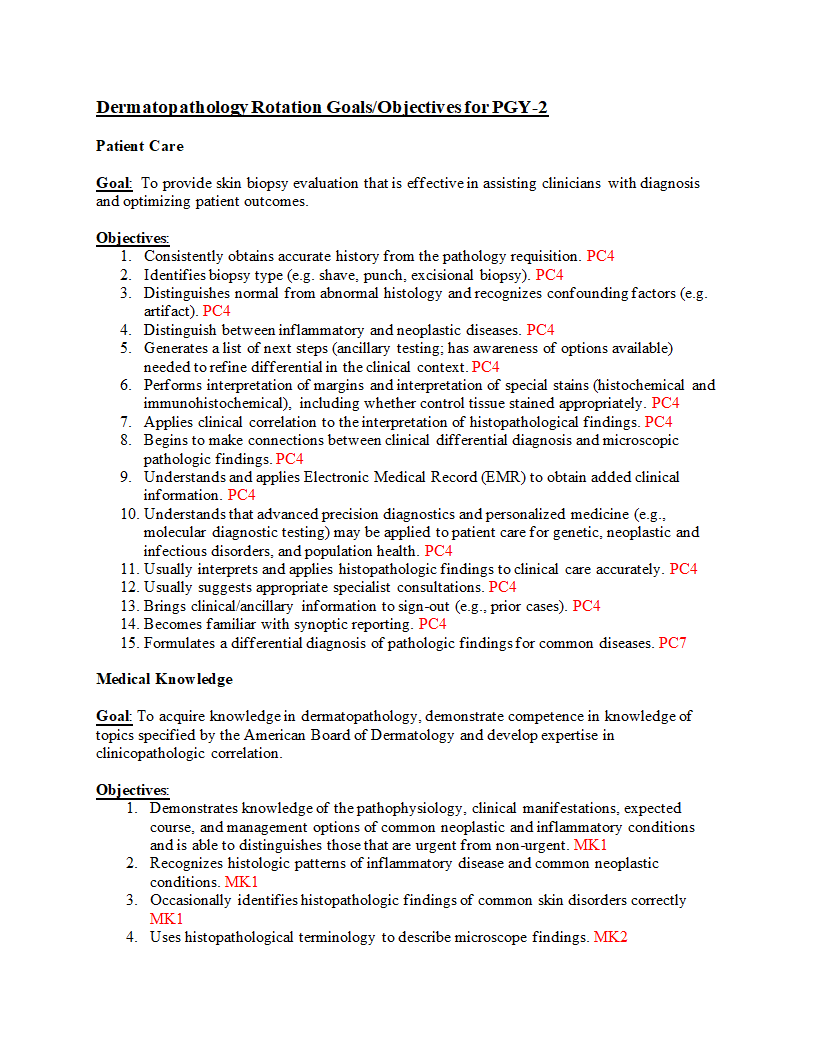
Dermatopathology Rotation Goals/Objectives for PGY-2
Patient Care
Goal: To provide skin biopsy evaluation that is effective in assisting clinicians with diagnosis
and optimizing patient outcomes.
Objectives:
- Consistently obtains accurate history from the pathology requisition. PC4
- Identifies biopsy type (e.g. shave, punch, excisional biopsy). PC4
- Distinguishes normal from abnormal histology and recognizes confounding factors (eg.
artifact). PC4 - Distinguish between inflammatory and neoplastic diseases. PC4
- Generates a list of next steps (ancillary testing; has awareness of options available)
needed to refine differential in the clinical context. PC4 - Performs interpretation of margins and interpretation of special stains (histochemical and
immunohistochemical), including whether control tissue stained appropriately. PC4 - Applies clinical correlation to the interpretation of histopathological findings. PC4
- Begins to make connections between clinical differential diagnosis and microscopic
pathologic findings. PC4 - Understands and applies Electronic Medical Record (EMR) to obtain added clinical
information. PC4 - Understands that advanced precision diagnostics and personalized medicine (e.g..
molecular diagnostic testing) may be applied to patient care for genetic, neoplastic and
infectious disorders, and population health. PC4 - Usually interprets and applies histopathologic findings to clinical care accurately. PC4
- Usually suggests appropriate specialist consultations. PC4
- Brings clinical/ancillary information to sign-out (e.g.. prior cases). PC4
- Becomes familiar with synoptic reporting. PC4
ynoptic repo tong Pout (es. prior cases) PC. - Formulates a differential diagnosis of pathologic findings for common diseases. PC7
Medical Knowledge
Goal: To acquire knowledge in dermatopathology, demonstrate competence in knowledge of
topics specified by the American Board of Dermatology and develop expertise in
clinicopathologic correlation.
Objectives: - Demonstrates knowledge of the pathophysiology, clinical manifestations, expected
course, and management options of common neoplastic and inflammatory conditions
and is able to distinguishes those that are urgent from non-urgent. MK1 - Recognizes histologic patterns of inflammatory disease and common neoplastic
conditions. MK1 - Occasionally identifies histopathologic findings of common skin disorders correctly
MK1 - Uses histopathological terminology to describe microscope findings. MK2
Page 2
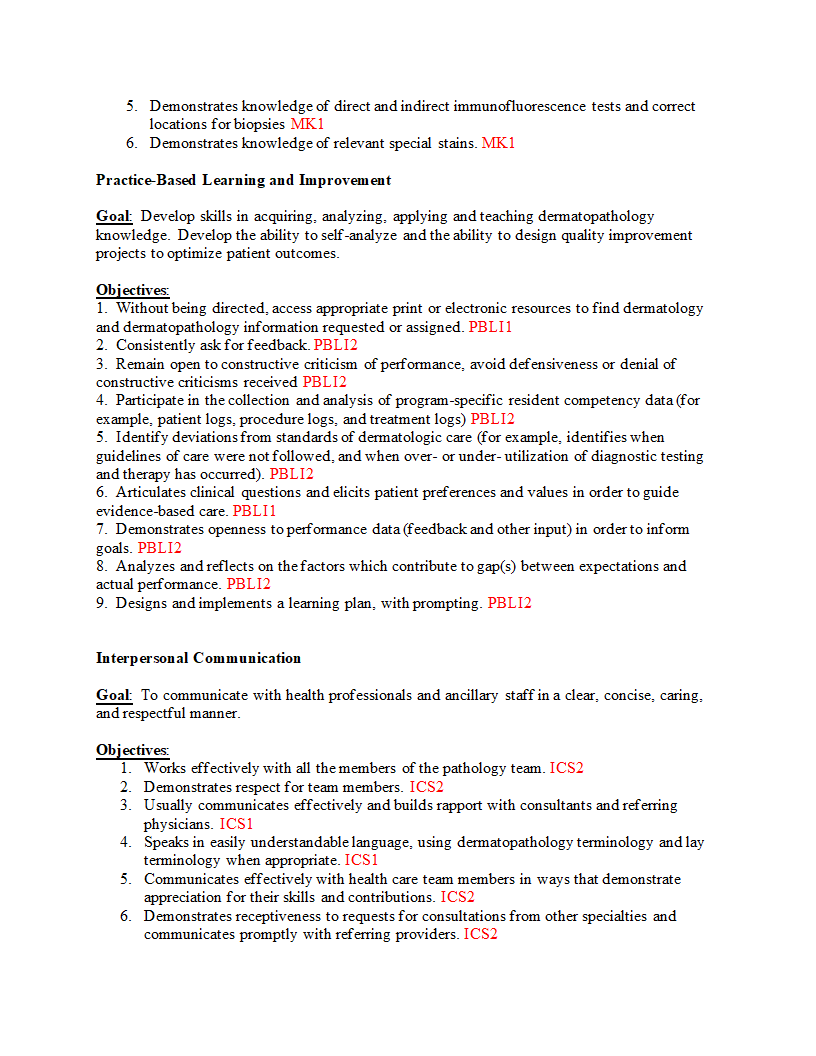
5. Demonstrates knowledge of direct and indirect immunofluorescence tests and correct
locations for biopsies MK1
6. Demonstrates knowledge of relevant special stains. MK1
Practice-Based Learning and Improvement
Goal: Develop skills in acquiring, analyzing, applying and teaching dermatopathology
knowledge. Develop the ability to self-analyze and the ability to design quality improvement
projects to optimize patient outcomes.
Objectives:
- Without being directed, access appropriate print or electronic resources to find dermatology
and dermatopathology information requested or assigned. PBLI1 - Consistently ask for feedback. PBLI2
- Remain open to constructive criticism of performance, avoid defensiveness or denial of
constructive criticisms received PBLI2 - Participate in the collection and analysis of program-specific resident competency data (for
example, patient logs, procedure logs, and treatment logs) PBLI2 - Identify deviations from standards of dermatologic care (for example, identifies when
guidelines of care were not followed, and when over- or under-utilization of diagnostic testing
and therapy has occurred). PBLI2 - Articulates clinical questions and elicits patient preferences and values in order to guide
evidence-based care. PBLI1 - Demonstrates openness to performance data (feedback and other input) in order to inform
goals. PBLI2 - Analyzes and reflects on the factors which contribute to gap(s) between expectations and
actual performance. PBLI2 - Designs and implements a learning plan, with prompting. PBLI2
Interpersonal Communication
Goal: To communicate with health professionals and ancillary staff in a clear, concise, caring.
and respectful manner.
Objectives: - Works effectively with all the members of the pathology team. ICS2
- Demonstrates respect for team members. ICS2
- Usually communicates effectively and builds rapport with consultants and referring
physicians. ICS - Speaks in easily understandable language, using dermatopathology terminology and lay
terminology when appropriate. ICS1 - Communicates effectively with health care team members in ways that demonstrate
appreciation for their skills and contributions. ICS2 - Demonstrates receptiveness to requests for consultations from other specialties and
communicates promptly with referring providers. ICS2
Page 3
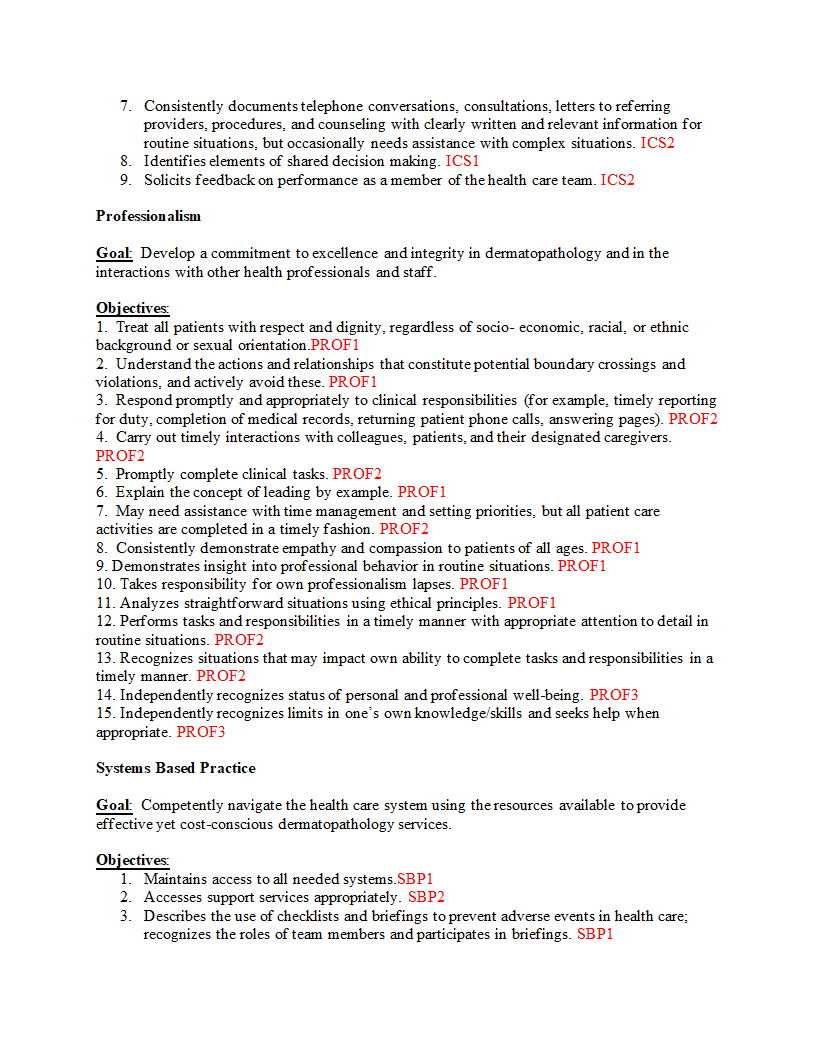
7. Consistently documents telephone conversations, consultations, letters to referring
providers, procedures, and counseling with clearly written and relevant information for
routine situations, but occasionally needs assistance with complex situations. ICS2
8. Identifies elements of shared decision making. ICS1
9. Solicits feedback on performance as a member of the health care team. ICS2
Professionalism
Goal: Develop a commitment to excellence and integrity in dermatopathology and in the
interactions with other health professionals and staff.
Objectives:
- Treat all patients with respect and dignity, regardless of socio- economic, racial, or ethnic
background or sexual orientation PROF1 - Understand the actions and relationships that constitute potential boundary crossings and
violations, and actively avoid these. PROF1 - Respond promptly and appropriately to clinical responsibilities (for example, timely reporting
for duty, completion of medical records, returning patient phone calls, answering pages). PROF2 - Carry out timely interactions with colleagues, patients, and their designated caregivers.
PROF2 - Promptly complete clinical tasks. PROF2
- Explain the concept of leading by example. PROF1
- May need assistance with time management and setting priorities, but all patient care
activities are completed in a timely fashion. PROF2 - Consistently demonstrate empathy and compassion to patients of all ages. PROF1
- Demonstrates insight into professional behavior in routine situations. PROF1
- Takes responsibility for own professionalism lapses. PROF1
- Analyzes straightforward situations using ethical principles. PROF1
- Performs tasks and responsibilities in a timely manner with appropriate attention to detail in
routine situations. PROF2 - Recognizes situations that may impact own ability to complete tasks and responsibilities in a
timely manner. PROF2 - Independently recognizes status of personal and professional well-being. PROF3
- Independently recognizes limits in one’s own knowledge/skills and seeks help when
appropriate. PROF3
Systems Based Practice
Goal: Competently navigate the health care system using the resources available to provide
effective yet cost-conscious dermatopathology services.
Objectives: - Maintains access to all needed systems.SBP1
- Accesses support services appropriately. SBP2
- Describes the use of checklists and briefings to prevent adverse events in health care;
recognizes the roles of team members and participates in briefings. SBP1
Page 4
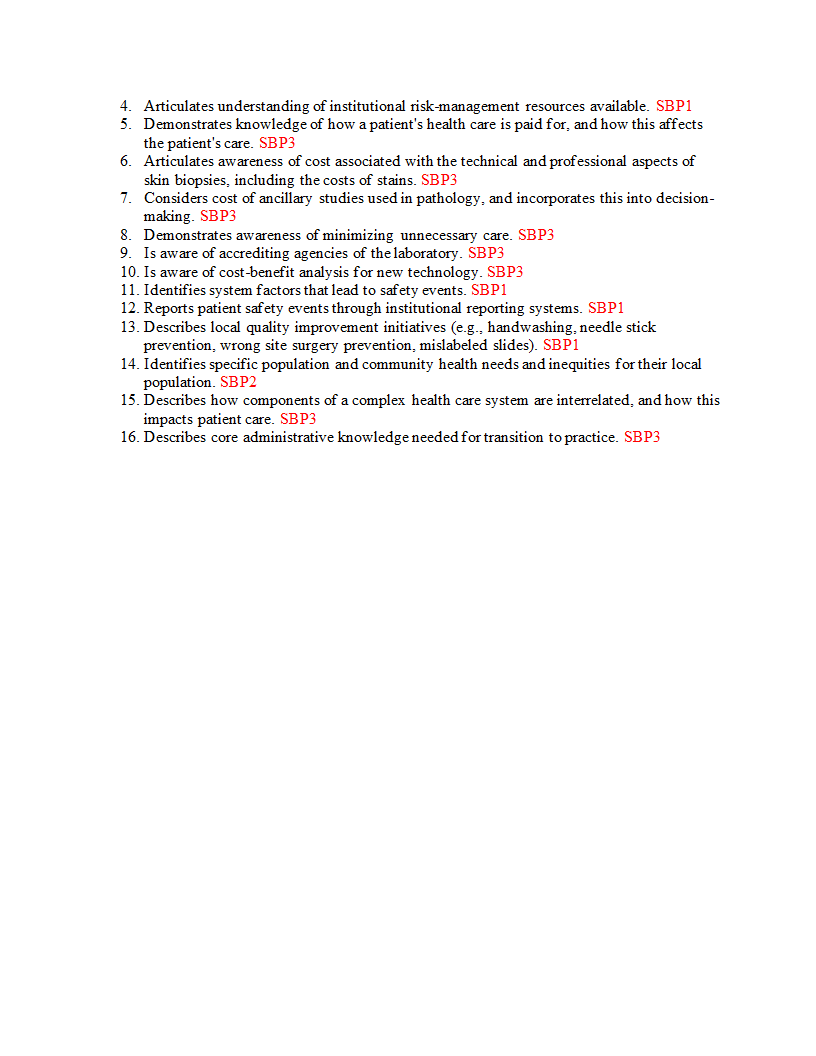
4. Articulates understanding of institutional risk-management resources available. SBP1
5. Demonstrates knowledge of how a patient’s health care is paid for, and how this affects
the patient’s care. SBP3
6. Articulates awareness of cost associated with the technical and professional aspects of
skin biopsies, including the costs of stains. SBP3
7. Considers cost of ancillary studies used in pathology, and incorporates this into decision-
making. SBP3
8. Demonstrates awareness of minimizing unnecessary care. SBP3
9. Is aware of accrediting agencies of the laboratory. SBP3
10. Is aware of cost-benefit analysis for new technology. SBP3
11. Identifies system factors that lead to safety events. SBP1
12. Reports patient safety events through institutional reporting systems. SBP1
13. Describes local quality improvement initiatives (e.g., handwashing, needle stick
prevention, wrong site surgery prevention, mislabeled slides). SBP1
14. Identifies specific population and community health needs and inequities for their local
population. SBP2
15. Describes how components of a complex health care system are interrelated, and how this
impacts patient care. SBP3
16. Describes core administrative knowledge needed for transition to practice. SBP3