Dermatopathology PGY-4
Inserted document · 3 pages · click any page to read
Text from this document (searchable)
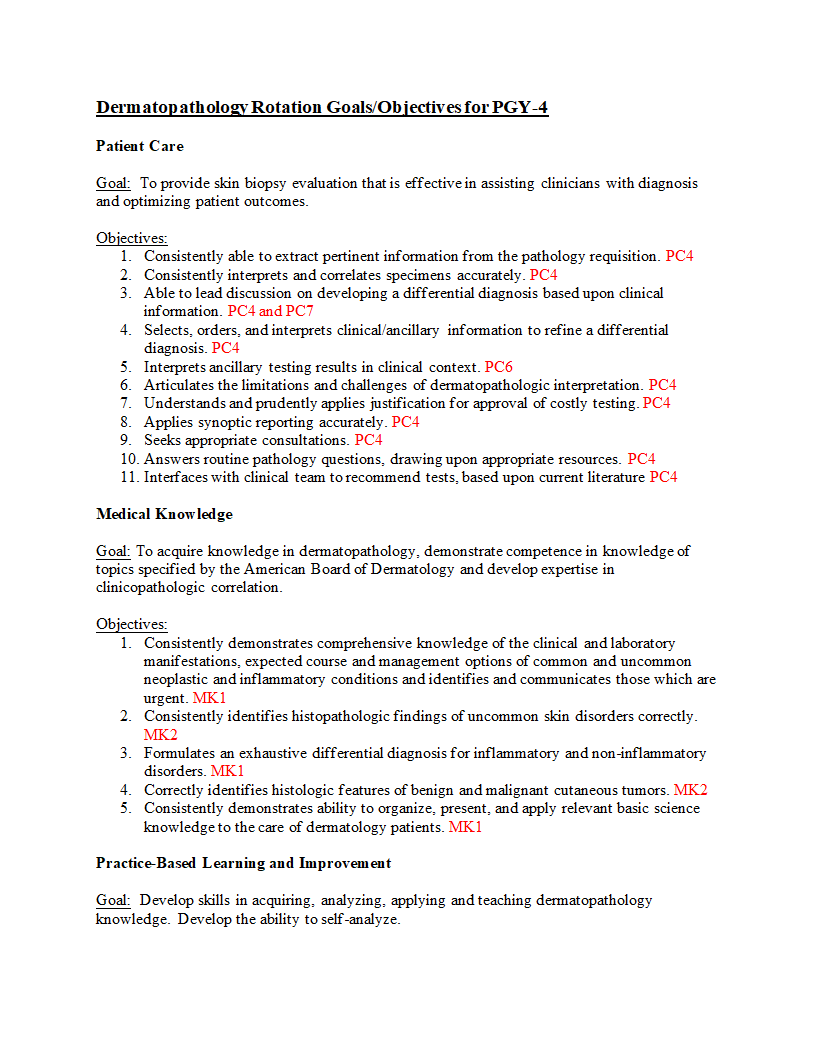
Page 1
Dermatopathology Rotation Goals/Objectives for PGY-4
Patient Care
Goal: To provide skin biopsy evaluation that is effective in assisting clinicians with diagnosis
and optimizing patient outcomes.
Objectives:
- Consistently able to extract pertinent information from the pathology requisition. PC4
- Consistently interprets and correlates specimens accurately. PC4
- Able to lead discussion on developing a differential diagnosis based upon clinical
information. PC4 and PC7 - Selects, orders, and interprets clinical/ancillary information to refine a differential
diagnosis. PC4 - Interprets ancillary testing results in clinical context. PC6
- Articulates the limitations and challenges of dermatopathologic interpretation. PC4
- Understands and prudently applies justification for approval of costly testing. PC4
- Applies synoptic reporting accurately. PC4
- Seeks appropriate consultations. PC4
- Answers routine pathology questions, drawing upon appropriate resources. PC4
- Interfaces with clinical team to recommend tests, based upon current literature PC4
Medical Knowledge
Goal: To acquire knowledge in dermatopathology, demonstrate competence in knowledge of
topics specified by the American Board of Dermatology and develop expertise in
clinicopathologic correlation.
Objectives: - Consistently demonstrates comprehensive knowledge of the clinical and laboratory
manifestations, expected course and management options of common and uncommon
neoplastic and inflammatory conditions and identifies and communicates those which are
urgent. MK1 - Consistently identifies histopathologic findings of uncommon skin disorders correctly.
MK2 - Formulates an exhaustive differential diagnosis for inflammatory and non-inflammatory
disorders. MK1 - Correctly identifies histologic features of benign and malignant cutaneous tumors. MK2
- Consistently demonstrates ability to organize, present, and apply relevant basic science
knowledge to the care of dermatology patients. MK1
Practice Based Learning and Improvement
Goal: Develop skills in acquiring, analyzing, applying and teaching dermatopathology
knowledge. Develop the ability to self-analyze.
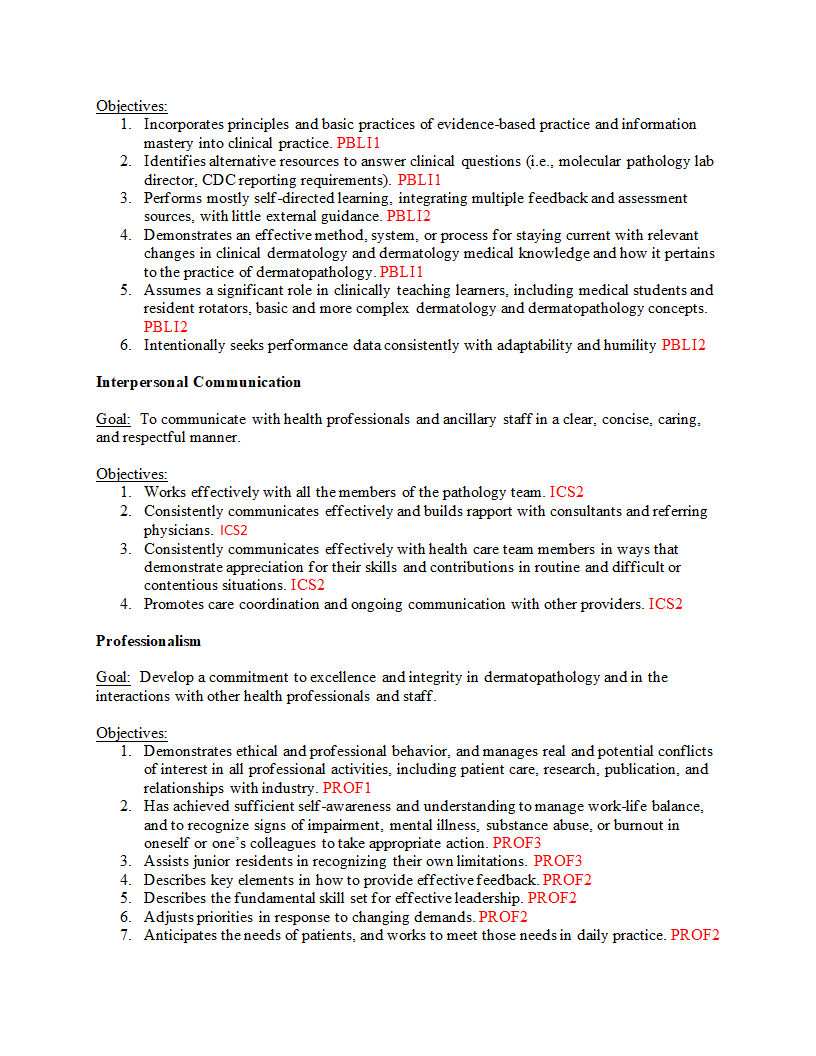
Page 2
Objectives:
- Incorporates principles and basic practices of evidence-based practice and information
mastery into clinical practice. PBLI1 - Identifies alternative resources to answer clinical questions (i.e., molecular pathology lab
director, CDC reporting requirements). PBLI1 - Performs mostly self-directed learning, integrating multiple feedback and assessment
sources, with little external guidance. PBLI2 - Demonstrates an effective method, system, or process for staying current with relevant
changes in clinical dermatology and dermatology medical knowledge and how it pertains
to the practice of dermatopathology. PBLI - Assumes a significant role in clinically teaching learners, including medical students and
resident rotators, basic and more complex dermatology and dermatopathology concepts.
PBLI2 - Intentionally seeks performance data consistently with adaptability and humility PBLI2
Interpersonal Communication
Goal: To communicate with health professionals and ancillary staff in a clear, concise, caring.
and respectful manner.
Objectives: - Works effectively with all the members of the pathology team. ICS2
- Consistently communicates effectively and builds rapport with consultants and referring
physicians. ICS2 - Consistently communicates effectively with health care team members in ways that
demonstrate appreciation for their skills and contributions in routine and difficult or
contentious situations. ICS2 - Promotes care coordination and ongoing communication with other providers. ICS2
Professionalism
Goal: Develop a commitment to excellence and integrity in dermatopathology and in the
interactions with other health professionals and staff.
Objectives: - Demonstrates ethical and professional behavior, and manages real and potential conflicts
of interest in all professional activities, including patient care, research, publication, and
relationships with industry. PROF1 - Has achieved sufficient self-awareness and understanding to manage work-life balance,
and to recognize signs of impairment, mental illness, substance abuse, or burnout in
oneself or one’s colleagues to take appropriate action. PROF3 - Assists junior residents in recognizing their own limitations. PROF3
- Describes key elements in how to provide effective feedback. PROF2
- Describes the fundamental skill set for effective leadership. PROF2
- Adjusts priorities in response to changing demands. PROF2
- Anticipates the needs of patients, and works to meet those needs in daily practice. PROF2
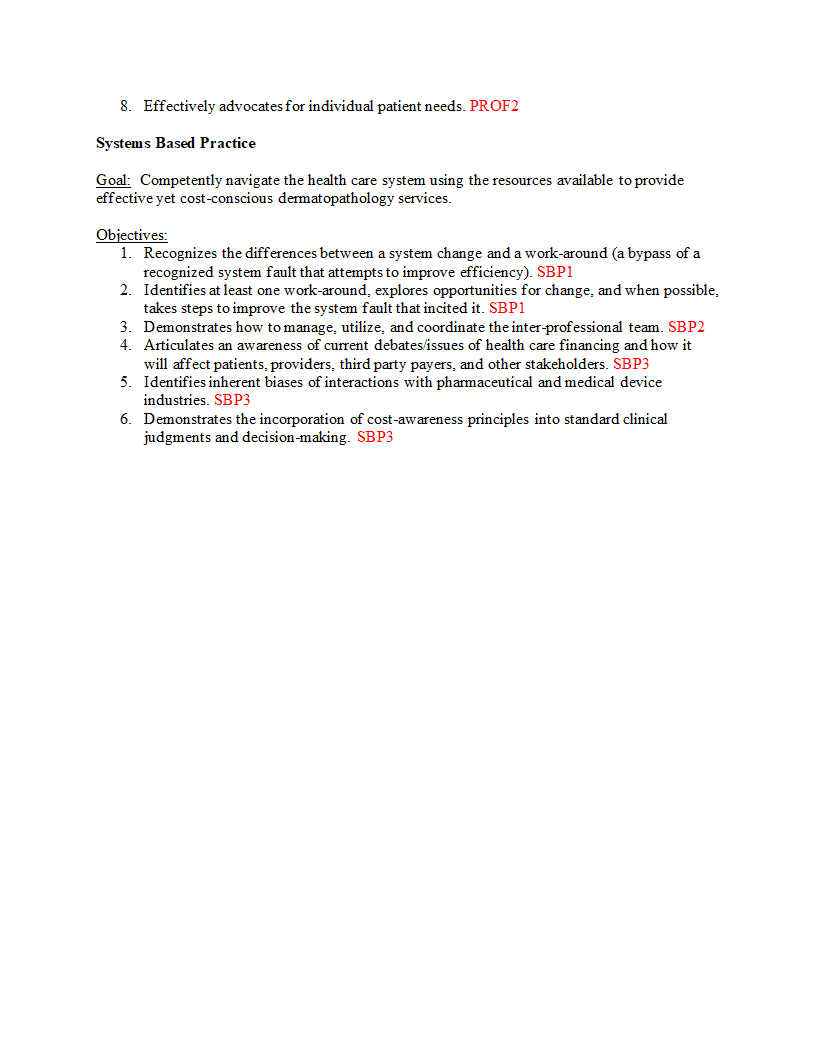
Page 3
8. Effectively advocates for individual patient needs. PROF2
Systems Based Practice
Goal: Competently navigate the health care system using the resources available to provide
effective yet cost-conscious dermatopathology services.
Objectives:
- Recognizes the differences between a system change and a work-around (a bypass of a
recognized system fault that attempts to improve efficiency). SBP1 - Identifies at least one work-around, explores opportunities for change, and when possible,
takes steps to improve the system fault that incited it. SBP1 - Demonstrates how to manage, utilize, and coordinate the inter-professional team. SBP2
- Articulates an awareness of current debates/issues of health care financing and how it
will affect patients, providers, third party payers, and other stakeholders. SBP3 - Identifies inherent biases of interactions with pharmaceutical and medical device
industries. SBP3 - Demonstrates the incorporation of cost-awareness principles into standard clinical
judgments and decision-making. SBP3