Appendix O – CCC & PEC Membership
Text from this document (searchable)
Page 1
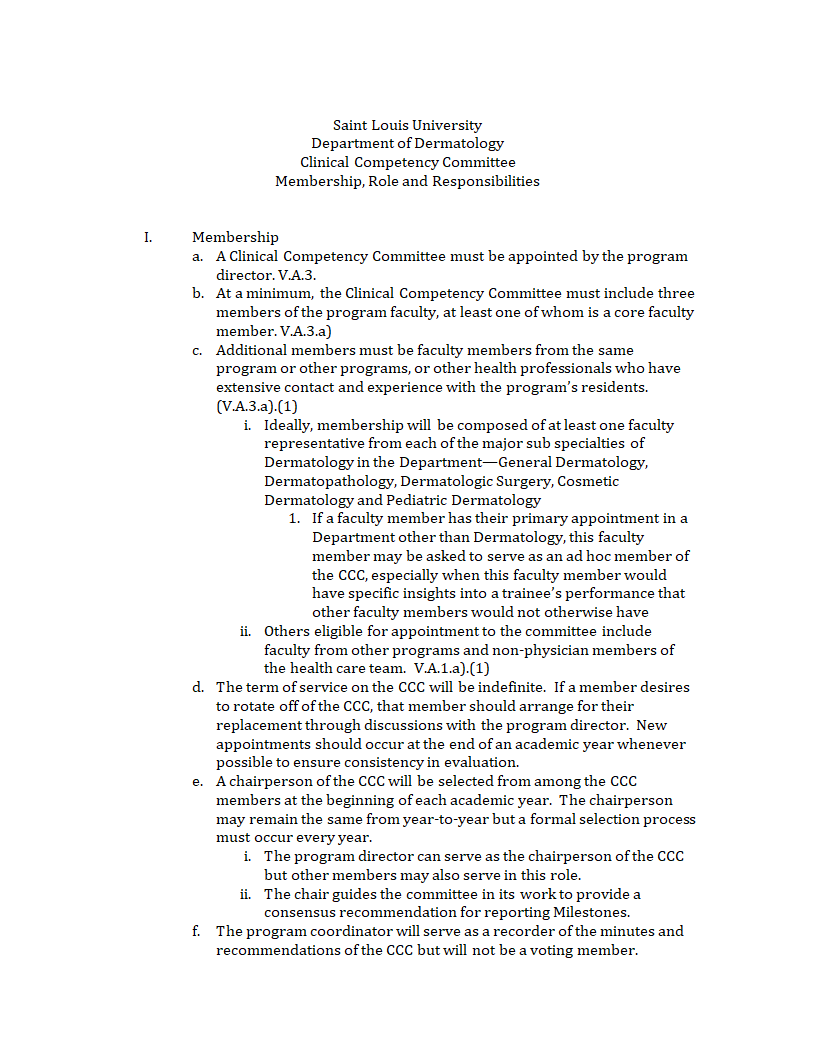
Saint Louis University
Department of Dermatology
Clinical Competency Committee
Membership, Role and Responsibilities
Membership
a. A Clinical Competency Committee must be appointed by the program
director. V.A.3.
b. At a minimum, the Clinical Competency Committee must include three
members of the program faculty, at least one of whom is a core faculty
member. V.A.3.a)
c. Additional members must be faculty members from the same
program or other programs, or other health professionals who have
extensive contact and experience with the program’s residents.
(V.A.3.a).(1)
i. Ideally, membership will be composed of at least one faculty
representative from each of the major sub specialties of
Dermatology in the Department-General Dermatology,
Dermatopathology, Dermatologic Surgery, Cosmetic
Dermatology and Pediatric Dermatology
- If a faculty member has their primary appointment in a
Department other than Dermatology, this faculty
member may be asked to serve as an ad hoc member of
the CCC, especially when this faculty member would
have specific insights into a trainee’s performance that
other faculty members would not otherwise have
ii. Others eligible for appointment to the committee include
faculty from other programs and non-physician members of
the health care team. V.A.1.a).(1)
d. The term of service on the CCC will be indefinite. If a member desires
to rotate off of the CCC, that member should arrange for their
replacement through discussions with the program director. New
appointments should occur at the end of an academic year whenever
possible to ensure consistency in evaluation.
e. A chairperson of the CCC will be selected from among the CCC
members at the beginning of each academic year. The chairperson
may remain the same from year-to-year but a formal selection process
must occur every year.
i. The program director can serve as the chairperson of the CCC
but other members may also serve in this role.
ii. The chair guides the committee in its work to provide a
consensus recommendation for reporting Milestones.
f. The program coordinator will serve as a recorder of the minutes and
recommendations of the CCC but will not be a voting member.
Page 2
Il.
III.
i. Minutes are captured at the meeting in writing, then
transposed electronically where they will be retained and
archived by coordinator.
ii. Minutes will contain key components and judgements about
each resident and fellow as well as Milestone plotting.
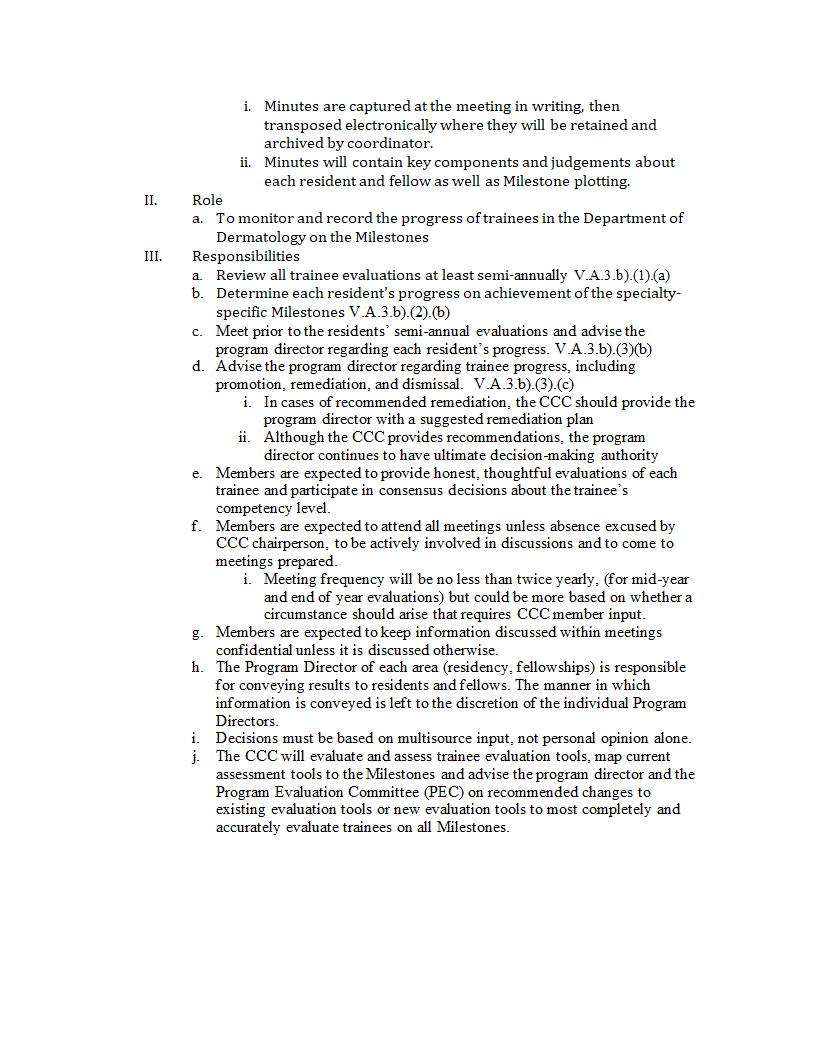
Role
a. To monitor and record the progress of trainees in the Department of
Dermatology on the Milestones
Responsibilities
a. Review all trainee evaluations at least semi-annually V.A.3.b).(1).(a)
b. Determine each resident’s progress on achievement of the specialty-
specific Milestones V.A.3.b).(2).(b)
c. Meet prior to the residents’ semi-annual evaluations and advise the
program director regarding each resident’s progress. V.A.3.b).(3)(b)
d. Advise the program director regarding trainee progress, including
promotion, remediation, and dismissal. V.A.3.b) (3)(c)
i. In cases of recommended remediation, the CCC should provide the
program director with a suggested remediation plan
ii. Although the CCC provides recommendations, the program
director continues to have ultimate decision-making authority
e. Members are expected to provide honest, thoughtful evaluations of each
trainee and participate in consensus decisions about the trainee’s
competency level.
f. Members are expected to attend all meetings unless absence excused by
CCC chairperson, to be actively involved in discussions and to come to
meetings prepared.
i. Meeting frequency will be no less than twice yearly, (for mid-year
and end of year evaluations) but could be more based on whether a
circumstance should arise that requires CCC member input.
g. Members are expected to keep information discussed within meetings
confidential unless it is discussed otherwise.
h. The Program Director of each area (residency, fellowships) is responsible
for conveying results to residents and fellows. The manner in which
information is conveyed is left to the discretion of the individual Program
i. Decisions must be based on multisource input, not personal opinion alone.
The CCC will evaluate and assess trainee evaluation tools, map current
assessment tools to the Milestones and advise the program director and the
Program Evaluation Committee (PEC) on recommended changes to
existing evaluation tools or new evaluation tools to most completely and
accurately evaluate trainees on all Milestones.
Page 3
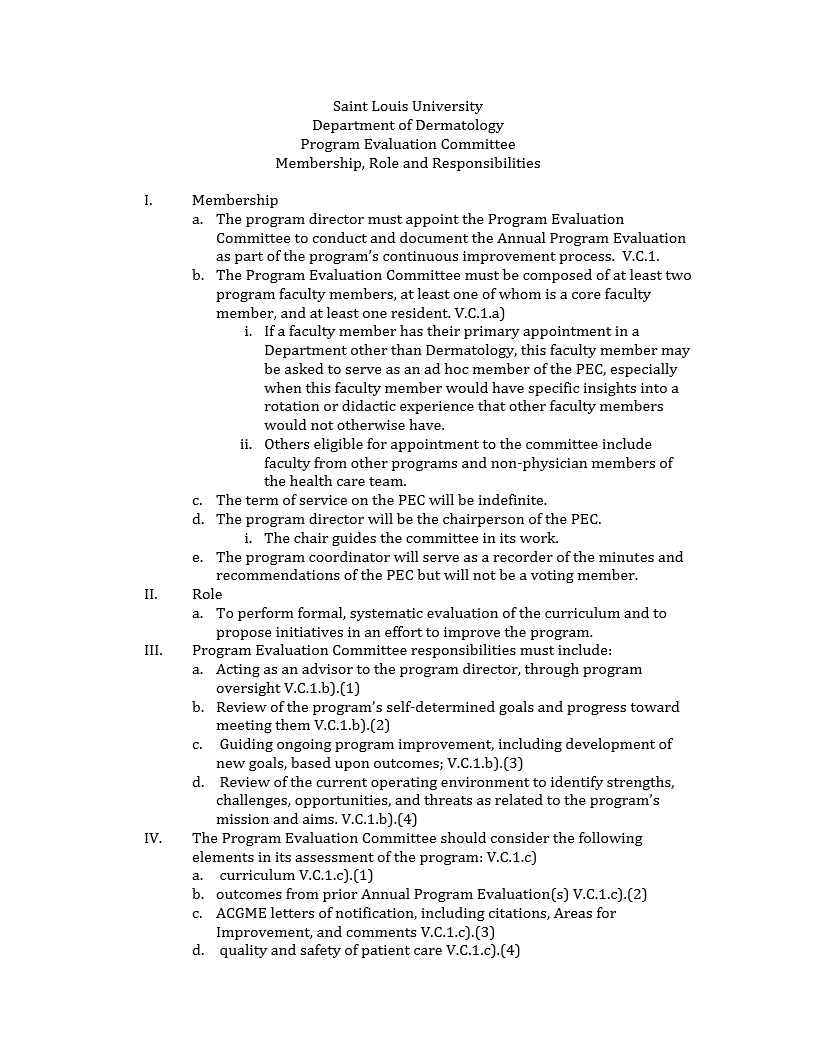
Saint Louis University
Department of Dermatology
Program Evaluation Committee
Membership, Role and Responsibilities
I.
II.
III.
IV.
Membership
a. The program director must appoint the Program Evaluation
Committee to conduct and document the Annual Program Evaluation
as part of the program’s continuous improvement process. V.C.1.
b. The Program Evaluation Committee must be composed of at least two
program faculty members, at least one of whom is a core faculty
member, and at least one resident. V.C.1.a)
i. If a faculty member has their primary appointment in a
Department other than Dermatology, this faculty member may
be asked to serve as an ad hoc member of the PEC, especially
when this faculty member would have specific insights into a
rotation or didactic experience that other faculty members
would not otherwise have.
ii. Others eligible for appointment to the committee include
faculty from other programs and non-physician members of
the health care team.
c. The term of service on the PE will be indefinite.
d. The program director will be the chairperson of the PEC.
i. The chair guides the committee in its work.
e. The program coordinator will serve as a recorder of the minutes and
recommendations of the PEC but will not be a voting member.
Role
a. To perform formal, systematic evaluation of the curriculum and to
propose initiatives in an effort to improve the program.
Program Evaluation Committee responsibilities must include:
a. Acting as an advisor to the program director, through program
oversight V.C.1.b).(1)
b. Review of the program’s self-determined goals and progress toward
meeting them V.C.1.b).(2)
c. Guiding ongoing program improvement, including development of
new goals, based upon outcomes; V.C.1.b). (3)
d. Review of the current operating environment to identify strengths,
challenges, opportunities, and threats as related to the program’s
mission and aims. V.C.1.b).(4)
The Program Evaluation Committee should consider the following
elements in its assessment of the program: V.C.1.c)
a. curriculum V.C.1.c).(1)
b. outcomes from prior Annual Program Evaluation(s) V.C.1.c).(2)
c. ACGME letters of notification, including citations, Areas for
Improvement, and comments V.C.1.c).(3)
d. quality and safety of patient care V.C.1.c).(4)
Page 4
Val
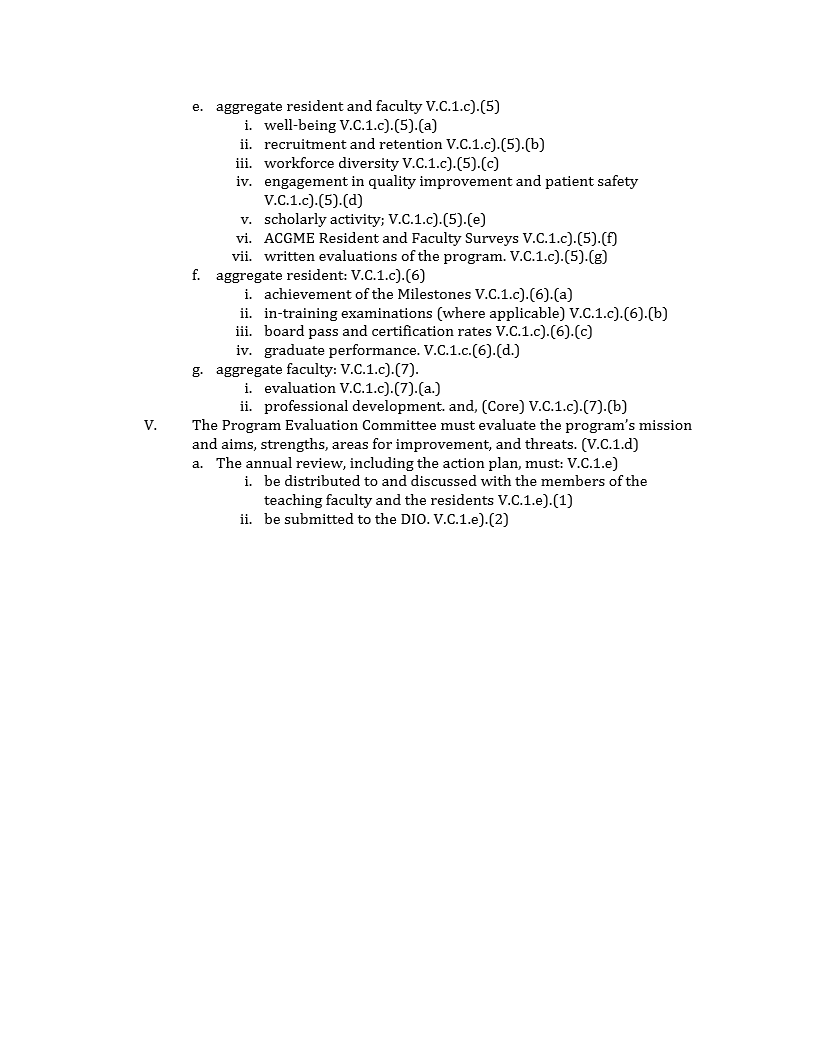
e. aggregate resident and faculty V.C.1.c) (5)
i. well-being V.C.1.c).(5).(a)
ii. recruitment and retention V.C.1.c).(5).(b)
iii. workforce diversity V.C.1.c).(5).(c)
iv. engagement in quality improvement and patient safety
v.C.1.c) (5) (d)
vi. ACGME Resident and Faculty Surveys V.C.1.c).(5).(f)
vii. written evaluations of the program. V.C.1.c).(5) (g)
f. aggregate resident: V.C.1.c).(6)
i. achievement of the Milestones V.C.1.c).(6).(a)
ii. in-training examinations (where applicable) V.C.1.c).(6).(b)
iii. board pass and certification rates V.C.1.c).(6).(c)
iv. graduate performance. V.C.1.c.(6).(d.)
g. aggregate faculty: V.C.1.c).(7).
i. evaluation V.C.1.c).(7).(a.)
ii. professional development. and, (Core) V.C.1.c).(7) (b)
The Program Evaluation Committee must evaluate the program’s mission
and aims, strengths, areas for improvement, and threats. (V.C.1.d)
a. The annual review, including the action plan, must: V.C.1.e)
i. be distributed to and discussed with the members of the
teaching faculty and the residents V.C.1.e) (1)
ii. be submitted to the DIO. V.C.1.e).(2)