Appendix Q – ACGME Program Requirements for GME in Dermatology (Effective 7/1/2023)
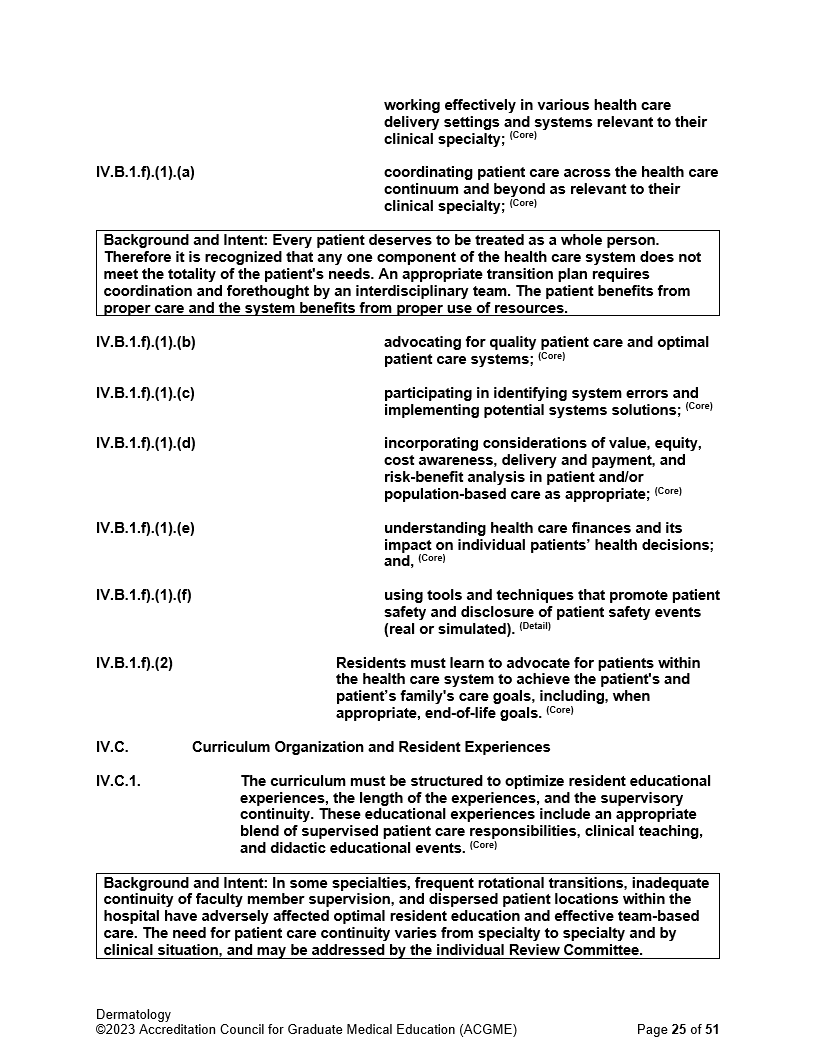
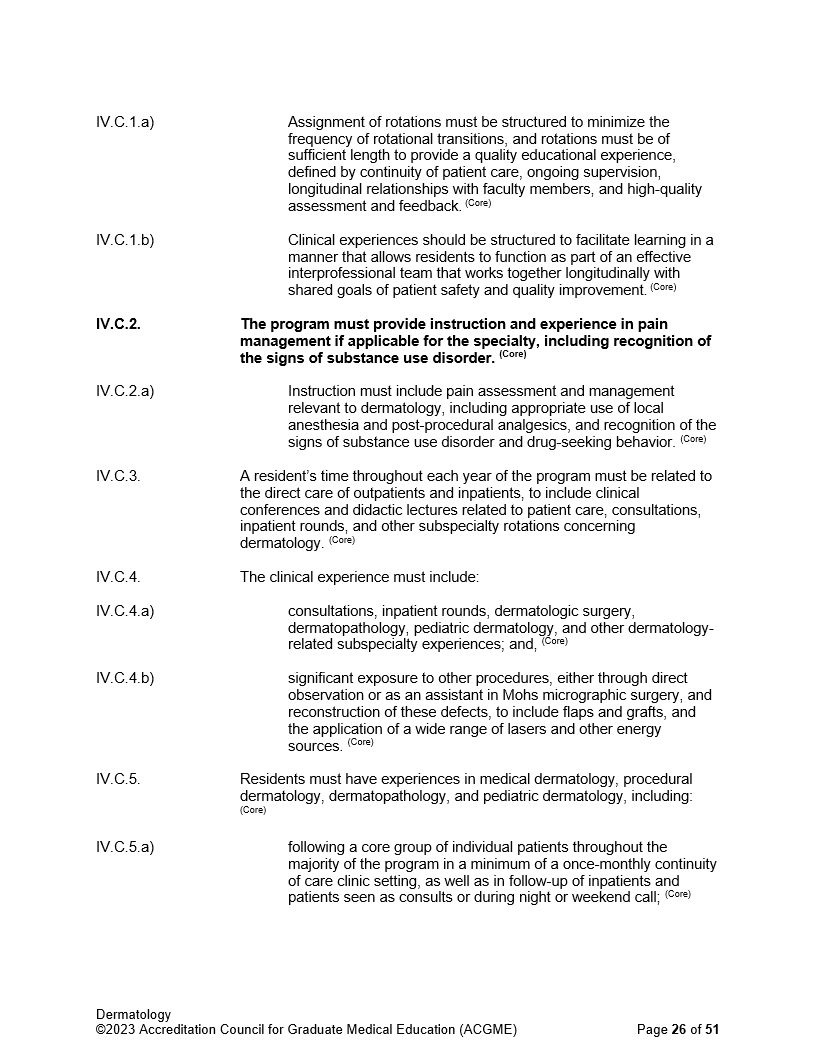
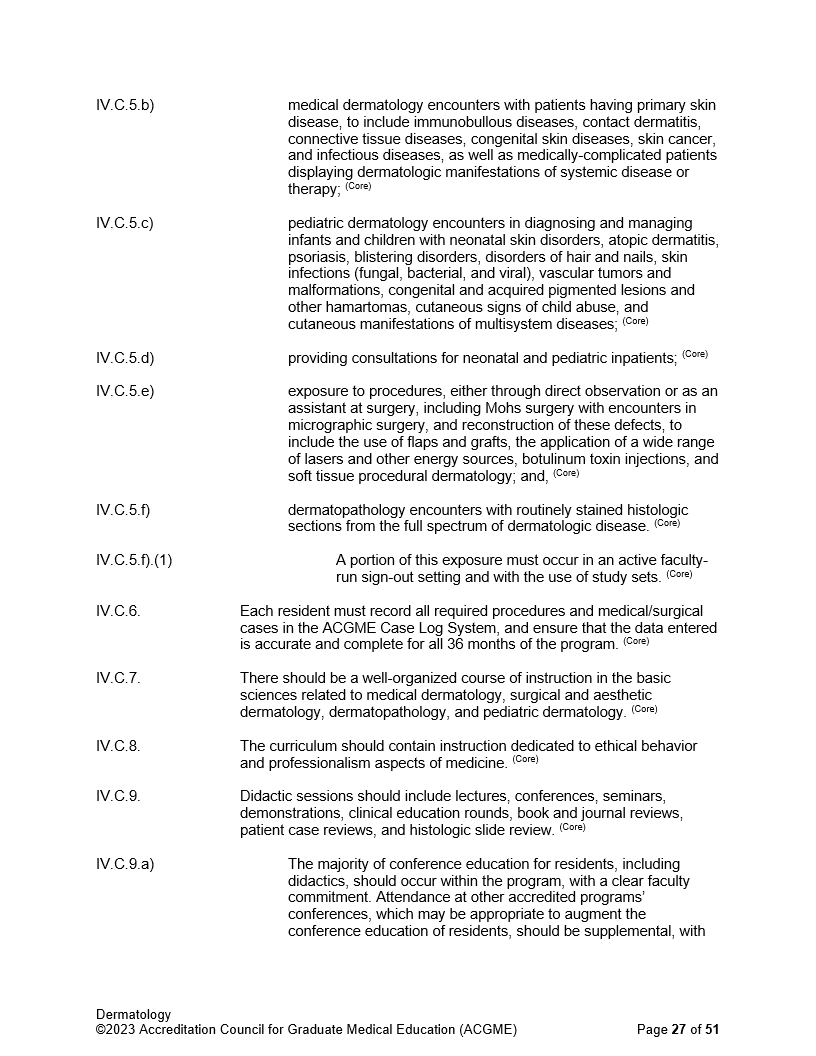
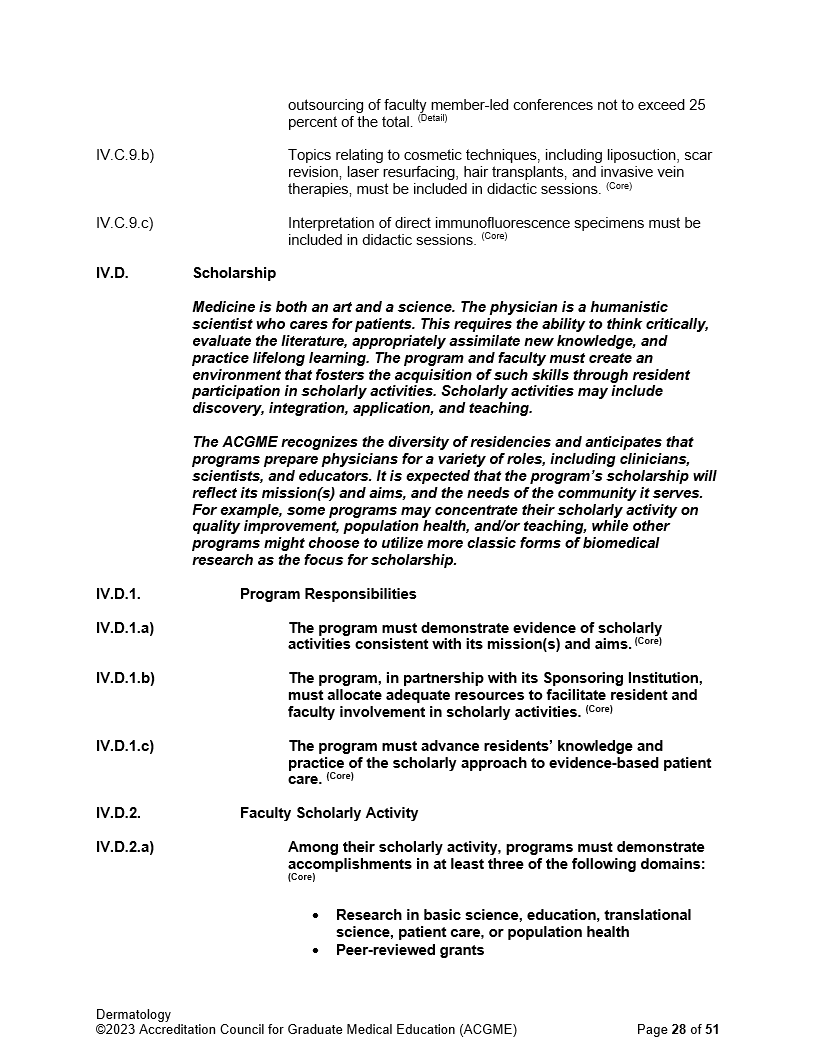
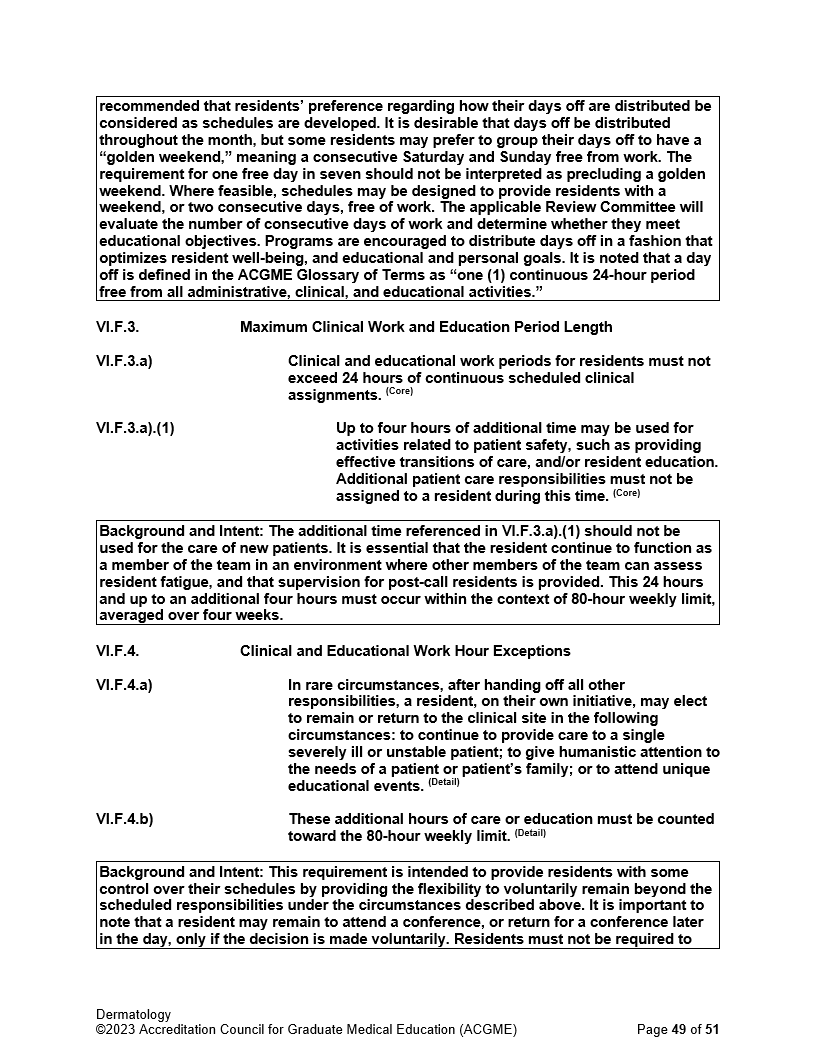
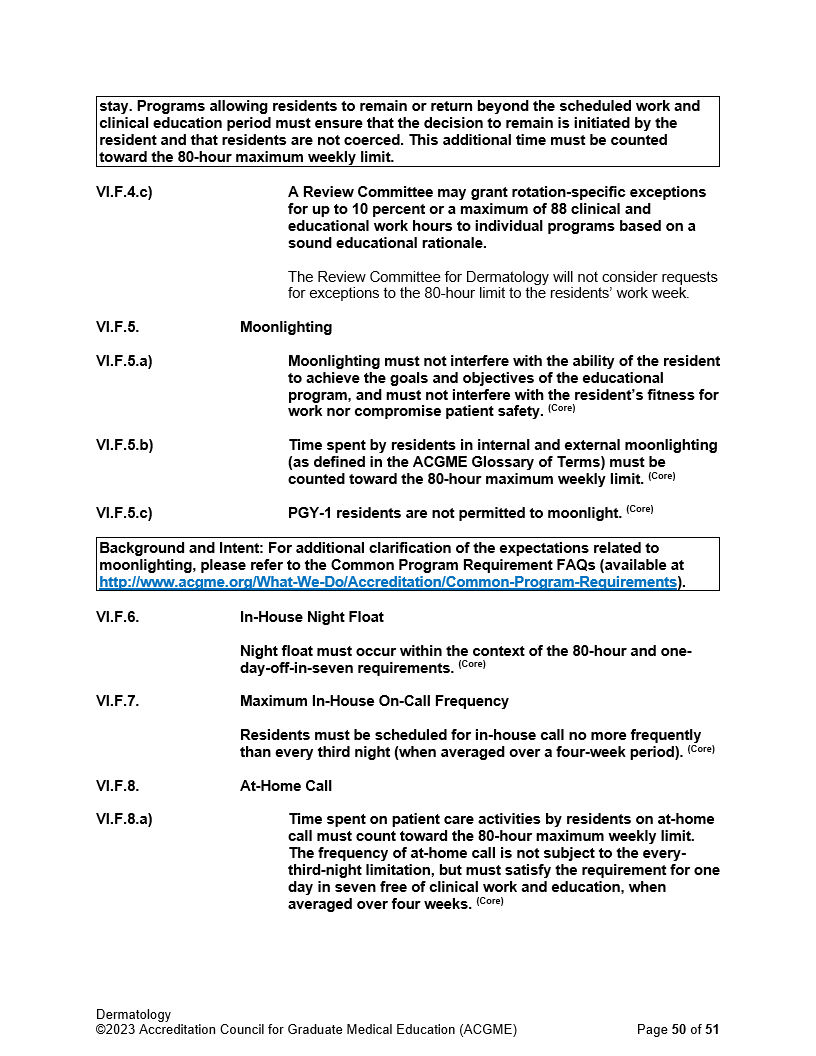
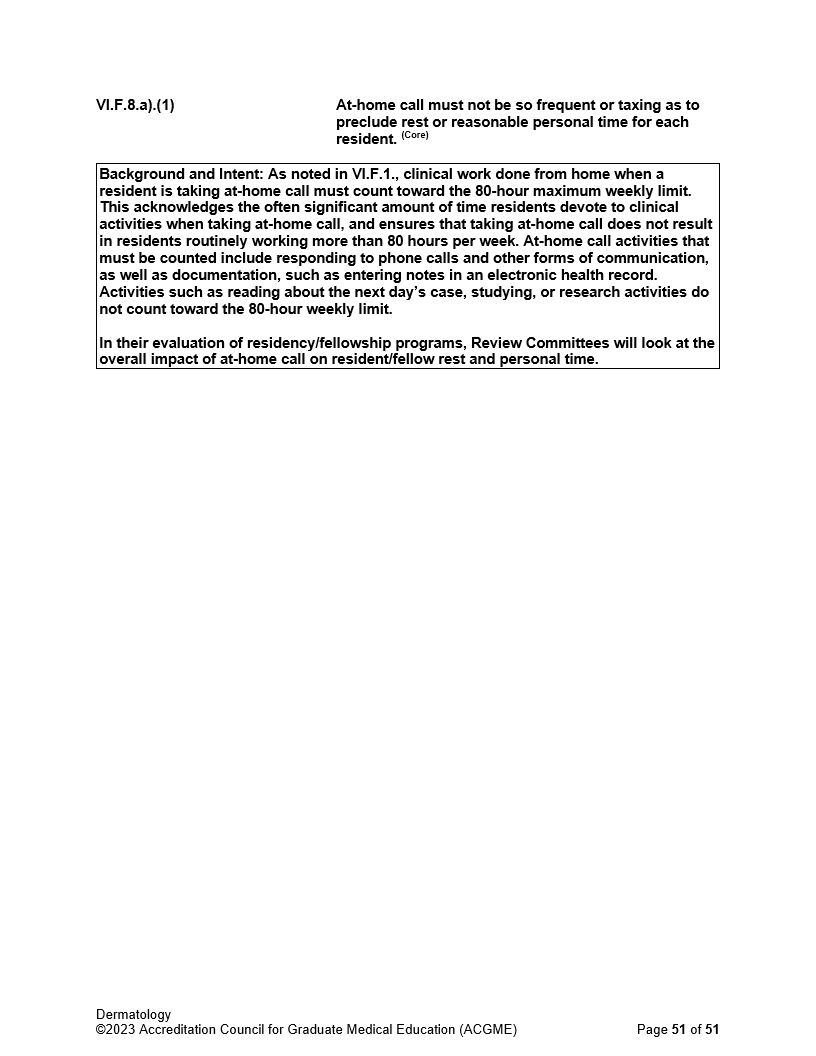
Text from this document (searchable)
Page 1
ACGME Program Requirements for
Graduate Medical Education
in Dermatology
Revision Information
ACGME-approved focused revision: June 12, 2022; effective July 1, 2022
Updated to include revised Common Program Requirements, effective July 1, 2023
Definitions
For more information, see the ACGME Glossary of Terms.
Core Requirements: Statements that define structure, resource, or process elements
essential to every graduate medical educational program.
Detail Requirements: Statements that describe a specific structure, resource, or
process, for achieving compliance with a Core Requirement. Programs and
sponsoring institutions in substantial compliance with the Outcome Requirements may
utilize alternative or innovative approaches to meet Core Requirements.
Outcome Requirements: Statements that specify expected measurable or observable
attributes (knowledge, abilities, skills, or attitudes) of residents or fellows at key stages
of their graduate medical education.
Osteopathic Recognition
For programs with or applying for Osteopathic Recognition, the Osteopathic Recognition
Requirements also apply (www.acgme.org/OsteopathicRecognition).
Page 2
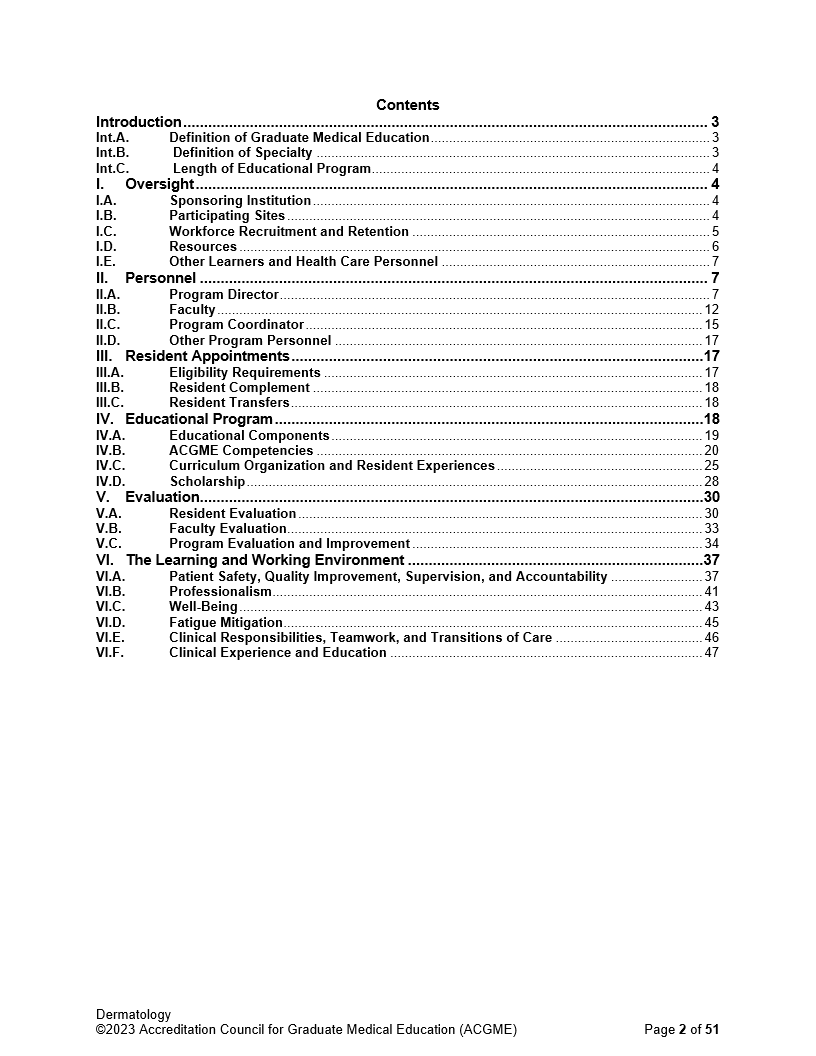
Contents
Introduction.
Int.A.
Defin
ition of Graduate Medical Education
Int.B.
Definition of Specialty
Int.C.
Length of Educational Program.
1.
Oversight…
I.A.
Sponsoring Institution
I.B
Participating Sites..
I.C
Workforce Recruitment and Retention
I.D.
Resources
I.E.
Other Learners and Health Care Personnel
Il.
Personnel..
II.A.
Program Director
II.B.
Faculty
II.C.
II.D.
Program Coordinator
Other Program Personnel
III. Resident Appointments..
III.A.
Eligibility Requirements
III.B.
III.C.
Resident Complement
Resident Transfers
IV. Educational Program…
IV.A.
IV.B.
Educational Components
ACME Competencies
IV.C.
Curriculum Organization and Resident Experiences…
IV.D.
V.
Scholarship…
Evaluation…
V.A.
Resident Evaluation
V.B.
Faculty Evaluation..
V.C.
Program Evaluation and Improvement.
/I. The Learning and Working Environment
VI.A.
Patient Safety, Quality Improvement, Supervision, and Accountability
VI.B.
VI.C.
VI.D.
VI.E.
VI.F.
Nell-Being
Fatigue Mitigation
Clinical Responsibilities, Teamwork, and Transitions of Care
Clinical Experience and Education
3
3
3
7
12
15
17
.17
17
18
18
.18
19
20
. 25
. 28
.30
30
33
. 37
.41
43
45
46
47
Dermatology
©2023 Accreditation Council for Graduate Medical Education (ACGME)
Page 2 of 51
Page 3
ACGME Program Requirements for Graduate Medical Education
in Dermatology
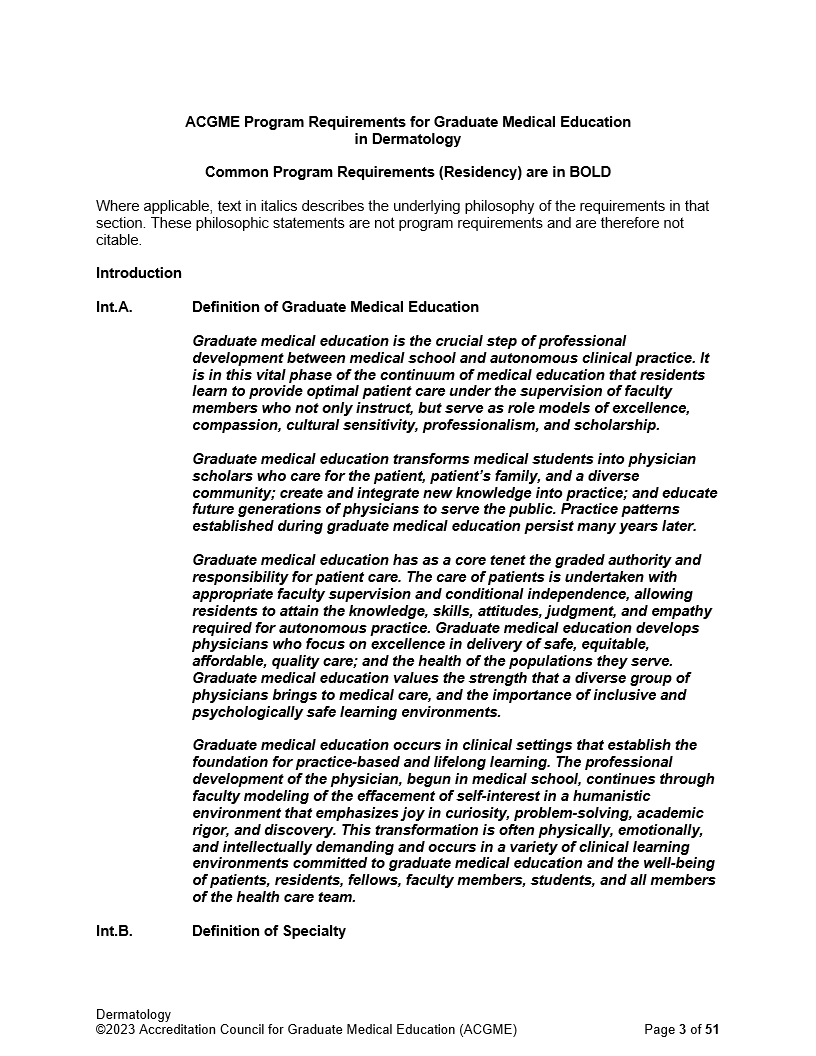
Common Program Requirements (Residency) are in BOLD
Where applicable, text in italics describes the underlying philosophy of the requirements in that
section. These philosophic statements are not program requirements and are therefore not
citable
Introduction
Int.A.
Int.B.
Definition of Graduate Medical Education
Graduate medical education is the crucial step of professional
development between medical school and autonomous clinical practice. It
is in this vital phase of the continuum of medical education that residents
learn to provide optimal patient care under the supervision of faculty
members who not only instruct, but serve as role models of excellence,
compassion, cultural sensitivity, professionalism, and scholarship.
Graduate medical education transforms medical students into physician
scholars who care for the patient, patient’s family, and a diverse
community; create and integrate new knowledge into practice; and educate
future generations of physicians to serve the public. Practice patterns
established during graduate medical education persist many years later.
Graduate medical education has as a core tenet the graded authority and
responsibility for patient care. The care of patients is undertaken with
appropriate faculty supervision and conditional independence, allowing
residents to attain the knowledge, skills, attitudes, judgment, and empathy
required for autonomous practice. Graduate medical education develops
physicians who focus on excellence in delivery of safe, equitable,
affordable, quality care; and the health of the populations they serve.
Graduate medical education values the strength that a diverse group of
physicians brings to medical care, and the importance of inclusive and
psychologically safe learning environments.
Graduate medical education occurs in clinical settings that establish the
foundation for practice-based and lifelong learning. The professional
development of the physician, begun in medical school, continues through
faculty modeling of the effacement of self-interest in a humanistic
environment that emphasizes joy in curiosity, problem-solving, academic
rigor, and discovery. This transformation is often physically, emotionally,
and intellectually demanding and occurs in a variety of clinical learning
environments committed to graduate medical education and the well-being
of patients, residents, fellows, faculty members, students, and all members
of the health care team.
Definition of Specialty
Dermatology
©2023 Accreditation Council for Graduate Medical Education (ACGME)
Page 3 of 51
Page 4
Int.C.
Accredited programs in dermatology provide educational and practical
experiences that result in delivery of superior specialized care to patients with
diseases of the skin, hair, nails, and mucous membranes.
Length of Educational Program
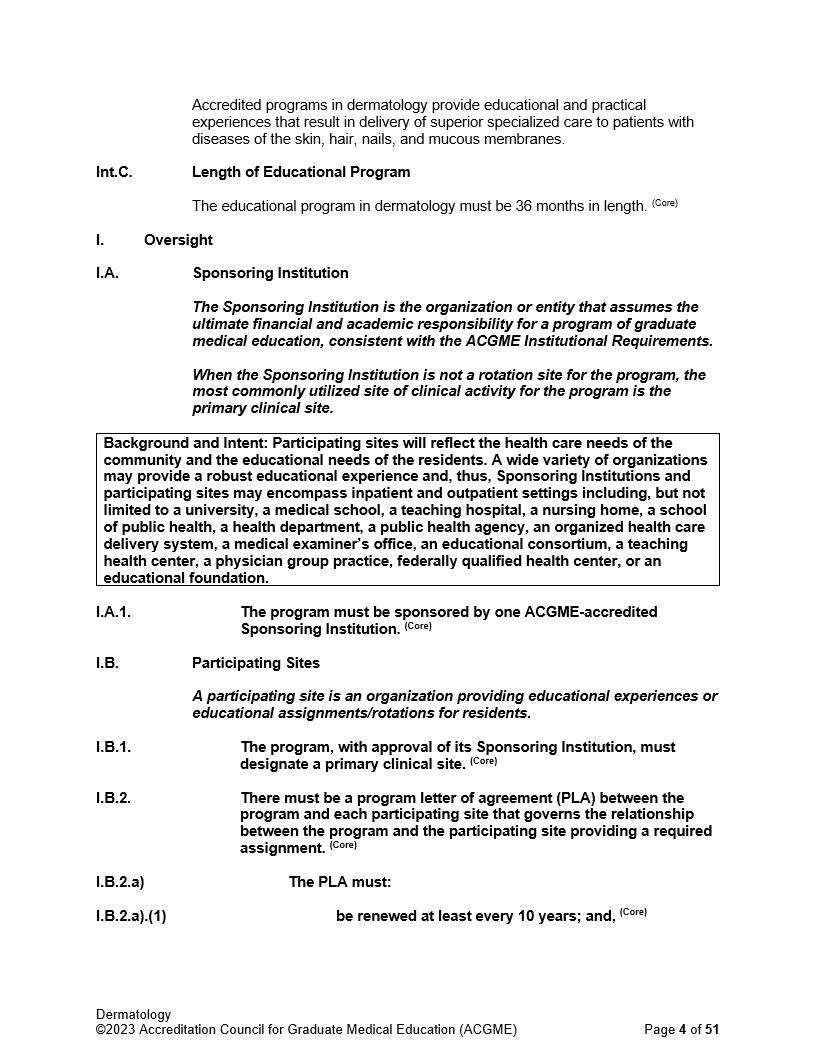
The educational program in dermatology must be 36 months in length. (Core)
I.
I.A.
Oversight
Sponsoring Institution
The Sponsoring Institution is the organization or entity that assumes the
ultimate financial and academic responsibility for a program of graduate
medical education, consistent with the ACME Institutional Requirements.
Ven the only ring laste on is not a rotation site for ra roam, the
rimary clinical site
Background and Intent: Participating sites will reflect the health care needs of the
community and the educational needs of the residents. A wide variety of organizations
may provide a robust educational experience and, thus, Sponsoring Institutions and
participating sites may encompass inpatient and outpatient settings including, but not
limited to a university, a medical school, a teaching hospital, a nursing home, a school
of public health, a health department, a public health agency, an organized health care
delivery system, a medical examiner’s office, an educational consortium, a teaching
health center, a physician group practice, federally qualified health center, or an
educational foundation.
I.A.1.
The program must be sponsored by one ACME-accredited
Sponsoring Institution. (Core)
I.B.
Participating Sites
A participating site is an organization providing educational experiences or
educational assignments/rotations for residents.
I.B.1.
Ths progra prith croval ste Sponsoring Institution, must
I.B.2.
1.B.2.a)
I.B.2.a).(1)
The PLA must:
be renewed at least every 10 years; and, (Core)
Dermatology
©2023 Accreditation Council for Graduate Medical Education (ACGME)
Page 4 of 51
Page 5
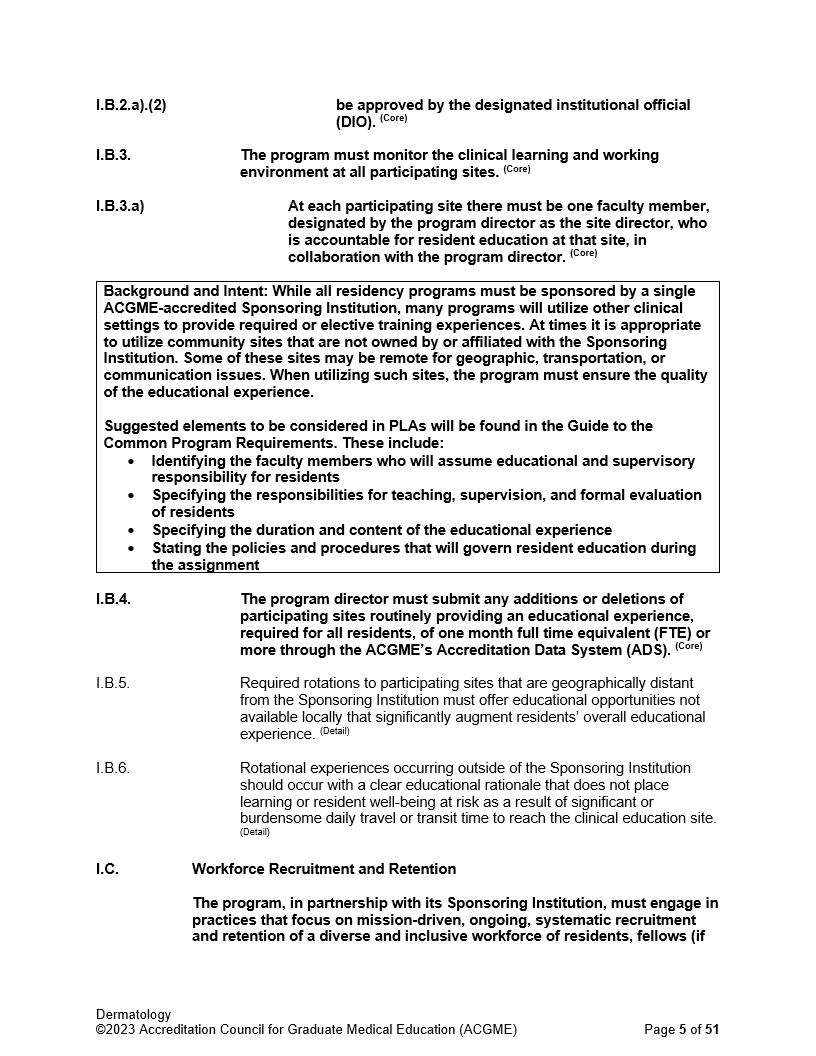
l.B.2.a).(2)
be approved by the designated institutional official
(DIO). (Core)
I.B.3.
The program must monitor the clinical learning and working
environment at all participating sites. (Core)
I.B.3.a)
At each participating site there must be one faculty member,
designated by the program director as the site director, who
is accountable for resident education at that site, in
collaboration with the program director. (Core)
Background and Intent: While all residency programs must be sponsored by a single
ACGME-accredited Sponsoring Institution, many programs will utilize other clinical
settings to provide required or elective training experiences. At times it is appropriate
to utilize community sites that are not owned by or affiliated with the Sponsoring
Institution. Some of these sites may be remote for geographic, transportation, or
communication issues. When utilizing such sites, the program must ensure the quality
of the educational experience.
Suggested elements to be considered in PLAs will be found in the Guide to the
Common Program Requirements. These include:
•
Identifying the faculty members who will assume educational and supervisory
responsibility for residents
•
Specifying the responsibilities for teaching, supervision, and formal evaluation
of residents
•
Specifying the duration and content of the educational experience
•
Stating the policies and procedures that will govern resident education during
the assignment
I.B.4.
The program director must submit any additions or deletions of
participating sites routinely providing an educational experience,
required for all residents, of one month full time equivalent (FTE) o
nore through the ACME’s Accreditation Data System (ADS). (Core
I.B.5.
Required rotations to participating sites that are geographically distant
from the Sponsoring Institution must offer educational opportunities not
available locally that significantly augment residents’ overall educational
experience. (Detail)
I.B.6.
Rotational experiences occurring outside of the Sponsoring Institution
should occur with a clear educational rationale that does not place
learning or resident well-being at risk as a result of significant or
burdensome daily travel or transit time to reach the clinical education site.
(Detail)
I.C.
Workforce Recruitment and Retention
The program, in partnership with its Sponsoring Institution, must engage in
practices that focus on mission-driven, ongoing, systematic recruitment
and retention of a diverse and inclusive workforce of residents, fellows (if
Dermatology
©2023 Accreditation Council for Graduate Medical Education (ACGME)
Page 5 of 51
Page 6
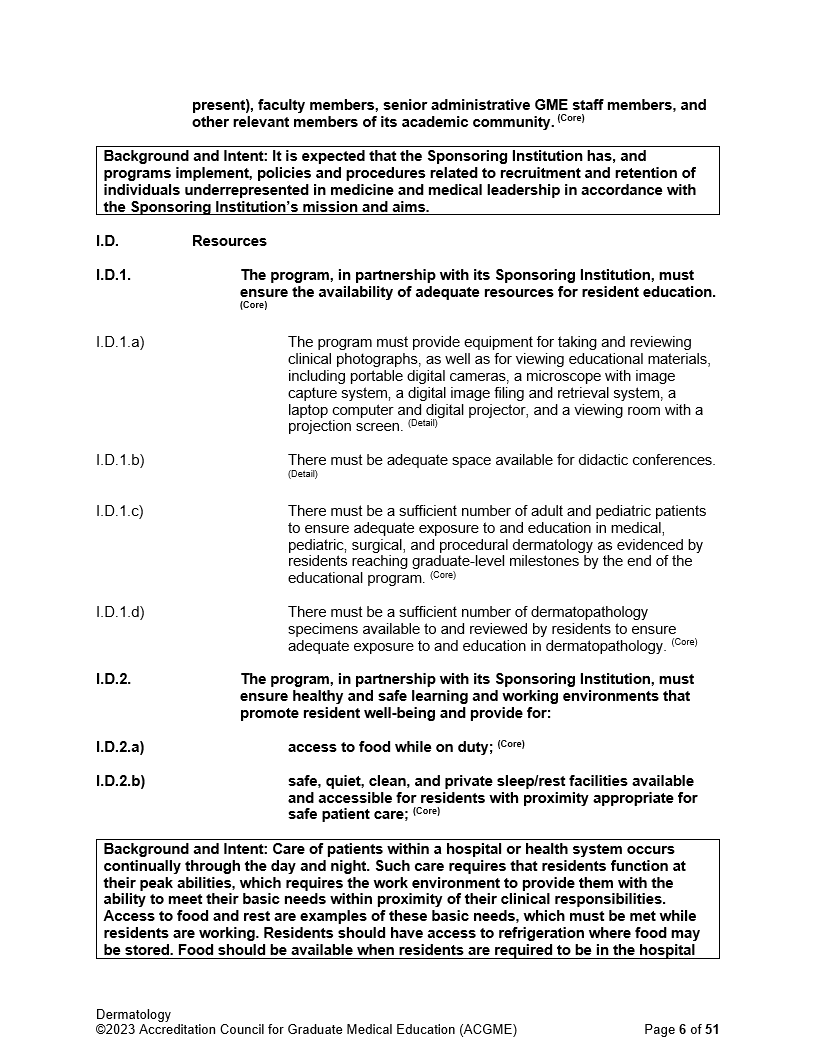
present), faculty members, senior administrative GME staff members, and
other relevant members of its academic community. (Core)
Background and Intent: It is expected that the Sponsoring Institution has, and
programs implement, policies and procedures related to recruitment and retention of
individuals underrepresented in medicine and medical leadership in accordance with
the Sponsoring Institution’s mission and aims.
I.D.
Resources
I.D.1.
The program, in partnership with its Sponsoring Institution, must
ensure the availability of adequate resources for resident education.
(Core)
I.D.1.a)
I.D.1.b)
The program must provide equipment for taking and reviewing
clinical photographs, as well as for viewing educational materials,
including portable digital cameras, a microscope with image
capture system, a digital image filing and retrieval system, a
laptop computer and digital projector, and a viewing room with a
projection screen. (Detail)
There must be adequate space available for didactic conferences.
I.D.1.c)
I.D.1.d)
I.D.2.
I.D.2.a)
I.D.2.b)
There must be a sufficient number of adult and pediatric patients
to ensure adequate exposure to and education in medical,
pediatric, surgical, and procedural dermatology as evidenced by
residents reaching graduate-level milestones by the end of the
educational program. (Core)
There must be a sufficient number of dermatopathology
specimens available to and reviewed by residents to ensure
adequate exposure to and education in dermatopathology. (Core
The program, in partnership with its Sponsoring Institution, must
ensure healthy and safe learning and working environments that
promote resident well-being and provide for:
access to food while on duty; (Core)
safe, quiet, clean, and private sleep/rest facilities available
and access are residents with proximity appropriate for
Background and Intent: Care of patients within a hospital or health system occurs
continually through the day and night. Such care requires that residents function at
their peak abilities, which requires the work environment to provide them with the
ability to meet their basic needs within proximity of their clinical responsibilities.
Access to food and rest are examples of these basic needs, which must be met while
residents are working. Residents should have access to refrigeration where food may
be stored. Food should be available when residents are required to be in the hospital
Dermatology
©2023 Accreditation Council for Graduate Medical Education (ACGME)
Page 6 of 51
Page 7
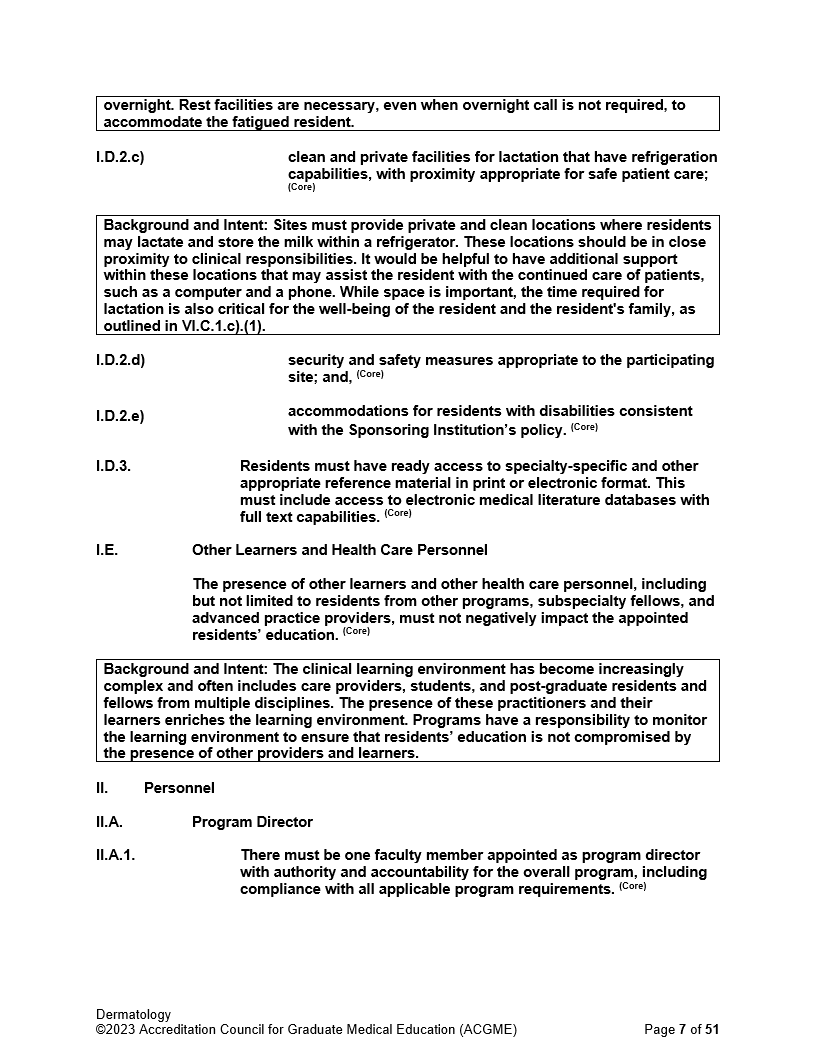
overnight. Rest facilities are necessary, even when overnight call is not required, to
accommodate the fatigued resident.
I.D.2.c)
clean and private facilities for lactation that have refrigeration
capabilities, with proximity appropriate for safe patient care;
Background and Intent: Sites must provide private and clean locations where residents
may lactate and store the milk within a refrigerator. These locations should be in close
proximity to clinical responsibilities. It would be helpful to have additional support
within these locations that may assist the resident with the continued care of patients,
such as a computer and a phone. While space is important, the time required for
lactation is also critical for the well-being of the resident and the resident’s family, as
outlined in VI.C.1.c).(1).
I.D.2.d)
I.D.2.e)
I.D.3.
security and safety measures appropriate to the participating
site; and, (Core)
accommodations for residents with disabilities consistent
with the Sponsoring Institution’s policy. (Core)
Residents must have ready access to specialty-specific and other
appropriate reference material in print or electronic format. This
nust include access to electronic medical literature databases with
Full text capabilities. (Core
L.E.
Other Learners and Health Care Personnel
The presence of other learners and other health care personnel, including
but not limited to residents from other programs, subspecialty fellows, and
residened practicion viders, must not negatively impact the appointed
learners enriches the learning environment. Programs have a responsibility to monitor
the learning environment to ensure that residents’ education is not compromised by
the presence of other providers and learners.
Il.
Personnel
II.A.
Program Director
II.A.1.
There must be one faculty member appointed as program director
with authority and accountability for the overall program, including
compliance with all applicable program requirements. (Core)
Dermatology
©2023 Accreditation Council for Graduate Medical Education (ACGME)
Page 7 of 51
Page 8
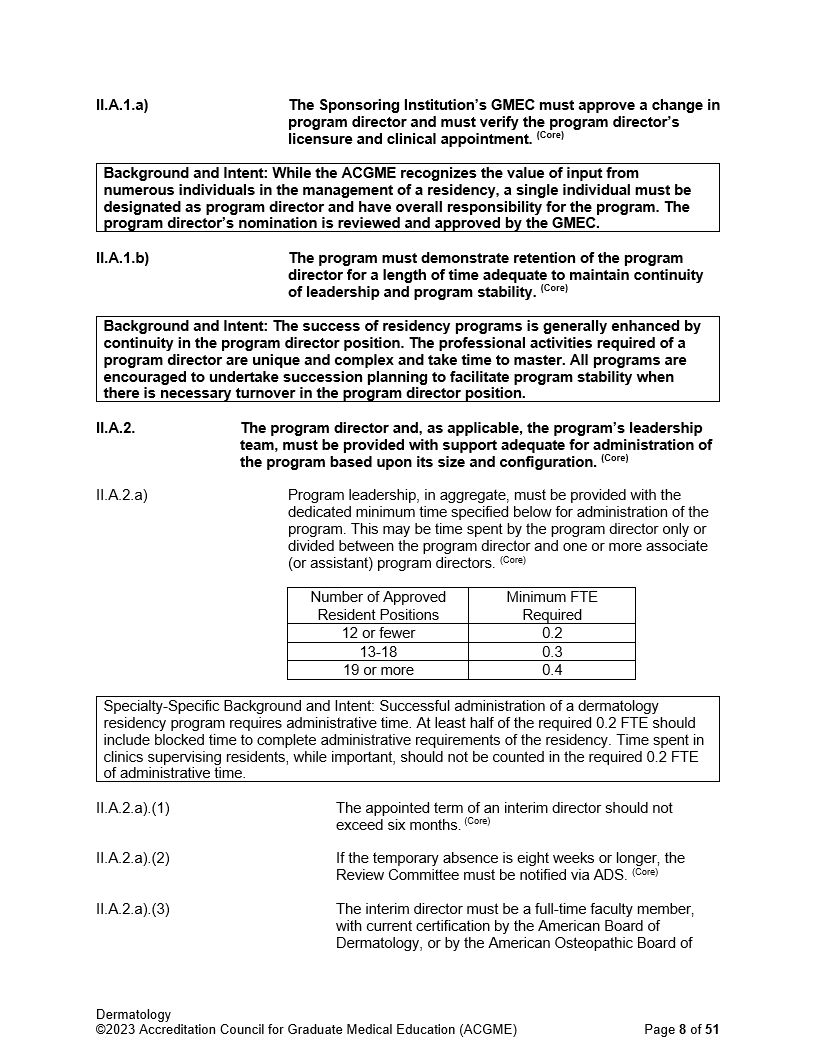
The Sponsoring Institution’s GMEC must approve a change in
program director and must verify the program director’s
licensure and clinical appointment. (Core)
Background and Intent: While the ACME recognizes the value of input from
numerous individuals in the management of a residency, a single individual must be
designated as program director and have overall responsibility for the program. The
program director’s nomination is reviewed and approved by the GMEC.
II.A.1.b)
The program must demonstrate retention of the program
director for a length of time adequate to maintain continuity
of leadership and program stability. (Core)
Background and Intent: The success of residency programs is generally enhanced by
continuity in the program director position. The professional activities required of a
program director are unique and complex and take time to master. All programs are
encouraged to undertake succession planning to facilitate program stability when
there is necessary turnover in the program director position.
II.A.2.
ll.A.2.a)
The program director and, as applicable, the program’s leadership
team, must be provided with support adequate for administration of
the program based upon its size and configuration. (Core)
Program leadership, in aggregate, must be provided with the
dedicated minimum time specified below for administration of the
program. This may be time spent by the program director only or
divided between the program director and one or more associate
(or assistant) program directors. (Core)
Number of Approved
Resident Positions
2 or fewe
13-18
19 or more
Minimum FTE
Required
0.2
0.3
0.4
Specialty-Specific Background and Intent: Successful administration of a dermatology
residency program requires administrative time. At least half of the required 0.2 FTE shoulo
of administrative time
lI.A.2.a). (1)
Il.A.2.a).(2)
lI.A.2.a). (3)
le appointed term of an interim director should n
ceed six months. (Co
If the temporary absence is eight weeks or longer, the
Review Committee must be notified via ADS. (Core)
Dermatology
©2023 Accreditation Council for Graduate Medical Education (ACGME)
Page 8 of 51
Page 9
Dermatology, with at least three years of experience
educating dermatology residents or fellows. (Core)
Background and Intent: To achieve successful graduate medical education, individuals
serving as education and administrative leaders of residency programs, as well as
those significantly engaged in the education, supervision, evaluation, and mentoring of
residents, must have sufficient dedicated professional time to perform the vital
activities required to sustain an accredited program.
The ultimate outcome of graduate medical education is excellence in resident
education and patient care.
The program director and, as applicable, the program leadership team, devote a
portion of their professional effort to the oversight and management of the residency
program, as defined in II.A.4.-II.A.4.a).(12). Both provision of support for the time
required for the leadership effort and flexibility regarding how this support is provided
are important. Programs, in partnership with their Sponsoring Institutions, may provide
support for this time in a variety of ways. Examples of support may include, but are not
limited to, salary support, supplemental compensation, educational value units, or
relief of time from other professional duties.
Program directors and, as applicable, members of the program leadership team, who
are new to the role may need to devote additional time to program oversight and
management initially as they learn and become proficient in administering the
program. It is suggested that during this initial period the support described above be
increased as needed.
In addition, it is important to remember that the dedicated time and support
requirement for ACGME activities is a minimum, recognizing that, depending on the
unique needs of the program, additional support may be warranted. The need to
ensure adequate resources, including adequate support and dedicated time for the
program director, is also addressed in Institutional Requirement Il.B.1. The amount of
support and dedicated time needed for individual programs will vary based on a
number of factors and may exceed the minimum specified in the applicable
specialty/subspecialty-specific Program Requirements. It is expected that the
Sponsoring Institution, in partnership with its accredited programs, will ensure support
for program directors to fulfill their program responsibilities effectively.
II.A.3.
Qualifications of the program director:
Il.A.3.a)
must include specialty expertise and at least three years of
documented educational and/or administrative experience, or
qualifications acceptable to the Review Committee; (Core)
Background and Intent: Leading a program requires knowledge and skills that are
established during residency and subsequently further developed. The time period
from completion of residency until assuming the role of program director allows the
individual to cultivate leadership abilities while becoming professionally established.
The three-year period is intended for the individual’s professional maturation.
Dermatology
©2023 Accreditation Council for Graduate Medical Education (ACGME)
Page 9 of 51
Page 10
The broad allowance for educational and/or administrative experience recognizes that
strong leaders arise through diverse pathways. These areas of expertise are important
when identifying and appointing a program director. The choice of a program director
should be informed by the mission of the program and the needs of the community.
In certain circumstances, the program and Sponsoring Institution may propose and the
Review Committee may accept a candidate for program director who fulfills these
goals but does not meet the three-year minimum.
II.A.3.b)
must include current certification in the specialty for which
they are the program director by the American Board of
Dermatology or by the American Osteopathic Board of
Dermatology, or specialty qualifications that are acceptable to
the Review Committee; (Core)
II.A.3.c)
must include ongoing clinical activity; and, (Core)
Background and Intent: A program director is a role model for faculty members and
residents. The program director must participate in clinical activity consistent with the
specialty. This activity will allow the program director to role model the Core
Competencies for the faculty members and residents.
II.A.3.d)
must include a minimum of one year of documented experience
serving as a core faculty member for an ACME-accredited
dermatology program, or specialty qualifications that are
acceptable to the Review Committee. (Core)
II.A.4.
Program Director Responsibilities
The program director must have responsibility, authority, and
accountability for: administration and operations; teaching and
cholarly activity; resident recruitment and selection, evaluation
ind promotion of residents, and disciplinary action; supervision of
residents; and resident education in the context of patient care. (Core)
Il.A.4.a)
The program director must:
ll.A.4.a).(1)
be a role model of professionalism; (Core)
Background and Intent: The program director, as the leader of the program, must serve
as a role model to residents in addition to fulfilling the technical aspects of the role. As
residents are expected to demonstrate compassion, integrity, and respect for others,
they must be able to look to the program director as an exemplar. It is of utmost
importance, therefore, that the program director model outstanding professionalism,
high quality patient care, educational excellence, and a scholarly approach to work.
The program director creates an environment where respectful discussion is welcome,
with the goal of continued improvement of the educational experience.
l.A.4.a).(2)
design and conduct the program in a fashion
consistent with the needs of the community, the
Dermatology
©2023 Accreditation Council for Graduate Medical Education (ACGME)
Page 10 of 51
Page 11
mission(s) of the Sponsoring Institution, and the
mission(s) of the program; (Core)
Background and Intent: The mission of institutions participating in graduate medical
education is to improve the health of the public. Each community has health needs that
vary based upon location and demographics. Programs must understand the structural
and social determinants of health of the populations they serve and incorporate them
in the design and implementation of the program curriculum, with the ultimate goal of
addressing these needs and eliminating health disparities.
II.A.4.a).(3)
administer and maintain a learning environment
conducive to educating the residents in each of the
ACGME Competency domains; (Core)
Background and Intent: The program director may establish a leadership team to
assist in the accomplishment of program goals. Residency programs can be highly
complex. In a complex organization, the leader typically has the ability to delegate
authority to others, yet remains accountable. The leadership team may include
physician and non-physician personnel with varying levels of education, training, and
experience.
II.A.4.a).(4)
have the authority to approve or remove physicians
and non-physicians as faculty members at all
participating sites, including the designation of core
faculty members, and must develop and oversee a
process to evaluate candidates prior to approval; (Core)
Background and Intent: The provision of optimal and safe patient care requires a team
approach. The education of residents by non-physician educators may enable the
resident to better manage patient care and provides valuable advancement of the
residents’ knowledge. Furthermore, other individuals contribute to the education of
residents in the basic science of the specialty or in research methodology. If the
program director determines that the contribution of a non-physician individual is
significant to the education of the residents, the program director may designate the
individual as a program faculty member or a program core faculty member.
Il.A.4.a).(5)
have the authority to remove residents from
supervising interactions and/or learning environments
that do not meet the standards of the program; (Core)
Background and Intent: The program director has the responsibility to ensure that all
who educate residents effectively role model the Core Competencies. Working with a
resident is a privilege that is earned through effective teaching and professional role
modeling. This privilege may be removed by the program director when the standards
of the clinical learning environment are not met.
There may be faculty in a department who are not part of the educational program, and
the program director controls who is teaching the residents.
Dermatology
©2023 Accreditation Council for Graduate Medical Education (ACGME)
Page 11 of 51
Page 12
Il.A.4.a).(6)
submit accurate and complete information requirec
and requested by the DIO, GMEC, and ACME; (Core
Background and Intent: This includes providing information in the form and forma
requested by the ACME and obtaining requisite sign-off by the DIC
II.A.4.a).(7)
Il.A.4.a).(8)
Background and Intent: A program does not operate independently of its Sponsoring
I.A.4.a).(9)
Il.A.4.a).(10)
Residents must not be required to sign a non-
Competition guarantee or restrictive covenant.
cument verification of education for all residen
within to and, of completion of or departure from the
Il.A.4.a).(11)
Background and Intent: Primary verification of graduate medical education is
II.B.
Faculty
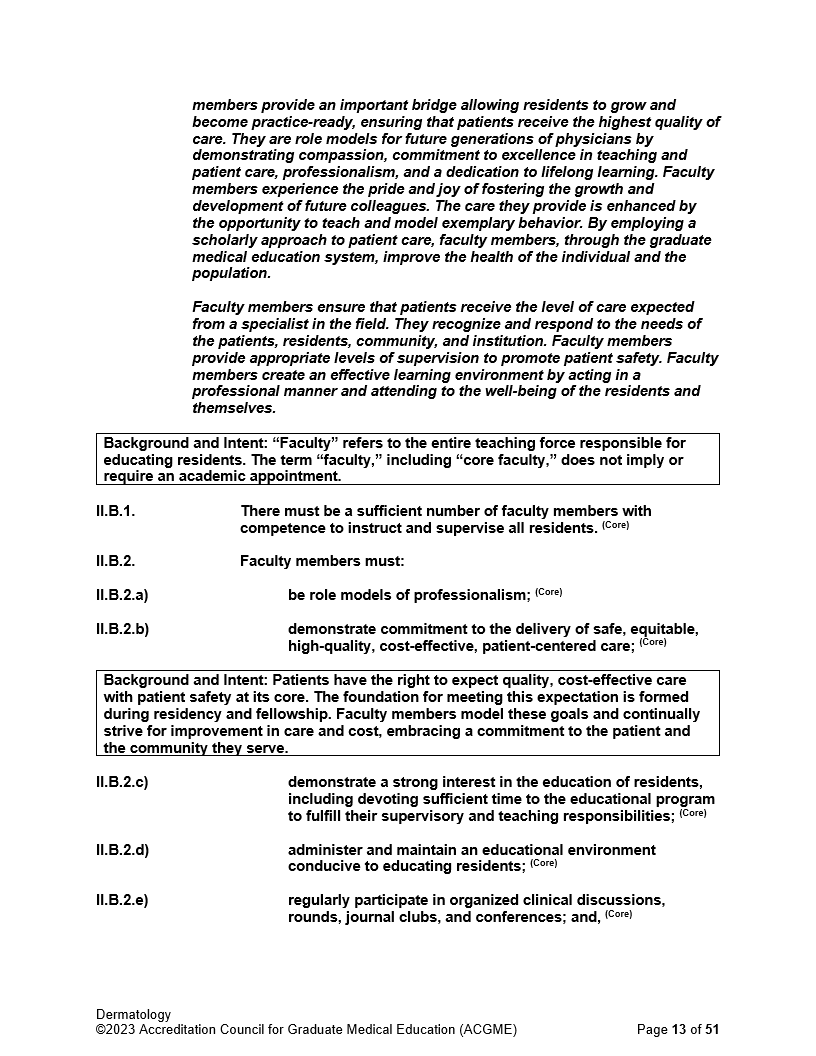
Faculty members are a foundational element of graduate medical education
- faculty members teach residents how to care for patients. Faculty
Dermatology
©2023 Accreditation Council for Graduate Medical Education (ACGME)
Page 12 of 51
Page 13
members provide an important bridge allowing residents to grow and
become practice-ready, ensuring that patients receive the highest quality of
care. They are role models for future generations of physicians by
demonstrating compassion, commitment to excellence in teaching and
patient care, professionalism, and a dedication to lifelong learning. Faculty
members experience the pride and joy of fostering the growth and
development of future colleagues. The care they provide is enhanced by
the opportunity to teach and model exemplary behavior. By employing a
scholarly approach to patient care, faculty members, through the graduate
medical education system, improve the health of the individual and the
population.
Faculty members ensure that patients receive the level of care expected
from a specialist in the field. They recognize and respond to the needs of
the patients, residents, community, and institution. Faculty members
provide appropriate levels of supervision to promote patient safety. Faculty
members create an effective learning environment by acting in a
professional manner and attending to the well-being of the residents and
themselves.
Background and Intent: “Faculty” refers to the entire teaching force responsible for
educating residents. The term “faculty,” including “core faculty,” does not imply or
require an academic appointment.
II.B.1.
There must be a sufficient number of faculty members with
competence to instruct and supervise all residents. (Core)
II.B.2.
Faculty members must:
II.B.2.a)
be role models of professionalism; (Core)
Il.B.2.b)
lemonstrate commitment to the delivery of safe, equitable
igh-quality, cost-effective, patient-centered care; (Cor
Background and Intent: Patients have the right to expect quality, cost-effective care
II.B.2.c)
II.B.2.d)
Il.B.2.e)
demonstrate a strong interest in the education of residents,
ncluding devoting sufficient time to the educational prograr
o fulfill their supervisory and teaching responsibilities; (Core
administer and maintain an educational environment
conducive to educating residents; (Core
regularly participate in organized clinical discussions,
rounds, journal clubs, and conferences; and, (Core)
Dermatology
©2023 Accreditation Council for Graduate Medical Education (ACGME)
Page 13 of 51
Page 14
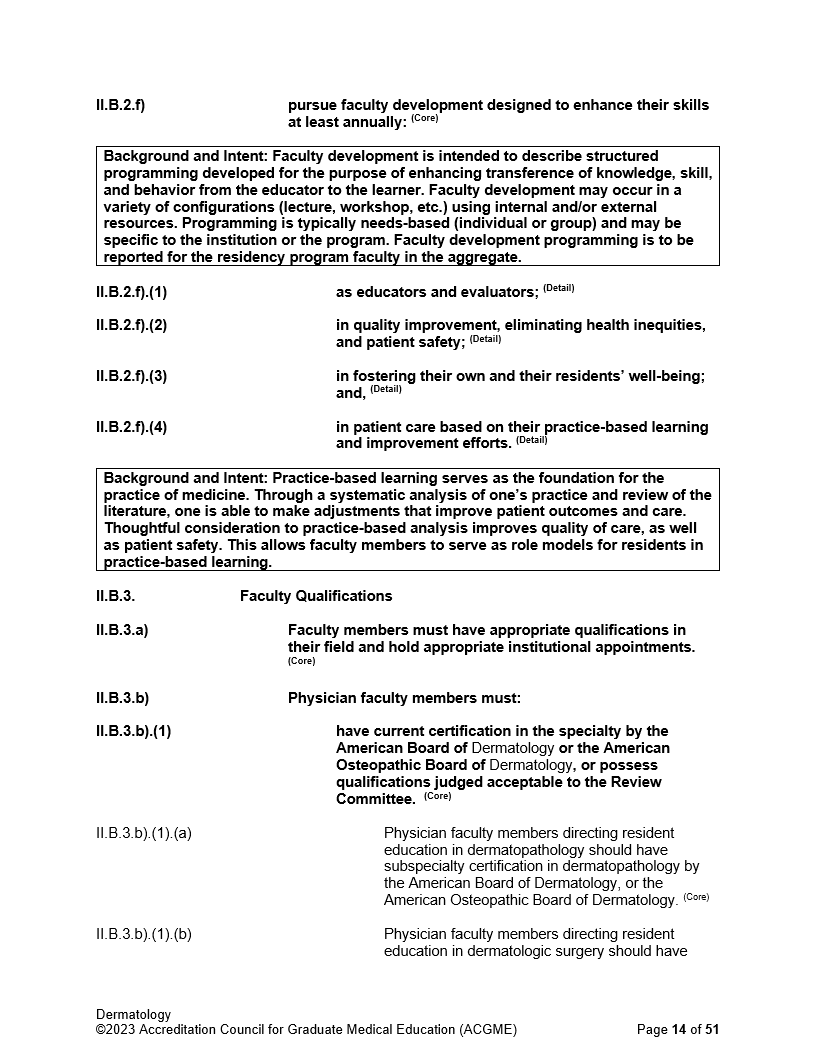
II.B.2.f)
pursue faculty development designed to enhance their skills
at least annually: (Core)
Background and Intent: Faculty development is intended to describe structured
programming developed for the purpose of enhancing transference of knowledge, skill,
and behavior from the educator to the learner. Faculty development may occur in a
variety of configurations (lecture, workshop, etc.) using internal and/or external
resources. Programming is typically needs-based (individual or group) and may be
pecific to the institution or the program. Faculty development programming is to b
eported for the residency program faculty in the aggregate
II.B.2.f).(1)
II.B.2.f).(2)
as educators and evaluators; (Detail)
in quality improvement, eliminating health inequities,
and patient safety; (Detail)
II.B.2.f).(3)
in fostering their own and their residents’ well-being;
and, (Detail)
II.B.2.f).(4)
in patient care based on their practice-based learning
and improvement efforts. (Detail)
Background and Intent: Practice-based learning serves as the foundation for the
ractice of medicine. Through a systematic analysis of one’s practice and review of thi
terature, one is able to make adjustments that improve patient outcomes and care
Thoughtful consideration to practice-based analysis improves quality of care, as well
as patient safety. This allows faculty members to serve as role models for residents in
practice-based learning.
II.B.3.
Faculty Qualifications
II.B.3.a)
II.B.3.b)
ll.B.3.b).(1)
II.B.3.b). (1).(a)
Physician faculty members must:
have current certification in the specialty by the
American Board of Dermatology or the American
Osteopathic Board of Dermatology, or possess
lalifications judged acceptable to the Revie
mmittee. co
Physician faculty members directing resident
education in dermatopathology should have
subspecialty certification in dermatopathology by
the American Board of Dermatology, or the
American Osteopathic Board of Dermatology. (Core)
Physician faculty members directing resident
education in dermatologic surgery should have
Dermatology
©2023 Accreditation Council for Graduate Medical Education (ACGME)
Page 14 of 51
Page 15
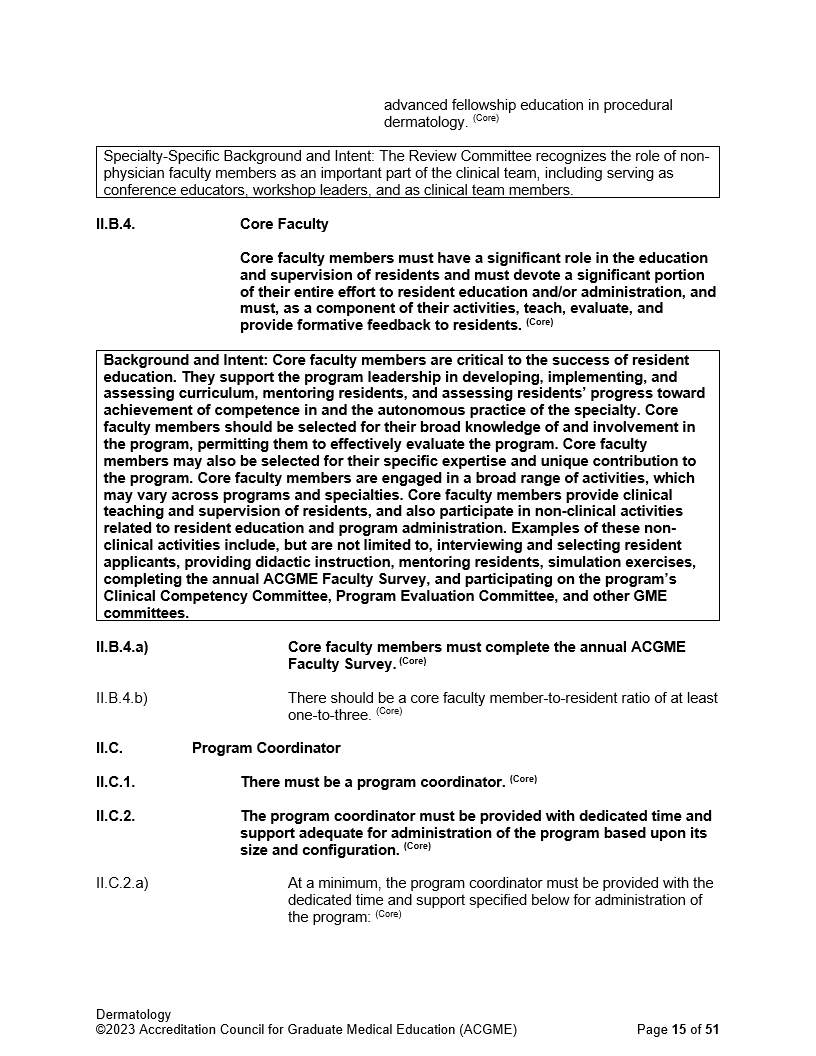
advanced fellowship education in procedural
dermatology. (Core)
Specialty-Specific Background and Intent: The Review Committee recognizes the role of non-
physician faculty members as an important part of the clinical team, including serving as
conference educators, workshop leaders. and as clinical team members.
II.B.4.
Core Faculty
Core faculty members must have a significant role in the education
and supervision of residents and must devote a significant portion
of their entire effort to resident education and/or administration, and
must, as a component of their activities, teach, evaluate, and
provide formative feedback to residents. (Core)
Background and Intent: Core faculty members are critical to the success of resident
education. They support the program leadership in developing, implementing, and
assessing curriculum, mentoring residents, and assessing residents’ progress toward
achievement of competence in and the autonomous practice of the specialty. Core
faculty members should be selected for their broad knowledge of and involvement in
the program, permitting them to effectively evaluate the program. Core faculty
members may also be selected for their specific expertise and unique contribution to
the program. Core faculty members are engaged in a broad range of activities, which
may vary across programs and specialties. Core faculty members provide clinical
teaching and supervision of residents, and also participate in non-clinical activities
related to resident education and program administration. Examples of these non-
clinical activities include, but are not limited to, interviewing and selecting resident
applicants, providing didactic instruction, mentoring residents, simulation exercises,
Clinical Competency Commite Program valuation Compatie, an the the can
committees.
II.B.4.a)
Core faculty members must complete the annual ACGME
Faculty Survey. (Core)
II.B.4.b)
II.C.
II.C.1.
II.C.2.
There should be a core faculty member-to-resident ratio of at least
one-to-three. (Core)
Program Coordinator
There must be a program coordinator. (Core)
The program coordinator must be provided with dedicated time and
size and antiate for, drinistration of the program based upon its
Il.C.2.a)
the program: (Core)
Dermatology
©2023 Accreditation Council for Graduate Medical Education (ACGME)
Page 15 of 51
Page 16
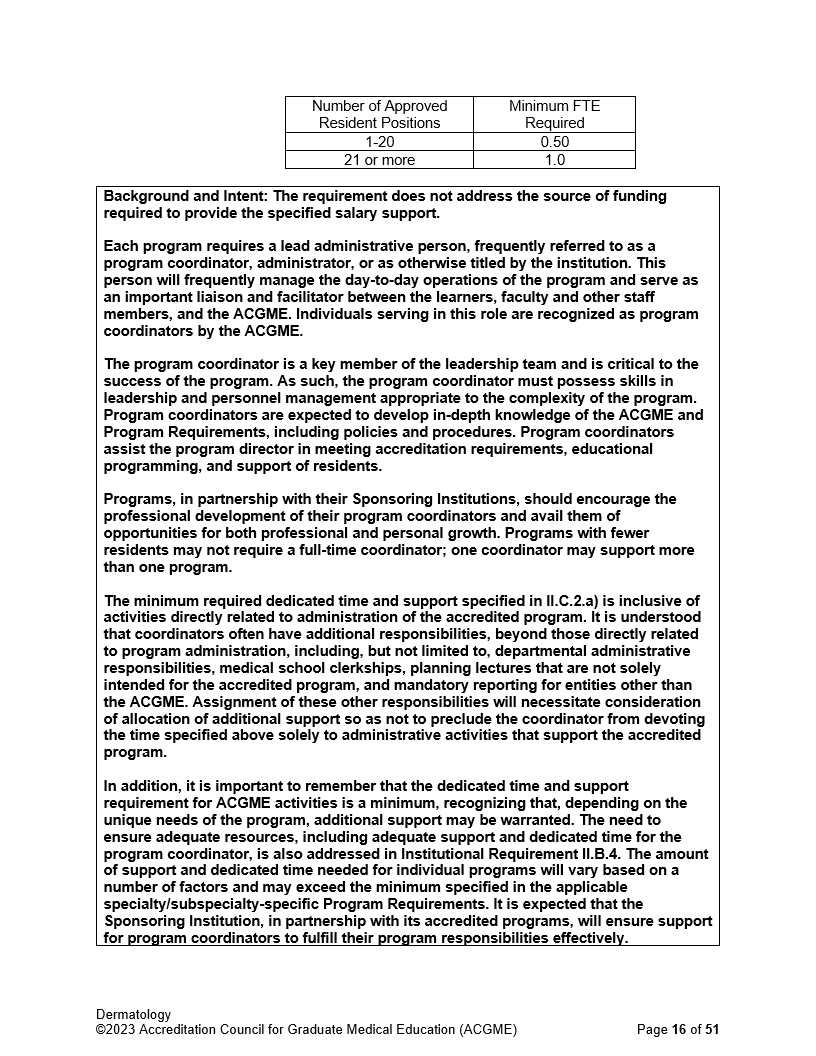
Number of Approved
Resident Positions
1-20
21 or more
Minimum FTE
Required
0.50
1.0
Background and Intent: The requirement does not address the source of funding
required to provide the specified salary support.
members, and the ACME. Individuals serving in this role are recognized as program
coordinators by the ACME.
The program coordinator is a key member of the leadership team and is critical to the
success of the program. As such, the program coordinator must possess skills in
eadership and personnel management appropriate to the complexity of the program.
Program coordinators are expected to develop in-depth knowledge of the ACGME anc
Program Requirements, including policies and procedures. Program coordinators
assist the program director in meeting accreditation requirements, educational
programming, and support of residents.
Programs, in partnership with their Sponsoring Institutions, should encourage the
professional development of their program coordinators and avail them of
opportunities for both professional and personal growth. Programs with fewer
residents may not require a full-time coordinator; one coordinator may support more
than one program.
The minimum required dedicated time and support specified in II.C.2.a) is inclusive of
activities directly related to administration of the accredited program. It is understood
that coordinators often have additional responsibilities, beyond those directly related
to program administration, including, but not limited to, departmental administrative
responsibilities, medical school clerkships, planning lectures that are not solely
intended for the accredited program, and mandatory reporting for entities other than
the ACGME. Assignment of these other responsibilities will necessitate consideration
of allocation of additional support so as not to preclude the coordinator from devoting
the time specified above solely to administrative activities that support the accredited
program.
In addition, it is important to remember that the dedicated time and support
requirement for ACME activities is a minimum, recognizing that, depending on the
unique needs of the program, additional support may be warranted. The need to
ensure adequate resources, including adequate support and dedicated time for the
program coordinator, is also addressed in Institutional Requirement Il.B.4. The amount
of support and dedicated time needed for individual programs will vary based on a
number of factors and may exceed the minimum specified in the applicable
specialty/subspecialty-specific Program Requirements. It is expected that the
Sponsoring Institution, in partnership with its accredited programs, will ensure support
for program coordinators to fulfill their program responsibilities effectively.
Dermatology
©2023 Accreditation Council for Graduate Medical Education (ACGME)
Page 16 of 51
Page 17
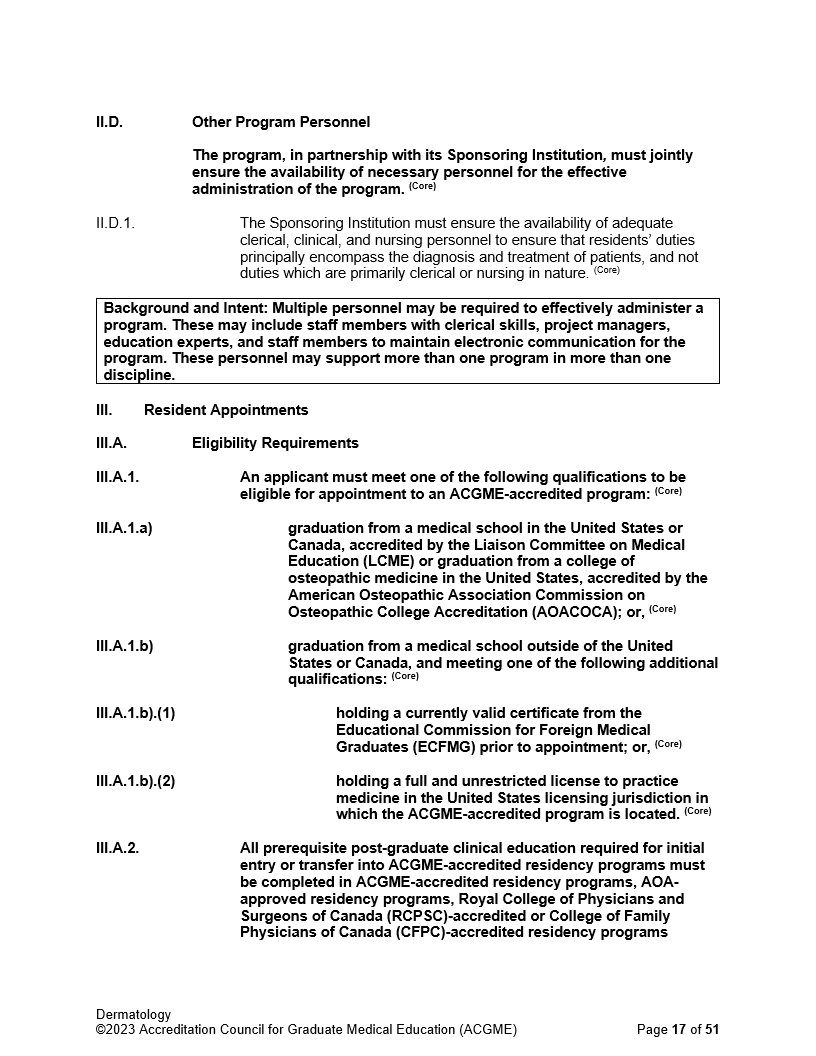
II.D.
Other Program Personnel
The program, in partnership with its Sponsoring Institution, must jointly
ensure the availability of necessary personnel for the effective
administration of the program. (Core)
II.D.1.
The Sponsoring Institution must ensure the availability of adequate
clerical, clinical, and nursing personnel to ensure that residents duties
principally encompass the diagnosis and treatment of patients, and not
duties which are primarily clerical or nursing in nature. (Core)
Background and Intent: Multiple personnel may be required to effectively administer a
program. These may include staff members with clerical skills, project managers,
education experts, and staff members to maintain electronic communication for the
program. These personnel may support more than one program in more than one
Ill.
III.A.
III.A.1.
Resident Appointments
Eligibility Requirements
An applicant must meet one of the following qualifications to be
eligible for appointment to an ACGME-accredited program: (Core
III.A.1.a)
III.A.1.b)
Osteopathic College Accreditation (AOACOCA); or, (Core)
raduation from a medical school outside of the Unite
tates or ons: a and meeting one of the following additiona
III.A. 1.b).(1)
III.A.1.b).(2)
III.A.2.
All prerequisite post-graduate clinical education required for initial
entry or transfer into ACME-accredited residency programs must
be completed in ACME-accredited residency programs, AOA
approved residency programs, Royal College of Physicians an
surgeons of Canada (RCPSC)-accredited or College of Famil
Physicians of Canada (CFPC)-accredited residency program:
Dermatology
©2023 Accreditation Council for Graduate Medical Education (ACGME)
Page 17 of 51
Page 18
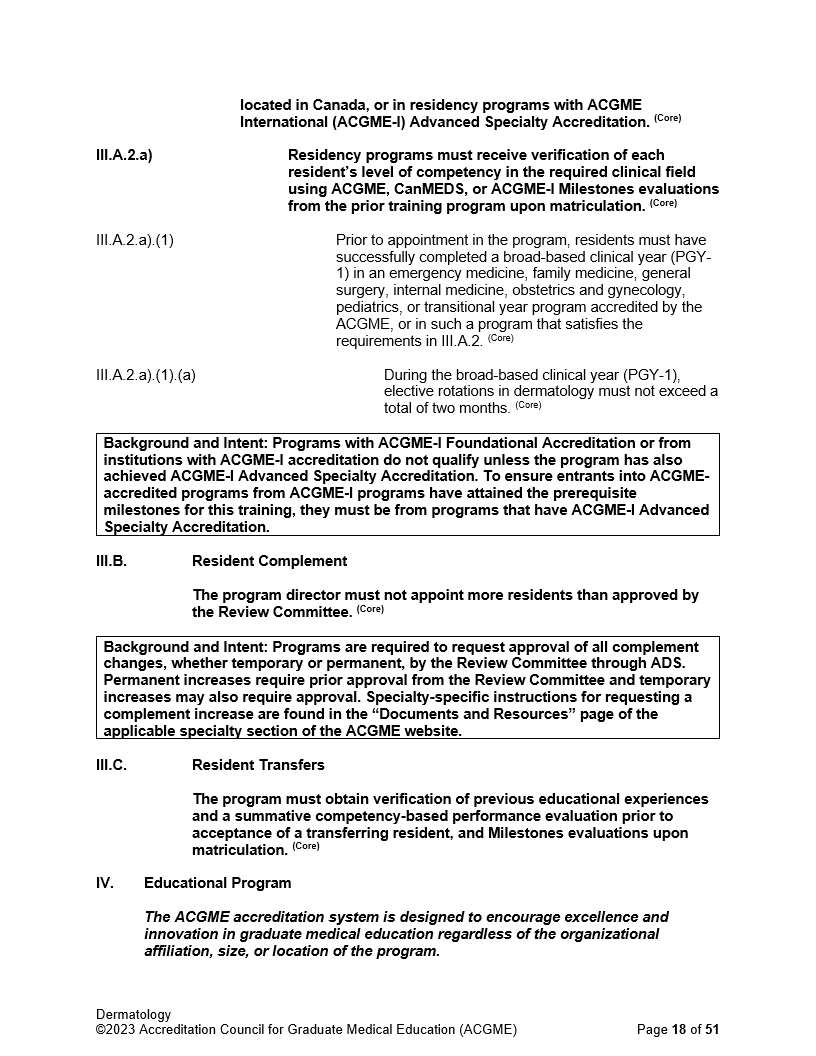
located in Canada, or in residency programs with ACGME
International (ACGME-I) Advanced Specialty Accreditation.
llI.A.2.a)
esidency programs must receive verification of eac
sident’s level of competency in the required clinical fie
from he prior raining program upon matristanton, aluations
III. A.2.a).(1)
Prior to appointment in the program, residents must have
successfully completed a broad-based clinical year (PGY-
- in an emergency medicine, family medicine, general
surgery, internal medicine, obstetrics and gynecology,
pediatrics, or transitional year program accredited by the
ACGME, or in such a program that satisfies the
requirements in III.A.2. (Core)
Ill.A.2.a). (1).(a)
During the broad-based clinical year (PGY-1)
elector rotation his dermatology must not exceed a
Background and Intent: Programs with ACGME-I Foundational Accreditation or from
nstitutions with ACME-| accreditation do not qualify unless the program has als
chieved ACME-I Advanced Specialty Accreditation. To ensure entrants into ACGME
accredited programs from ACGME-I programs have attained the prerequisite
milestones for this training, they must be from programs that have ACGME-I Advancec
Specialty Accreditation.
III.B.
Resident Complement
ne program director must not appoint more residents than approved b
le Review Committee. (Cor
Background and Intent: Programs are required to request approval of all complement
changes, whether temporary or permanent, by the Review Committee through ADS.
Permanent increases require prior approval from the Review Committee and temporary
increases may also require approval. Specialty-specific instructions for requesting a
complement increase are found in the “Documents and Resources” page of the
Lapplicable specialty section of the ACME website.
III.C.
Resident Transfers
The program must obtain verification of previous educational experiences
nd a summative competency-based performance evaluation prior t
cceptance of a transferring resident, and Milestones evaluations upo
matriculation. (Core)
IV. Educational Program
The ACME accreditation system is designed to encourage excellence and
innovation in graduate medical education regardless of the organizational
affiliation, size, or location of the program.
Dermatology
©2023 Accreditation Council for Graduate Medical Education (ACGME)
Page 18 of 51
Page 19
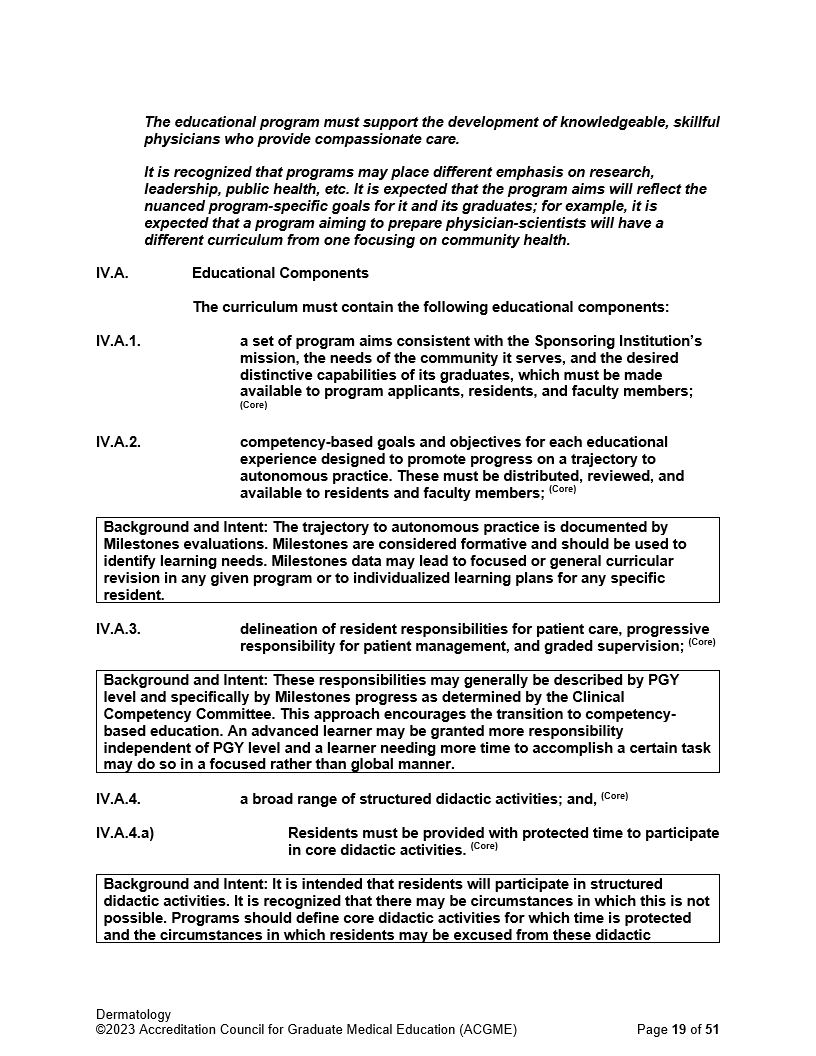
The educational program must support the development of knowledgeable, skillful
physicians who provide compassionate care.
It is recognized that programs may place different emphasis on research,
leadership, public health, etc. It is expected that the program aims will reflect the
nuanced program-specific goals for it and its graduates; for example, it is
expected that a program aiming to prepare physician-scientists will have a
different curriculum from one focusing on community health.
IV.A.
Educational Components
The curriculum must contain the following educational components:
IV.A.1.
a set of program aims consistent with the Sponsoring Institution’s
mission, the needs of the community it serves, and the desired
distinctive capabilities of its graduates, which must be made
available to program applicants, residents, and faculty members;
(Core)
IV.A.2.
competency-based goals and objectives for each educational
experience designed to promote progress on a trajectory to
autonomous practice. These must be distributed, reviewed, and
available to residents and faculty members; (Core)
Background and Intent: The trajectory to autonomous practice is documented by
Milestones evaluations. Milestones are considered formative and should be used to
identify learning needs. Milestones data may lead to focused or general curricular
revision in any given program or to individualized learning plans for any specific
resident.
IV.A.3.
lelineation of resident responsibilities for patient care, progressiv
esponsibility for patient management, and graded supervision; Core
Background and Intent: These responsibilities may generally be described by PGY
level and specifically by Milestones progress as determined by the Clinical
Competency Committee. This approach encourages the transition to competency-
based education. An advanced learner may be granted more responsibility
independent of PGY level and a learner needing more time to accomplish a certain task
may do so in a focused rather than global manner.
IV.A.4.
a broad range of structured didactic activities; and, (Core)
IV.A.4.a)
Residents must be provided with protected time to participate
in core didactic activities. (Core
Background and Intent: It is intended that residents will participate in structured
didactic activities. It is recognized that there may be circumstances in which this is not
possible. Programs should define core didactic activities for which time is protected
Land the circumstances in which residents may be excused from these didactic
Dermatology
©2023 Accreditation Council for Graduate Medical Education (ACGME)
Page 19 of 51
Page 20
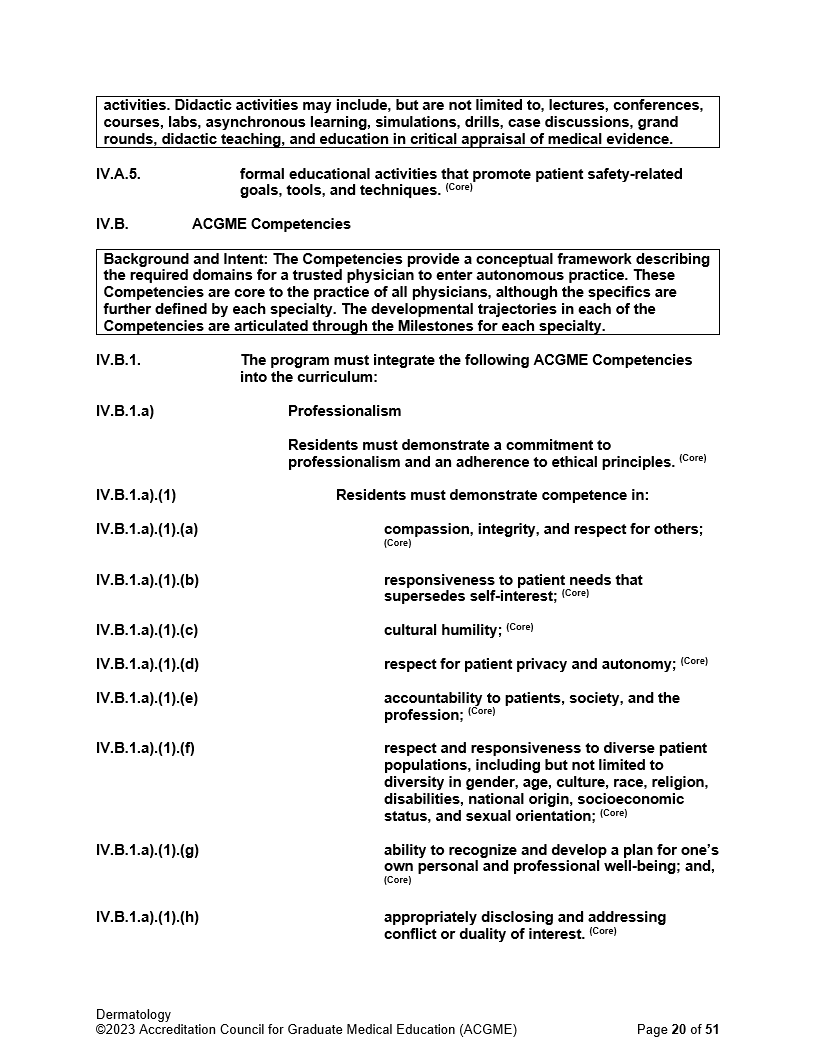
activities. Didactic activities may include, but are not limited to, lectures, conferences,
courses, labs, asynchronous learning, simulations, drills, case discussions, grand
rounds, didactic teaching, and education in critical appraisal of medical evidence.
IV.A.5.
formal educational activities that promote patient safety-related
goals, tools, and techniques. (Core)
IV.B.
ACGME Competencies
Background and Intent: The Competencies provide a conceptual framework describing
the required domains for a trusted physician to enter autonomous practice. These
Competencies are core to the practice of all physicians, although the specifics are
further defined by each specialty. The developmental trajectories in each of the
Competencies are articulated through the Milestones for each specialty.
IV.B.1.
The program must integrate the following ACGME Competencies
into the curriculum:
IV.B.1.a)
Professionalism
IV.B.1.a).(1)
IV.B.1.a).(1).(a)
Residents must demonstrate a commitment to
professionalism and an adherence to ethical principles. (Core)
Residents must demonstrate competence in:
compassion, integrity, and respect for others;
IV.B.1.a).(1).(d)
IV.B.1.a).(1).(e)
IV.B.1.a).(1).(f)
responsiveness to patient needs that
supersedes self-interest; (Core)
cultural humility; (Core)
respect for patient privacy and autonomy; (Core)
accountability to patients, society, and the
profession; (Core
respect and responsiveness to diverse patient
populations, including but not limited to
diversity in gender, age, culture, race, religion,
lisabilities, national origin, socioeconomic
status, and sexual orientation; (Core
IV.B.1.a).(1).(g)
ability to recognize and develop a plan for one’s
own personal and professional well-being; and,
IV.B.1.a).(1).(h)
appropriately disclosing and addressing
conflict or duality of interest. (Core)
Dermatology
©2023 Accreditation Council for Graduate Medical Education (ACGME)
Page 20 of 51
Page 21
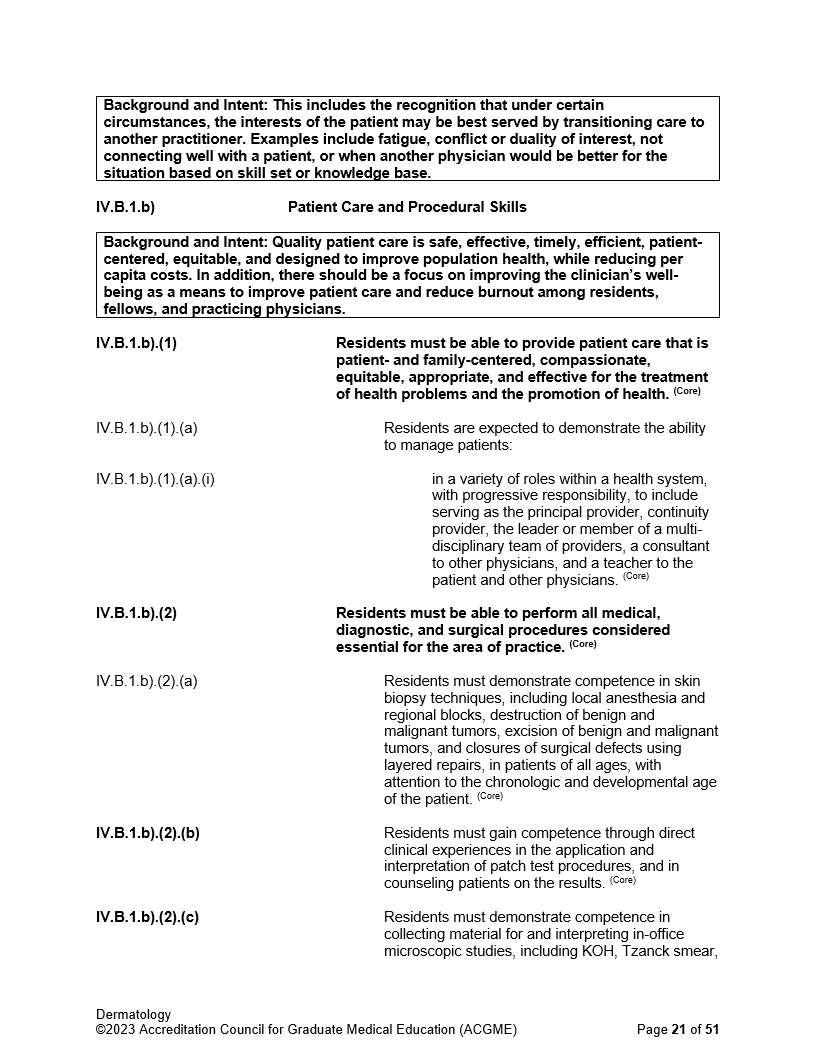
Background and Intent: This includes the recognition that under certain
circumstances, the interests of the patient may be best served by transitioning care to
another practitioner. Examples include fatigue, conflict or duality of interest, not
connecting well with a patient, or when another physician would be better for the
situation based on skill set or knowledge base.
IV.B.1.b)
Patient Care and Procedural Skills
Background and Intent: Quality patient care is safe, effective, timely, efficient, patient-
centered, equitable, and designed to improve population health, while reducing per
capita costs. In addition, there should be a focus on improving the clinician’s well-
being as a means to improve patient care and reduce burnout among residents,
fellows, and practicing physicians.
IV.B.1.b).(1)
IV.B.1.b).(1).(a)
IV.B.1.b).(1).(a).(i)
Residents must be able to provide patient care that is
patient- and family-centered, compassionate,
equitable, appropriate, and effective for the treatment
of health problems and the promotion of health. (Core)
Residents are expected to demonstrate the ability
to manage patients:
in a variety of roles within a health system,
with progressive responsibility, to include
erving as the principal provider, continu
ovider. the leader or member of a mul
disciplinary team of providers, a consultant
to other physicians, and a teacher to the
patient and other physicians. (Core)
IV.B.1.b).(2)
IV.B.1.b).(2). (a)
Residents must demonstrate competence in skin
biopsy techniques, including local anesthesia and
egional blocks, destruction of benign an
alignant tumors, excision of benign and malignar
tumors, and closures of surgical defects using
IV.B.1.b).(2).(b)
IV.B.1.b).(2).(c)
Residents must gain competence through direct
clinical experiences in the application anc
interpretation of patch test procedures, and ir
counseling patients on the results. (Core)
Residents must demonstrate competence ir
collecting material for and interpreting in-office
microscopic studies, including KOH, Tzanck smear,
Dermatology
©2023 Accreditation Council for Graduate Medical Education (ACGME)
Page 21 of 51
Page 22
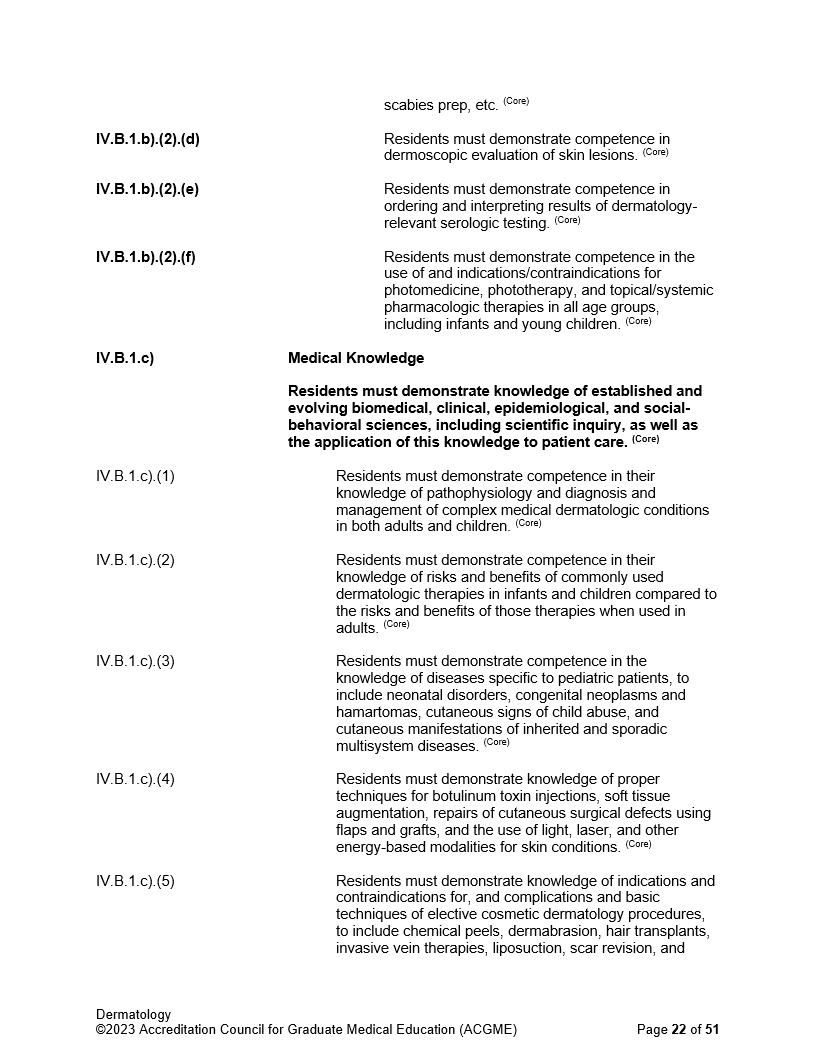
scabies prep, etc. (Core)
Dermiscopic evaluation of sen resons. ein
IV.B.1.b).(2).(d)
IV.B.1.b).(2).(e)
IV.B.1.b).(2) (f)
Ruse of and mications containerations ce in the
IV.B.1.c)
Medical Knowledge
IV.B.1.c).(1)
IV.B. 1.c).(2)
Residents must demonstrate competence in their
knowledge of pathophysiology and diagnosis and
management of complex medical dermatologic conditions
in both adults and children. (Core)
Residents must demonstrate competence in their
knowledge of risks and benetits of commonly used
dermatologic therapies in infants and children compared to
allis, and benefits of those therapies when used in
IV.B.1.c) (3)
IV.B.1.c).(4)
multisystem diseases.
Residents must demonstrate knowledge of proper
techniques for botulinum toxin injections, soft tissue
IV.B.1.c).(5)
Residents must demonstrate knowledge of indications anc
contraindications for, and complications and basic
techniques of elective cosmetic dermatology procedures
to include chemical peels, dermabrasion, hair transplants
invasive vein therapies, liposuction, scar revision, and
Dermatology
©2023 Accreditation Council for Graduate Medical Education (ACGME)
Page 22 of 51
Page 23
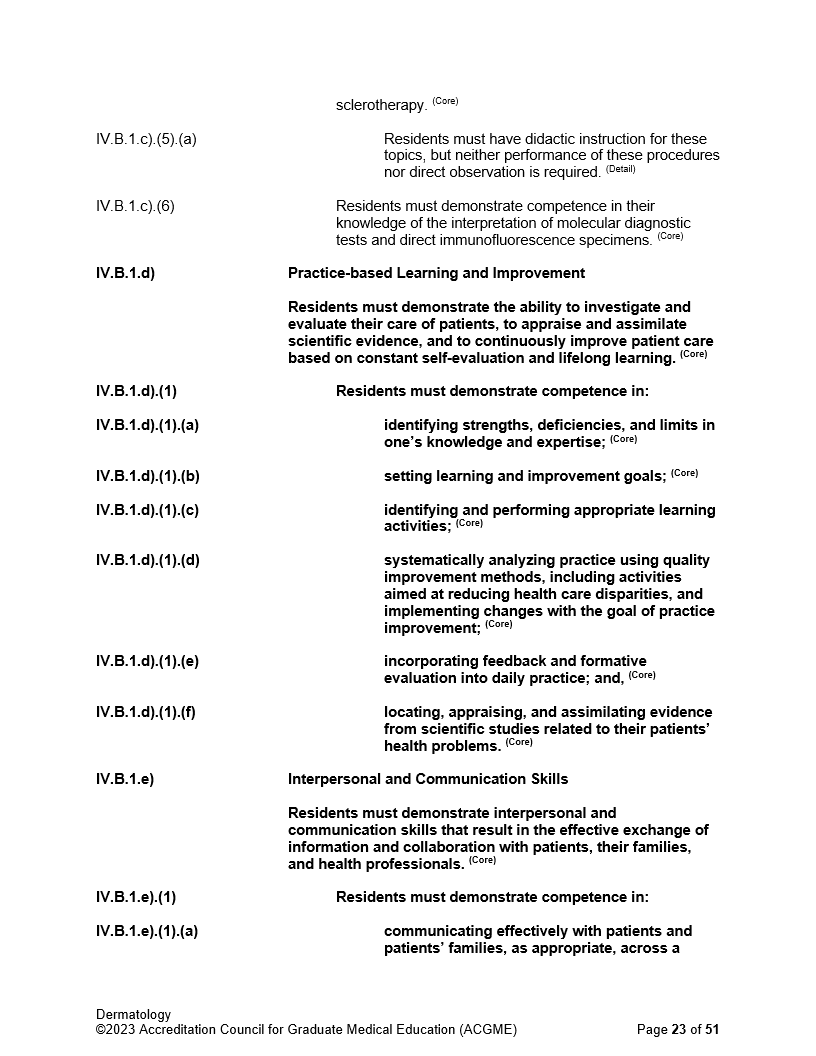
IV.B.1.c). (5).(a)
IV.B. 1.c). (6)
sclerotherapy. (Core)
Residents must have didactic instruction for these
topics, but neither performance of these procedures
nor direct observation is required. (Detail)
Residents must demonstrate competence in their
IV.B.1.d)
IV.B.1.d).(1)
IV.B.1.d. (1).(a)
IV.B.1.d). (1).(b)
IV.B.1.d). (1).(c)
IV.B.1.d). (1).(d)
IV.B.1.d). (1).(e)
IV.B.1.d). (1).(f)
IV.B.1.e)
IV.B.1.e).(1)
IV.B.1.e.(1). a)
Practice-based Learning and Improvement
Residents must demonstrate the ability to investigate and
evaluate their care of patients, to appraise and assimilate
scientific evidence, and to continuously improve patient care
based on constant self-evaluation and lifelong learning. (Core)
Residents must demonstrate competence in:
identifying strengths, deficiencies, and limits in
one’s knowledge and expertise; (Core)
setting learning and improvement goals; (Core)
lentifying and performing appropriate learnir
ctivities; (Co
systematically analyzing practice using quality
improvement methods, including activities
aimed at reducing health care disparities, and
implementing changes with the goal of practice
improvement; (Core)
incorporating feedback and formative
evaluation into daily practice; and, (Core)
locating, appraising, and assimilating evidence
from scientific studies related to their patients’
health problems. (Core)
Interpersonal and Communication Skills
Residents must demonstrate interpersonal and
communication skills that result in the effective exchange of
formation and collaboration with patients, their familie
nd health professionals. (Col
Residents must demonstrate competence in:
communicating effectively with patients and
patients’ families, as appropriate, across a
Dermatology
©2023 Accreditation Council for Graduate Medical Education (ACGME)
Page 23 of 51
Page 24
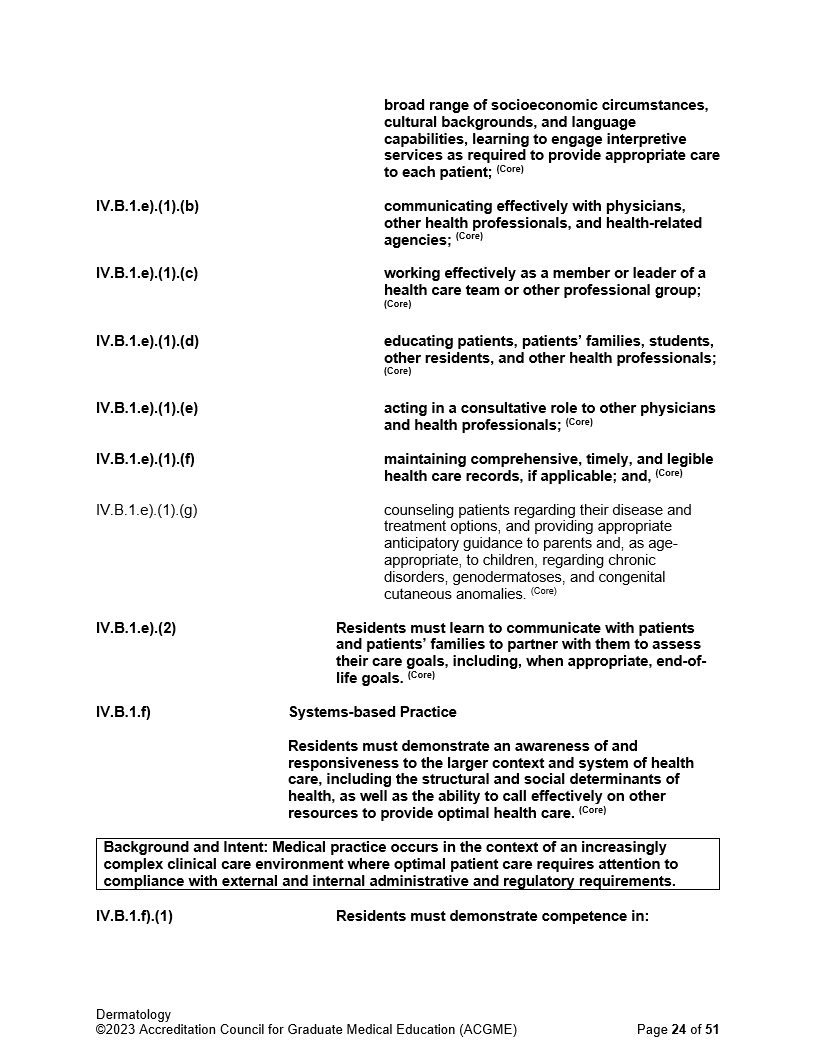
IV.B.1.e) (1).(d)
IV.B.1.e).(1).(e)
IV.B.1.e).(1).(f)
IV.B. 1.e). (1) (g)
IV.B.1.f)
services as required to provide appropriate care
to each patient; (Core)
communicating effectively with physicians
agencies, th professionals, and health related
working effectively as a member or leader of a
health care team or other professional group;
(Core)
educating patients, patients’ families, students,
Other residents, and other health professionals;
acting in a consultative role to other physicians
and health professionals; (Core)
maintaining comprehensive, timely, and legible
health care records, if applicable; and, (Core)
counseling patients regarding their disease and
treatment options, and providing appropriate
anticipatory guidance to parents and, as age-
appropriate, to children, regarding chronic
disorders, genodermatoses, and congenital
cutaneous anomalies. (Core)
Residents must learn to communicate with patient:
and patients’ families to partner with them to asses!
their care goals, including, when appropriate, end-of-
life goals. (Core)
Systems-based Practice
Residents must demonstrate an awareness of and
responsiveness to the larger context and system of health
care, including the structural and social determinants of
lealth, as well as the ability to call effectively on othe
esources to provide optimal health care. (Core
Background and Intent: Medical practice occurs in the context of an increasingly
complex clinical care environment where optimal patient care requires attention to
compliance with external and internal administrative and regulatory requirements.
IV.B.1.f).(1)
Residents must demonstrate competence in:
Dermatology
©2023 Accreditation Council for Graduate Medical Education (ACGME)
Page 24 of 51
Page 25
working effectively in various health care
deliveal specialty, and systems relevant to their
IV.B.1.f).(1).(a)
proper care and the system benefits from proper use of resources.
IV.B.1.f).(1).(b)
patient care systems, ratient care and primal
IV.B.1.f).(1).(c)
papering plea systems ros de,
IV.B.1f) (1) d)
IV.B.1.f).(1).(e)
IV.B.1.f).(1) (f)
understanding health care finances and its
and, on individual patients’ health decisions;
using tools and techniques that promote patient
safety and disclosure of patient safety events
(real or simulated). (Detail)
IV.B.1.f).(2)
IV.C.
IV.C.1.
Curriculum Organization and Resident Experiences
Contiquity of aculty meier superision, a, dr dispersed patient locations vitain quate
hospital have adversely affected optimal resident education and effective team-based
care. The need for patient care continuity varies from specialty to specialty and by
clinical situation, and may be addressed by the individual Review Committee.
Dermatology
©2023 Accreditation Council for Graduate Medical Education (ACGME)
Page 25 of 51
Page 26
IV.C.1.a)
IV.C.1.b)
Assignment of rotations must be structured to minimize the
frequency of rotational transitions, and rotations must be of
sufficient length to provide a quality educational experience,
defined by continuity of patient care, ongoing supervision,
longitudinal relationships with faculty members, and high-quality
assessment and feedback. (Core)
Clinical experiences should be structured to facilitate learning in a
manner that allows residents to function as part of an effective
interprofessional team that works together longitudinally with
shared goals of patient safety and quality improvement. (Core)
IV.C.2.
IV.C.2.a)
IV.C.3.
IV.C.4.
IV.C.4.a)
IV.C.4.b)
IV.C.5.
IV.C.5.a)
Instruction must include pain assessment and management
elevant to dermatology, including appropriate use of loca
nesthesia and post-procedural analgesics, and recognition of th
signs of substance use disorder and drug-seeking behavior. (Core)
A resident’s time throughout each year of the program must be related to
the direct care of outpatients and inpatients, to include clinical
dermatology. (Core)
nds, and other suspecialty laptain are consultations,
The clinical experience must include:
consultations, inpatient rounds, dermatologic surgery,
dermatopathology, pediatric dermatology, e)
and other dermatology-
related subspecialty experiences; and,
significant exposure to other procedures, either through direct
observation or as an assistant in Mohs micrographic surgery, and
reconstruction of these defects, to include flaps and grafts, and
the application of a wide range of lasers and other energy
Residents must have experiences in medical dermatology, procedural
(dermatology, dermatopathology, and pediatric dermatology, including:
following a core group of individual patients throughout the
majority of the program in a minimum of a once-monthly continuity
of care clinic setting, as well as in follow-up of inpatients and
patients seen as consults or during night or weekend call; (Core)
Dermatology
©2023 Accreditation Council for Graduate Medical Education (ACGME)
Page 26 of 51
Page 27
IV.C.5.b)
IV.C.5.c)
IV.C.5.d)
IV.C.5.e)
IV.C.5.f)
IV.C.5.f).(1)
IV.C.6.
IV.C.7.
IV.C.8.
IV.C.9
IV.C.9.a)
medical dermatology encounters with patients having primary skin
disease, to include immunobullous diseases, contact dermatitis,
connective tissue diseases, congenital skin diseases, skin cancer,
and infectious diseases, as well as medically-complicated patients
displaving dermatologic manifestations of svstemic disease or
therapy; (Core)
pediatric dermatology encounters in diagnosing and managing
infants and children with neonatal skin disorders, atopic dermatitis,
psoriasis, blistering disorders, disorders of hair and nails, skin
infections (fungal, bacterial, and viral), vascular tumors and
malformations, congenital and acquired pigmented lesions and
other hamartomas, cutaneous signs of child abuse, and
cutaneous manifestations of multisystem diseases; (Core)
providing consultations for neonatal and pediatric inpatients; (Core)
exposure to procedures, either through direct observation or as an
assistant at surgery, including Mohs surgery with encounters in
micrographic surgery, and reconstruction of these defects, to
include the use of flaps and grafts, the application of a wide range
of lasers and other energy sources, botulinum toxin injections, and
soft tissue procedural dermatology; and, (Core)
dermatopathology encounters with routinely stained histologic
sections from the full spectrum of dermatologic disease. (Core)
A portion of this exposure must occur in an active faculty-
run sign-out setting and with the use of study sets. (Core)
Each resident must record all required procedures and medical/surgical
cases in the ACME Case Log System, and ensure that the data entered
is accurate and complete for all 36 months of the program. (Core)
There should be a well-organized course of instruction in the basic
sciences related to medical dermatology, surgical and aesthetic
dermatology, dermatopathology, and pediatric dermatology. (Core)
The curriculum should contain instruction dedicated to ethical behavior
and professionalism aspects of medicine. (Core)
Didactic sessions should include lectures, conferences, seminars.
demonstrations, clinical education rounds, book and journal reviews,
patient case reviews, and histologic slide review. (Core)
The majority of conference education for residents, including
didactics, should occur within the program, with a clear faculty
commitment. Attendance at other accredited programs’
conferences, which may be appropriate to augment the
conference education of residents, should be supplemental, with
Dermatology
©2023 Accreditation Council for Graduate Medical Education (ACGME)
Page 27 of 51
Page 28
IV.C.9.b)
outsourcing of taculty member-led conterences not to exceed 25
percent of the total. (Detail)
Topics relating to cosmetic techniques, including liposuction, scar
revision, laser resurfacing, hair transplants, and invasive vein
therapies, must be included in didactic sessions. (Core)
Interpretation of direct immunofluorescence specimens must be
included in didactic sessions. (Core)
IV.C.9.C)
IV.D.
Scholarship
Medicine is both an art and a science. The physician is a humanistic
scientist who cares for patients. This requires the ability to think critically,
evaluate the literature, appropriately assimilate new knowledge, and
practice lifelong learning. The program and faculty must create an
environment that fosters the acquisition of such skills through residen
articipation in scholarly activities. Scholarly activities may include
discovery, integration, application, and teaching.
programs prepare physicians for a variety of roles, including clinicians,
scientists, and educators. It is expected that the program’s scholarship will
IV.D.1.
IV.D.1.a)
IV.D.1.b)
IV.D.1.c)
Program Responsibilities
ne program must demonstrate evidence of scholarl
ctivities consistent with its mission(s) and aims. (Co
The program, in partnership with its Sponsoring Institution
macity involvement in scholary acities, ate resident and
practice or the schary aproach to kidence ased patiente
care. (Core)
Faculty Scholarly Activity
IV.D.2.
IV.D.2.a)
• Research in basic science, education, translational
science, patient care, or population health
• Peer-reviewed grants
Dermatology
©2023 Accreditation Council for Graduate Medical Education (ACGME)
Page 28 of 51
Page 29
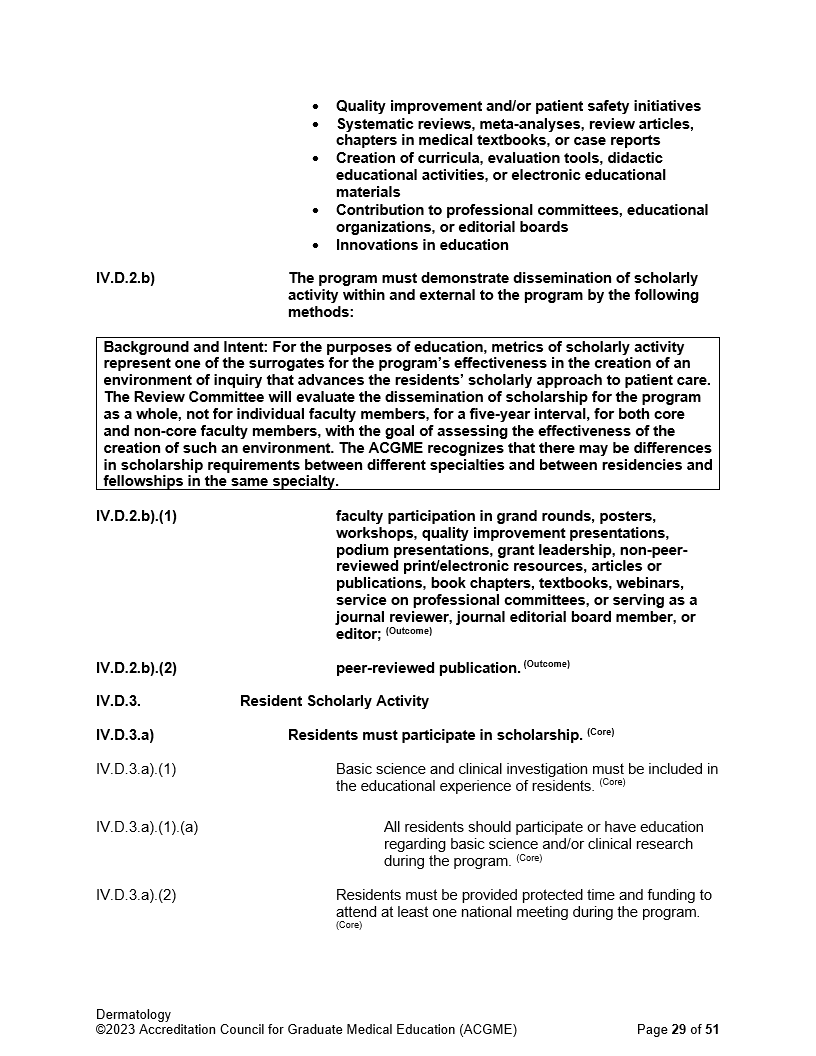
• Quality improvement and/or patient safety initiatives
• Systematic reviews, meta-analyses, review articles,
chapters in medical textbooks, or case reports
• Creation of curricula, evaluation tools, didactic
educational activities, or electronic educational
materials
• Contribution to professional committees, educational
organizations, or editorial boards
• Innovations in education
IV.D.2.b)
The program must demonstrate dissemination of scholarly
activity within and external to the program by the following
methods:
Background and Intent: For the purposes of education, metrics of scholarly activity
represent one of the surrogates for the program’s effectiveness in the creation of an
environment of inquiry that advances the residents’ scholarly approach to patient care.
The Review Committee will evaluate the dissemination of scholarship for the program
as a whole, not for individual faculty members, for a five-year interval, for both core
and non-core faculty members, with the goal of assessing the effectiveness of the
creation of such an environment. The ACGME recognizes that there may be differences
n scholarship requirements between different specialties and between residencies an
ellowships in the same specialty
IV.D.2.b).(1)
IV.D.2.b).(2)
IV.D.3.
IV.D.3.a)
IV.D.3.a). (1)
IV.D.3.a). (1).(a)
IV.D.3.a). (2)
ervice on professional committees, or serving as
outor: reviewer, journal editorial board member, o
peer-reviewed publication. (Outcome
Resident Scholarly Activity
Residents must participate in scholarship. (Core)
Basic science and clinical investigation must be included in
the educational experience of residents.
(Core)
All residents should participate or have education
regarding basic science and/or clinical researcr
during the program. (core
Resent must he real read in an eng to
Dermatology
©2023 Accreditation Council for Graduate Medical Education (ACGME)
Page 29 of 51
Page 30
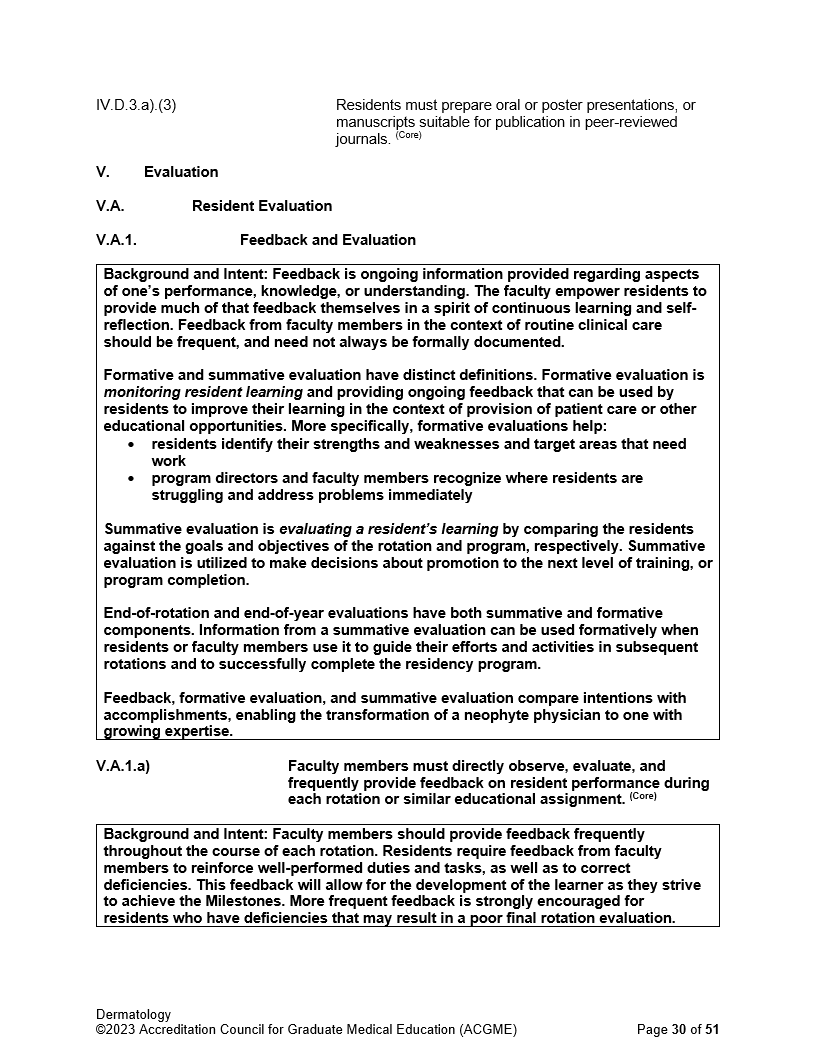
IV.D.3.a). (3)
Residents must prepare oral or poster presentations, or
manuscripts suitable for publication in peer-reviewed
journals. (Core)
V.
Evaluation
V.A.
Resident Evaluation
V.A.1.
Feedback and Evaluation
Background and Intent: Feedback is ongoing information provided regarding aspects
of one’s performance, knowledge, or understanding. The faculty empower residents to
provide much of that feedback themselves in a spirit of continuous learning and self-
reflection. Feedback from faculty members in the context of routine clinical care
should be frequent, and need not always be formally documented.
Formative and summative evaluation have distinct definitions. Formative evaluation is
monitoring resident learning and providing ongoing feedback that can be used by
residents to improve their learning in the context of provision of patient care or other
educational opportunities. More specifically, formative evaluations help:
• residents identify their strengths and weaknesses and target areas that need
work
program directors and faculty members recognize where residents are
struggling and address problems immediately
Summative evaluation is evaluating a resident’s learning by comparing the residents
against the goals and objectives of the rotation and program, respectively. Summative
evaluation is utilized to make decisions about promotion to the next level of training, or
program completion.
End-of-rotation and end-of-year evaluations have both summative and formative
components. Information from a summative evaluation can be used formatively when
residents or faculty members use it to guide their efforts and activities in subsequent
rotations and to successfully complete the residency program.
Feedback, formative evaluation, and summative evaluation compare intentions with
accomplishments, enabling the transformation of a neophyte physician to one with
growing expertise.
V.A.1.a)
Faculty members must directly observe, evaluate, and
frequently provide feedback on resident performance during
each rotation or similar educational assignment. (Core)
Background and Intent: Faculty members should provide feedback frequently
throughout the course of each rotation. Residents require feedback from faculty
members to reinforce well-performed duties and tasks, as well as to correct
deficiencies. This feedback will allow for the development of the learner as they strive
to achieve the Milestones. More frequent feedback is strongly encouraged for
residents who have deficiencies that may result in a poor final rotation evaluation.
Dermatology
©2023 Accreditation Council for Graduate Medical Education (ACGME)
Page 30 of 51
Page 31
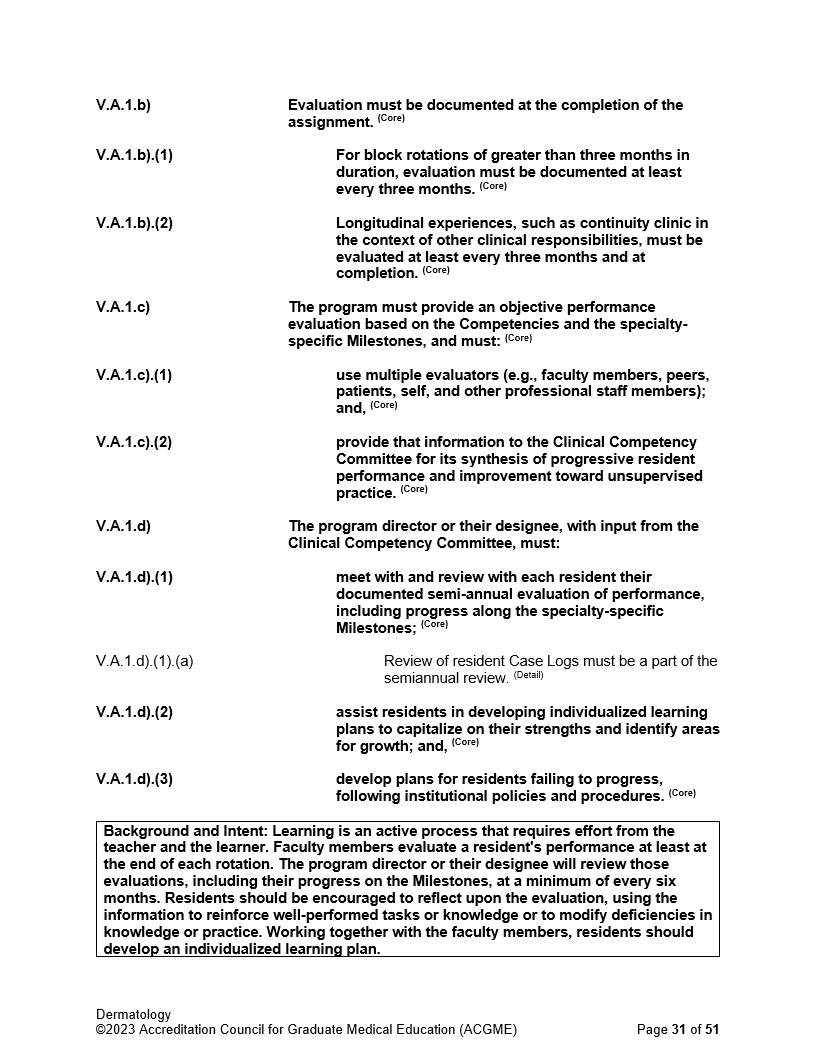
V.A.1.b)
V.A.1.b).(1)
V.A.1.b).(2)
V.A.1.c)
V.A.1.c) (1)
V.A.1.c).(2)
valuation must be documented at the completion of th
ssignment. (Con
For block rotations of greater than three months in
duration, evaluation must be documented at least
every three months. (Core)
Longitudinal experiences, such as continuity clinic ir
he context of other clinical responsibilities, must be
Completion, least every three months and at
The program must provide an objective performanc
evaluation based on the Competencies and the specialty.
specific Milestones, and must: (Core)
Ise multiple evaluators (e.g., faculty members, peers
and,s, self, and other professional staff members)
provide that information to the Clinical Competency
Committee for its synthesis of progressive resident
erformance and improvement toward unsupervise
ractice. (Core
V.A.1.d)
V.A.1.d).(1)
V.A.1.d). (1). (a)
V.A.1.d).(2)
V.A.1.d).(3)
neet with and review with each resident thei
locumented semi-annual evaluation of performance
milestones rogress along the specialty-specific
Review of resident Case Logs must be a part of the
semiannual review. (Detail)
assist residents in developing individualized learning
ans to capitalize on their strengths and identify are
r growth; and, (Co
levelop plans for residents failing to progres:
ollowing institutional policies and procedures. (Cor
information to reinforce well-performed tasks or knowledge or to modify deficiencies in
knowledge or practice. Working together with the faculty members, residents should
develop an individualized learning plan.
Dermatology
©2023 Accreditation Council for Graduate Medical Education (ACGME)
Page 31 of 51
Page 32
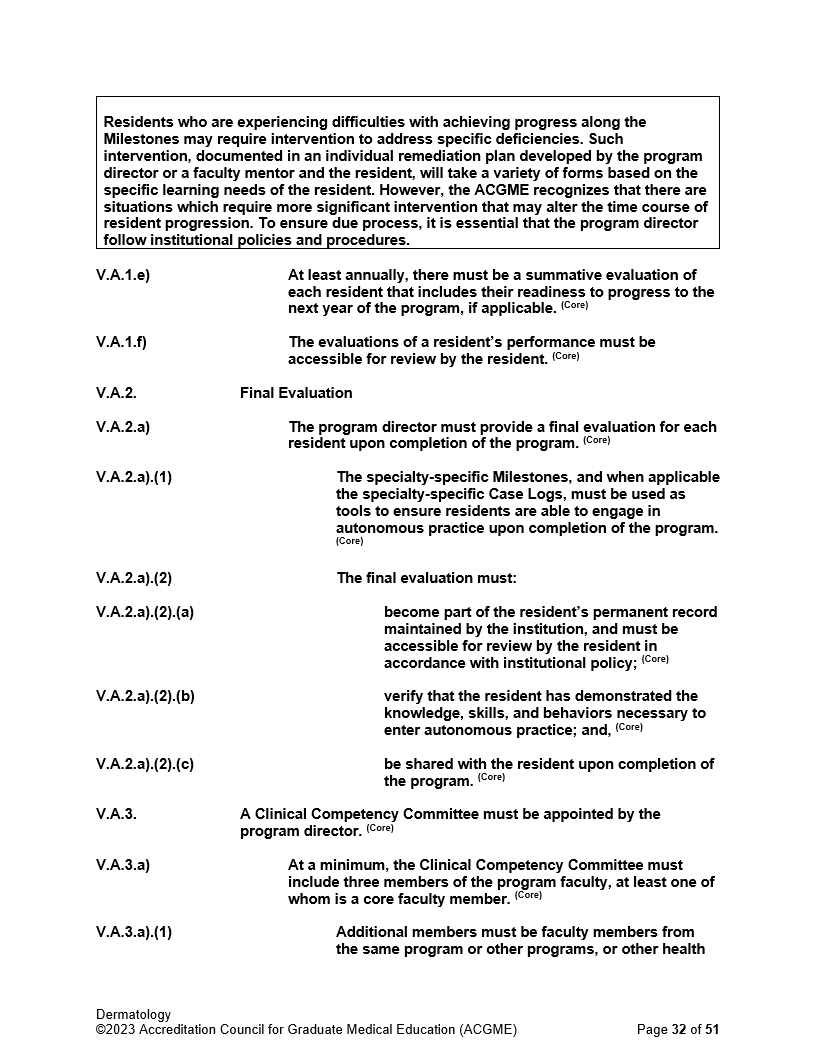
Residents who are experiencing difficulties with achieving progress along the
Milestones may require intervention to address specific deficiencies. Such
intervention, documented in an individual remediation plan developed by the program
director or a faculty mentor and the resident, will take a variety of forms based on the
specific learning needs of the resident. However, the ACME recognizes that there are
situations which require more significant intervention that may alter the time course of
resident progression. To ensure due process, it is essential that the program director
follow institutional policies and procedures.
V.A.1.e)
V.A.1.f)
V.A.2.
V.A.2.a)
V.A.2.a).(1)
V.A.2.a).(2)
V.A.2.a). (2).(a)
V.A.2.a).(2).(b)
V.A.2.a).(2).(c)
V.A.3.
V.A.3.a)
V.A.3.a).(1)
At least annually, there must be a summative evaluation of
each resident that includes their readiness to progress to the
next year of the program, if applicable. (Core)
The evaluations of a resident’s performance must be
accessible for review by the resident. (Core)
Final Evaluation
The program director must provide a final evaluation for each
resident upon completion of the program. (Core)
The specialty-specific Milestones, and when applicable
the specialty-specific Case Logs, must be used as
tools to ensure residents are able to engage in
autonomous practice upon completion of the program.
The final evaluation must:
ecome part of the resident’s permanent recor
naintained by the institution, and must b
accessible for review by the resident in
accordance with institutional policy; (Core)
verify that the resident has demonstrated the
knowledge, skills, and behaviors necessary to
enter autonomous practice; and, (Core)
be shared with the resident upon completion of
the program. (Core)
A Clinical Competency Committee must be appointed by the
program director. (Core
At a minimum, the Clinical Competency Committee must
nclude three members of the program faculty, at least one c
hom is a core faculty member. (Cor
Additional members must be faculty members from
the same program or other programs, or other health
Dermatology
©2023 Accreditation Council for Graduate Medical Education (ACGME)
Page 32 of 51
Page 33
professionals who have extensive contact and
experience with the program’s residents.
(Core)
Background and Intent: The requirements regarding the Clinical Competency
Committee do not preclude or limit a program director’s participation on the Clinical
Competency Committee. The intent is to leave flexibility for each program to decide the
best structure for its own circumstances, but a program should consider: its program
director’s other roles as resident advocate, advisor, and confidante; the impact of the
program director’s presence on the other Clinical Competency Committee members’
discussions and decisions; the size of the program faculty; and other program-relevant
factors. Inclusivity is an important consideration in the appointment of Clinical
Competency Committee members, allowing for diverse participation to ensure fair
evaluation. The program director has final responsibility for resident evaluation and
promotion decisions.
The program faculty may include more than the physician faculty members, such as
other physicians and non-physicians who teach and evaluate the program’s residents.
There may be additional members of the Clinical Competency Committee. Chief
residents who have completed core residency programs in their specialty may be
members of the Clinical Competency Committee.
V.A.3.b)
The Clinical Competency Committee must:
V.A.3.b).(1)
review all resident evaluations at least semi-annually;
(Core)
V.A.3.b).(2)
determine each resident’s progress on achievement of
the specialty-specific Milestones; and, (Core)
V.A.3.b).(3)
meet prior to the residents’ semi-annual evaluations
and advise the program director regarding each
resident’s progress. (Core)
V.B.
Faculty Evaluation
V.B.1.
The program must have a process to evaluate each faculty
member’s performance as it relates to the educational program at
least annually. (Core)
Background and Intent: The program director is responsible for the educational
program and all educators. While the term “faculty” may be applied to physicians
within a given institution for other reasons, it is applied to residency program faculty
members only through approval by a program director. The development of the faculty
improves the education, clinical, and research aspects of a program. Faculty members
have a strong commitment to the resident and desire to provide optimal education and
work opportunities. Faculty members must be provided feedback on their contribution
to the mission of the program. All faculty members who interact with residents desire
feedback on their education, clinical care, and research. If a faculty member does not
interact with residents, feedback is not required. With regard to the diverse operating
environments and configurations, the residency program director may need to work
with others to determine the effectiveness of the program’s faculty performance with
Dermatology
©2023 Accreditation Council for Graduate Medical Education (ACGME)
Page 33 of 51
Page 34
regard to their role in the educational program. All teaching faculty members should
have their educational efforts evaluated by the residents in a confidential and
anonymous manner. Other aspects for the feedback may include research or clinical
productivity, review of patient outcomes, or peer review of scholarly activity. The
process should reflect the local environment and identify the necessary information.
The feedback from the various sources should be summarized and provided to the
faculty on an annual basis by a member of the leadership team of the program.
V.B.1.a)
This evaluation must include a review of the faculty member’s
clinical teaching abilities, engagement with the educational
program, participation in faculty development related to their
skills as an educator, clinical performance, professionalism,
and scholarly activities. (Core)
V.B.1.b)
This evaluation must include written, anonymous, and
confidential evaluations by the residents. (Core)
V.B.2.
V.B.3.
Faculty members must receive feedback on their evaluations at least
annually. (Core)
Results of the faculty educational evaluations should be
incorporated into program-wide faculty development plans. (Core)
Background and Intent: The quality of the faculty’s teaching and clinical care is a
determinant of the quality of the program and the quality of the residents’ future
clinical care. Therefore, the program has the responsibility to evaluate and improve the
program faculty members’ teaching, scholarship, professionalism, and quality care.
This section mandates annual review of the program’s faculty members for this
purpose, and can be used as input into the Annual Program Evaluation.
V.C.
Program Evaluation and Improvement
V.C.1.
The program director must appoint the Program Evaluation
Committee to conduct and document the Annual Program
aluation as part of the program’s continuous improveme
ocess. (C
V.C.1.a)
V.C.1.b).(1)
V.C.1.b).(2)
The Program Evaluation Committee must be composed of at
least two program faculty members, at least one of whom is a
core faculty member, and at least one resident. (Core)
Program Evaluation Committee responsibilities must include:
progre of the programing tentermined goals and
guiding ongoing program improvement, including
and lopment of new goals, based upon outcomes;
Dermatology
©2023 Accreditation Council for Graduate Medical Education (ACGME)
Page 34 of 51
Page 35
V.C.1.b).(3)
review of the current operating environment to identify
strengths, challenges, opportunities, and threats as
related to the program’s mission and aims. (Core)
Background and Intent: To achieve its mission and educate and train quality
physicians, a program must evaluate its performance and plan for improvement in the
Annual Program Evaluation. Performance of residents and faculty members is a
reflection of program quality, and can use metrics that reflect the goals that a program
has set for itself. The Program Evaluation Committee utilizes outcome parameters and
other data to assess the program’s progress toward achievement of its goals and aims.
The Program Evaluation Committee advises the program director through program
oversight.
V.C.1.c)
The Program Evaluation Committee should consider the
outcomes from prior Annual Program Evaluation(s),
aggregate resident and faculty written evaluations of the
program, and other relevant data in its assessment of the
program. (Core)
Background and Intent: Other data to be considered for assessment include:
Curriculum
•
ACME letters of notification, including citations, Areas for Improvement, and
comments
:
Quality and safety of patient care
Aggregate resident and faculty well-being; recruitment and retention; workforce
diversity, including graduate medical education staff and other relevant
academic community members; engagement in quality improvement and patient
safety; and scholarly activity
:
ACME Resident and Faculty Survey results
Aggregate resident Milestones evaluations, and achievement on in-training
xaminations (where applicable), board pass and certification rates, an
raduate performanc
• Aggregate faculty evaluation and professional development
V.C.1.d)
The Program Evaluation Committee must evaluate the
programs mission areas, strengths, areas for
V.C.1.e)
he Annual Program Evaluation, including the action plan
ust be distributed to and discussed with the residents an
tho. embers of the teaching faculty, and be submitted to the
V.C.2.
The program must complete a Self-Study and submit it to the DIO.
(Core)
Background and Intent: Outcomes of the documented Annual Program Evaluation can
be integrated into the accreditation Self-Study process. The accreditation Self-Study is
an objective, comprehensive evaluation of the residency program, with the aim of
improving it. Underlying the accreditation Self-Study is this longitudinal evaluation of
Dermatology
©2023 Accreditation Council for Graduate Medical Education (ACGME)
Page 35 of 51
Page 36
the program and its learning environment, facilitated through sequential Annual
Program Evaluations that focus on the required components, with an emphasis on
program strengths and self-identified areas for improvement. Details regarding the
timing and expectations for the accreditation Self-Study are provided in the ACGME
Manual of Policies and Procedures. Additionally, a description of the accreditation
Self-Study process is available on the ACME website.
V.C.3.
V.C.3.a)
One goal of ACGME-accredited education is to educate physicians
who seek and achieve board certification. One measure of the
effectiveness of the educational program is the ultimate pass rate.
The program director should encourage all eligible program
graduates to take the certifying examination offered by the
applicable American Board of Medical Specialties (ABMS) member
board or American Osteopathic Association (AOA) certifying board.
For specialties in which the ABMS member board and/or AOA
certifying board offers) an annual written exam, in the
preceding three years, the program’s aggregate pass rate of
those taking the examination for the first time must be higher
than the bottom fifth percentile of programs in that specialty.
(Outcome)
V.C.3.c)
For specialties in which the ABMS member board and/or AOA
certifying board offers) an annual oral exam, in the preceding
V.C.3.d)
V.C.3.e)
Background and Intent: Setting a single standard for pass rate that works across
specialties is not supportable based on the heterogeneity of the psychometrics of
Dermatology
©2023 Accreditation Council for Graduate Medical Education (ACGME)
Page 36 of 51
Page 37
different examinations. By using a percentile rank, the performance of the lower five
percent (fifth percentile) of programs can be identified and set on a path to curricular
and test preparation reform.
There are specialties where there is a very high board pass rate that could leave
successful programs in the bottom five percent (fifth percentile) despite admirable
performance. These high-performing programs should not be cited, and V.C.3.e) is
designed to address this.
V.C.3.f)
Programs must report, in ADS, board certification status
annually for the cohort of board-eligible residents that
graduated seven years earlier. (Core)
Background and Intent: It is essential that residency programs demonstrate knowledge
and skill transfer to their residents. One measure of that is the qualifying or initial
certification exam pass rate. Another important parameter of the success of the
program is the ultimate board certification rate of its graduates. Graduates are eligible
for up to seven years from residency graduation for initial certification. The ACGME
will calculate a rolling three-year average of the ultimate board certification rate at
seven years post-graduation, and the Review Committees will monitor it.
The Review Committees will track the rolling seven-year certification rate as an
indicator of program quality. Programs are encouraged to monitor their graduates’
performance on board certification examinations.
In the future, the ACME may establish parameters related to ultimate board
certification rates.
VI. The Learning and Working Environment
Residency education must occur in the context of a learning and working
environment that emphasizes the following principles:
• Excellence in the safety and quality of care rendered to patients by residents
today
• Excellence in the safety and quality of care rendered to patients by today’s
residents in their future practice
• Excellence in professionalism through faculty modeling of:
• Appreciation for the privilege of providing care for patients
• Commitment to the well-being of the students, residents, faculty members, and
all members of the health care team
VI.A.
VI.A.1.
Patient Safety, Quality Improvement, Supervision, and Accountability
Patient Safety and Quality Improvement
Dermatology
©2023 Accreditation Council for Graduate Medical Education (ACGME)
Page 37 of 51
Page 38
VI.A.1.a)
VI.A.1.a).(1)
VI.A.1.a).(1).(a)
VI.A.1.a).(2)
VI.A.1.a).(2).(a)
VI.A.1.a).(2).(a).(i)
VI.A.1.a).(2).(a) (ii)
VI.A.1.a).(2).(b)
VI.A.1.a).(3)
Patient Safety
Culture of Safety
A culture of safety requires continuous identification
of vulnerabilities and a willingness to transparently
deal with them. An effective organization has formal
michaes of its persone oward sate, thirder a
identify areas for improvement.
he program, its faculty, residents, and fellow:
ust actively participate in patient safet
fostems and contribute to a culture of safery.
Patient Safety Events
Reporting, investigation, and follow-up of safety
events, near misses, and unsafe conditions are pivotal
mechanisms for improving patient safety, and are
essential for the success of any patient safety
program. Feedback and experiential learning are
essential to developing true competence in the ability
to identify causes and institute sustainable systems-
based changes to ameliorate patient safety
vulnerabilities.
Residents, fellows, faculty members, and other
clinical staff members must:
know their responsibilities in reporting
patient safety events and unsafe
conditions at the clinical site, including
how to report such events; and, (Core)
e provided with summary informatio
f their institution’s patient safet
reports. (Core)
Residents must participate as team members in
real and/or simulated interprofessional clinical
patient safety and quality improvement
activities, such as root cause analyses or other
activities that include analysis, as well as
formulation and implementation of actions. (Core)
Quality Metrics
Dermatology
©2023 Accreditation Council for Graduate Medical Education (ACGME)
Page 38 of 51
Page 39
Access to data is essential to prioritizing activities for
care improvement and evaluating success of
improvement efforts.
VI.A.1.a).(3).(a)
VI.A.2.
VI.A.2.a)
Supervision and Accountability
Although the attending physician is ultimately responsible for
the care of the patient, every physician shares in the
Supervision in the setting of graduate medical education
rovides safe and effective care to patients; ensures eac
esident’s development of the skills, knowledge, and attitude
required to enter the unsupervised practice of medicine; and
establishes a foundation for continued professional growth.
VI.A.2.a).(1)
Vl.A.2.a).(1).(a)
This information must be available to residents
faculty members, other members of the healt!
care team, and patients. (Core)
Background and Intent: Each patient will have an identifiable and appropriately
credentialed and privileged attending physician (or licensed independent practitioner
as specified by the applicable Review Committee) who is responsible and accountable
for the patient’s care.
VI.A.2.a).(2)
The program must demonstrate that the appropriate
level of supervision in place for all residents is based
on each resident’s level of training and ability, as well
as patient complexity and acuity. Supervision may be
to the sid ation, in a variety of methods, as appropriate
Background and Intent: Appropriate supervision is essential for patient safety and
high-quality teaching. Supervision is also contextual. There is tremendous diversity of
resident-patient interactions, training locations, and resident skills and abilities, even
at the same level of the educational program. The degree of supervision for a resident
is expected to evolve progressively as the resident gains more experience, even with
the same patient condition or procedure. The level of supervision for each resident is
Dermatology
©2023 Accreditation Council for Graduate Medical Education (ACGME)
Page 39 of 51
Page 40
commensurate with that resident’s level of independence in practice; this level of
supervision may be enhanced based on factors such as patient safety, complexity,
acuity, urgency, risk of serious safety events, or other pertinent variables.
VI.A.2.b)
Levels of Supervision
• promote appropriate resident supervision while providin
he foldeding chassif cadi on or supervisi che program must us
VI.A.2.b).(1)
VI.A.2.b).(1).(a)
Direct Supervision:
the she resing physicianes ply pinions ste
patient interaction
VI.A.2.b). (1).(a).(i)
PGY-1 residents must initially be
supervised directly, only as described in
VI.A.2.b). (1).(a). (Core)
Indirect Supervision: the supervising physician is not
providing physical or concurrent visual or audio
supervision but is immediately available to the
esident for guidance and is available to provid
ppropriate direct supervisior
VI.A.2.b).(3)
Oversight - the supervising physician is available t
provide review of procedures/encounters with
feedback provided after care is delivered.
VI.A.2.c)
The program must define when physical presence of a
supervising physician is required. (Core)
VI.A.2.d)
he privilege of progressive authority and responsibili
onditional independence, and a supervisory role in patier
program dated or aach eside members easigned by the
VI.A.2.d).(1)
The program director must evaluate each resident’s
alises es, ed on specific criteria, guided by the
VI.A.2.d).(2)
VI.A.2.d).(3)
Senior residents or fellows should serve in a
supervisory role to junior residents in recognition of
their progress toward independence, based on the
Dermatology
©2023 Accreditation Council for Graduate Medical Education (ACGME)
Page 40 of 51
Page 41
VI.A.2.e)
needs of each patient and the skills of the individua
resident or fellow. (Detail
Programs must set guidelines for circumstances and events
in which residents must communicate with the supervising
faculty member(s). (Core)
VI.A.2.e).(1)
Background and Intent: The ACME Glossary of Terms defines conditional
independence as: Graded, progressive responsibility for patient care with defined
oversight.
VI.A.2.f)
Faculty supervision assignments must be of sufficient
VI.B.
Professionalism
VI.B.1.
Programs, in partnership with their Sponsoring Institutions, must
educate residents and faculty members concerning the professional
and ethical responsibilities of physicians, including but not limited
to their obligation to be appropriately rested and fit to provide the
care required by their patients. (Core)
Background and Intent: This requirement emphasizes the professional responsibility
of residents and faculty members to arrive for work adequately rested and ready to
care for patients. It is also the responsibility of residents, faculty members, and other
members of the care team to be observant, to intervene, and/or to escalate their
concern about resident and faculty member fitness for work, depending on the
situation, and in accordance with institutional policies. This includes recognition of
impairment, including from illness, fatigue, and substance use, in themselves, their
peers, and other members of the health care team, and the recognition that under
certain circumstances, the best interests of the patient may be served by transitioning
that patient’s care to another qualified and rested practitioner.
VI.B.2.
The learning objectives of the program must:
Vl.B.2.a)
be accomplished without excessive reliance on residents to
fulfill non-physician obligations; (Core)
Background and Intent: Routine reliance on residents to fulfill non-physician obligations
increases work compression for residents and does not provide an optimal educational
experience. Non-physician obligations are those duties which in most institutions are
performed by nursing and allied health professionals, transport services, or clerical
staff. Examples of such obligations include transport of patients from the wards or units
Dermatology
©2023 Accreditation Council for Graduate Medical Education (ACME)
Page 41 of 51
Page 42
for procedures elsewhere in the hospital; routine blood drawing for laboratory tests;
routine monitoring of patients when off the ward; and clerical duties, such as
scheduling. While it is understood that residents may be expected to do any of these
things on occasion when the need arises, these activities should not be performed by
residents routinely and must be kept to a minimum to optimize resident education.
VI.B.2.b)
ensure manageable patient care responsibilities; and, (Core)
Background and Intent: The Common Program Requirements do not define
”manageable patient care responsibilities” as this is variable by specialty and PGY
level. Review Committees will provide further detail regarding patient care
responsibilities in the applicable specialty-specific Program Requirements and
accompanying FAQs. However, all programs, regardless of specialty, should carefully
assess how the assignment of patient care responsibilities can affect work
compression, especially at the PGY-1 level.
VI.B.2.c)
include efforts to enhance the meaning that each resident
finds in the experience of being a physician, including
protecting time with patients, providing administrative
support, promoting progressive independence and flexibility,
and enhancing professional relationships. (Core)
VI.B.3.
The program director, in partnership with the Sponsoring Institution,
must provide a culture of professionalism that supports patient
safety and personal responsibility. (Core)
Background and Intent: The accurate reporting of clinical and educational work hours,
patient outcomes, and clinical experience data are the responsibility of the program
leadership, residents, and faculty.
VI.B.4.
Residents and faculty members must demonstrate an understanding
of their personal role in the safety and welfare of patients entrusted
to their care, including the ability to report unsafe conditions and
safety events. (Core)
VI.B.5.
Programs, in partnership with their Sponsoring Institutions, must
provide a professional, equitable, respectful, and civil environment
that is psychologically safe and that is free from discrimination,
sexual and other forms of harassment, mistreatment, abuse, or
coercion of students, residents, faculty, and staff. (Core)
Background and Intent: Psychological safety is defined as an environment of trust and
respect that allows individuals to feel able to ask for help, admit mistakes, raise
concerns, suggest ideas, and challenge ways of working and the ideas of others on the
team, including the ideas of those in authority, without fear of humiliation, and the
knowledge that mistakes will be handled justly and fairly.
The ACME is unable to adjudicate disputes between individuals, including residents,
faculty members, and staff members. However, information that suggests a pattern of
behavior that violates the requirement above will trigger a careful review and, if
Dermatology
©2023 Accreditation Council for Graduate Medical Education (ACGME)
Page 42 of 51
Page 43
deemed appropriate, action by the Review Committee and/or ACME, in accordance
with ACME Policies and Procedures.
VI.B.6.
Programs, in partnership with their Sponsoring Institutions, should
have a process for education of residents and faculty regarding
unprofessional behavior and a confidential process for reporting,
investigating, and addressing such concerns. (Core)
VI.C.
Well-Being
Psychological, emotional, and physical well-being are critical in the
development of the competent, caring, and resilient physician and require
proactive attention to life inside and outside of medicine. Well-being
requires that physicians retain the joy in medicine while managing their
own real-life stresses. Self-care and responsibility to support other
members of the health care team are important components of
professionalism; they are also skills that must be modeled, learned, and
nurtured in the context of other aspects of residency training.
Residents and faculty members are at risk for burnout and depression.
Programs, in partnership with their Sponsoring Institutions, have the same
responsibility to address well-being as other aspects of resident
competence. Physicians and all members of the health care team share
responsibility for the well-being of each other. A positive culture in a
clinical learning environment models constructive behaviors, and prepares
residents with the skills and attitudes needed to thrive throughout their
careers.
VI.C.1.
VI.C.1.a)
The responsibility of the program, in partnership with the
Sponsoring Institution, must include:
tention to scheduling, work intensity, and wor
ompression that impacts resident well-being; (Co
Vl.C.1.b)
evaluating workplace safety data and addressing the safety of
residents and faculty members; (Core
Background and Intent: This requirement emphasizes the responsibility shared by the
Sponsoring Institution and its programs to gather information and utilize systems that
monitor and enhance resident and faculty member safety, including physical safety.
Issues to be addressed include, but are not limited to, monitoring of workplace injuries,
physical or emotional violence, vehicle collisions, and emotional well-being after safety
events.
VI.C.1.c)
policies and programs that encourage optimal resident and
faculty member well-being; and, (Core)
Background and Intent: Well-being includes having time away from work to engage with
family and friends, as well as to attend to personal needs and to one’s own health,
including adequate rest, healthy diet, and regular exercise. The intent of this
Dermatology
©2023 Accreditation Council for Graduate Medical Education (ACGME)
Page 43 of 51
Page 44
requirement is to ensure that residents have the opportunity to access medical and
VI.C.1.c) (1)
Resia, must he in the ental are poements,
including those scheduled during their working hours.
(Core)
education of residents and faculty members in:
VI.C.1.d)
VI.C.1.d) (1)
VI.C.1.d).(2)
VI.C.1.d).(3)
to seek approprate are, and, in themselves and how
access to appropriate tools for self-screening. (Core)
Background and Intent: Programs and Sponsoring Institutions are encouraged to review
materials to create systems for identification of burnout, depression, and substance use
disorders. Materials and more information are available in Learn at ACGME
(https://dl.acgme.org/pages/well-being-tools-resources).
Individuals experiencing burnout, depression, a substance use disorder, and/or suicidal
ideation are often reluctant to reach out for help due to the stigma associated with these
conditions and may be concerned that seeking help may have a negative impact on their
career. Recognizing that physicians are at increased risk in these areas, it is essential
that residents and faculty members are able to report their concerns when another
resident or faculty member displays signs of any of these conditions, so that the
program director or other designated personnel, such as the department chair, may
assess the situation and intervene as necessary to facilitate access to appropriate care.
Residents and faculty members must know which personnel, in addition to the program
director, have been designated with this responsibility; those personnel and the
program director should be familiar with the institution’s impaired physician policy and
any employee health, employee assistance, and/or wellness/well-being programs within
the institution. In cases of physician impairment, the program director or designated
personnel should follow the policies of their institution for reporting.
VI.C.1.e)
providing access to confidential, affordable mental health
assessment, counseling, and treatment, including access to
urgent and emergent care 24 hours a day, seven days a week.
(Core)
Background and Intent: The intent of this requirement is to ensure that residents have
immediate access at all times to a mental health professional (psychiatrist,
psychologist, Licensed Clinical Social Worker, Primary Mental Health Nurse
Dermatology
©2023 Accreditation Council for Graduate Medical Education (ACME)
Page 44 of 51
Page 45
Practitioner, or Licensed Professional Counselor) for urgent or emergent mental health
issues. In-person, telemedicine, or telephonic means may be utilized to satisfy this
requirement. Care in the Emergency Department may be necessary in some cases, but
not as the primary or sole means to meet the requirement.
The reference to affordable counseling is intended to require that financial cost not be a
barrier to obtaining care.
VI.C.2.
There are circumstances in which residents may be unable to attend
work, including but not limited to fatigue, illness, family
emergencies, and medical, parental, or caregiver leave. Each
program must allow an appropriate length of absence for residents
unable to perform their patient care responsibilities. (Core)
VI.C.2.a)
The program must have policies and procedures in place to
ensure coverage of patient care and ensure continuity of
patient care. (Core)
Vl.c.2.b)
These policies must be implemented without fear of negative
consequences for the resident who is or was unable to
provide the clinical work. (Core)
Background and Intent: Residents may need to extend their length of training
depending on length of absence and specialty board eligibility requirements.
Teammates should assist colleagues in need and equitably reintegrate them upon
return.
VI.D.
VI.D.1.
Fatigue Mitigation
Programs must educate all residents and faculty members in
recognition of the signs of fatigue and sleep deprivation, alertness
management, and fatigue mitigation processes. (Detail)
Background and Intent: Providing medical care to patients is physically and mentally
demanding. Night shifts, even for those who have had enough rest, cause fatigue.
Experiencing fatigue in a supervised environment during training prepares residents for
managing fatigue in practice. It is expected that programs adopt fatigue mitigation
processes and ensure that there are no negative consequences and/or stigma for using
fatigue mitigation strategies.
Strategies that may be used include but are not limited to strategic napping; the
judicious use of caffeine; availability of other caregivers; time management to maximize
sleep off-duty; learning to recognize the signs of fatigue, and self-monitoring
performance and/or asking others to monitor performance; remaining active to promote
alertness; maintaining a healthy diet; using relaxation techniques to fall asleep;
maintaining a consistent sleep routine; exercising regularly; increasing sleep time
before and after call; and ensuring sufficient sleep recovery periods.
Dermatology
©2023 Accreditation Council for Graduate Medical Education (ACGME)
Page 45 of 51
Page 46
VI.D.2.
VI.E.
VI.E.1.
The program, in partnership with its Sponsoring Institution, must
ensure adequate sleep facilities and safe transportation options for
residents who may be too fatigued to safely return home. (Core)
Clinical Responsibilities, Teamwork, and Transitions of Care
Clinical Responsibilities
The clinical responsibilities for each resident must be based on PGY
VI.E.1.a)
Assuming that the severity and complexity of illnesses or
conditions and available support services are comparable for the
patients cared for by residents at each level of education, then
PGY-2 residents are expected to carry a clinical case load equal
to at least 50 percent of that of PGY-4 residents, and PGY-3
sidents are expected to carry a clinical case load equal to a
east 75 percent of that of PGY-4 residents. (Deta
Background and Intent: The changing clinical care environment of medicine has meant
that work compression due to high complexity has increased stress on residents.
Faculty members and program directors need to make sure residents function in an
environment that has safe patient care and a sense of resident well-being. It is an
essential responsibility of the program director to monitor resident workload. Workload
should be distributed among the resident team and interdisciplinary teams to minimize
work compression.
VI.E.2.
Teamwork
Background and Intent: Effective programs will have a structure that promotes safe
interprofessional, team-based care. Optimal patient safety occurs in the setting of a
coordinated interprofessional learning and working environment.
VI.E.2.a)
Programs must maintain a process that results in referral of
patients from a broad group of specialty areas outside of
dermatology. Residents must be an integral part of the care of
these referred patients, and must play key roles in diagnostic
work-up, treatment decisions, measurement of treatment
outcomes, and the communication and coordination of these
activities with program faculty and referring sources. (Detail)
VI.E.3.
Transitions of Care
Dermatology
©2023 Accreditation Council for Graduate Medical Education (ACGME)
Page 46 of 51
Page 47
VI.E.3.a)
Programs must design clinical assignments to optimize
and structure patient care, including their safety, frequency.
VI.E.3.b)
VI.E.3.c)
VI.F.
saoes ses to facilitate both continuity of care and patient
Pron us is reta reader the one process.,
Clinical Experience and Education
2222
the previous use of the term “duty” in reference to number of hours worked may have
led some to conclude that residents’ duty to “clock out” on time superseded their duty
to their patients.
VI.F.1.
Maximum Hours of Clinical and Educational Work per Week
Clinical and educational work hours must be limited to no more than
80 hours per week, averaged over a four-week period, inclusive of all
in-house clinical and educational activities, clinical work done from
home, and all moonlighting. (Core)
Background and Intent: Programs and residents have a shared responsibility to ensure
that the 80-hour maximum weekly limit is not exceeded. While the requirement has been
written with the intent of allowing residents to remain beyond their scheduled work
periods to care for a patient or participate in an educational activity, these additional
hours must be accounted for in the allocated 80 hours when averaged over four weeks.
Work from Home
While the requirement specifies that clinical work done from home must be counted
toward the 80-hour maximum weekly limit, the expectation remains that scheduling be
structured so that residents are able to complete most work on site during scheduled
clinical work hours without requiring them to take work home. The requirements
acknowledge the changing landscape of medicine, including electronic health records,
and the resulting increase in the amount of work residents choose to do from home. The
requirement provides flexibility for residents to do this while ensuring that the time
spent by residents completing clinical work from home is accomplished within the 80-
hour weekly maximum. Types of work from home that must be counted include using an
Dermatology
©2023 Accreditation Council for Graduate Medical Education (ACGME)
Page 47 of 51
Page 48
electronic health record and taking calls from home. Reading done in preparation for the
following day’s cases, studying, and research done from home do not count toward the
80 hours. Resident decisions to leave the hospital before their clinical work has been
completed and to finish that work later from home should be made in consultation with
the resident’s supervisor. In such circumstances, residents should be mindful of their
professional responsibility to complete work in a timely manner and to maintain patient
confidentiality.
Residents are to track the time they spend on clinical work from home and to report that
time to the program. Decisions regarding whether to report infrequent phone calls of
very short duration will be left to the individual resident. Programs will need to factor in
time residents are spending on clinical work at home when schedules are developed to
ensure that residents are not working in excess of 80 hours per week, averaged over
four weeks. There is no requirement that programs assume responsibility for
documenting this time. Rather, the program’s responsibility is ensuring that residents
report their time from home and that schedules are structured to ensure that residents
are not working in excess of 80 hours per week, averaged over four weeks.
VI.F.2.
Mandatory Time Free of Clinical Work and Education
VI.F.2.a)
Residents should have eight hours off between scheduled
clinical work and education periods. (Detail)
Background and Intent: There may be circumstances when residents choose to stay to
care for their patients or return to the hospital with fewer than eight hours free of clinical
experience and education. This occurs within the context of the 80-hour and the one-
day-off-in-seven requirements. While it is expected that resident schedules will be
structured to ensure that residents are provided with a minimum of eight hours off
between scheduled work periods, it is recognized that residents may choose to remain
beyond their scheduled time, or return to the clinical site during this time-off period, to
care for a patient. The requirement preserves the flexibility for residents to make those
choices. It is also noted that the 80-hour weekly limit (averaged over four weeks) is a
deterrent for scheduling fewer than eight hours off between clinical and education work
periods, as it would be difficult for a program to design a schedule that provides fewer
than eight hours off without violating the 80-hour rule.
VI.F.2.b)
Residents must have at least 14 hours free of clinical work
and education after 24 hours of in-house call. (Core)
Background and Intent: Residents have a responsibility to return to work rested, and
thus are expected to use this time away from work to get adequate rest. In support of
this goal, residents are encouraged to prioritize sleep over other discretionary activities.
VI.F.2.c)
Residents must be scheduled for a minimum of one day in
seven free of clinical work and required education (when
averaged over four weeks). At-home call cannot be assigned
on these free days. (Core)
Background and Intent: The requirement provides flexibility for programs to distribute
days off in a manner that meets program and resident needs. It is strongly
Dermatology
©2023 Accreditation Council for Graduate Medical Education (ACGME)
Page 48 of 51
Page 49
recommended that residents’ preference regarding how their days off are distributed be
considered as schedules are developed. It is desirable that days off be distributed
throughout the month, but some residents may prefer to group their days off to have a
”golden weekend,” meaning a consecutive Saturday and Sunday free from work. The
requirement for one free day in seven should not be interpreted as precluding a golden
weekend. Where feasible, schedules may be designed to provide residents with a
weekend, or two consecutive days, free of work. The applicable Review Committee will
evaluate the number of consecutive days of work and determine whether they meet
educational objectives. Programs are encouraged to distribute days off in a fashion that
optimizes resident well-being, and educational and personal goals. It is noted that a day
off is defined in the ACME Glossary of Terms as “one (1) continuous 24-hour period
free from all administrative, clinical, and educational activities.”
VI.F.3.
Maximum Clinical Work and Education Period Length
VI.F.3.a)
Clinical and educational work periods for residents must not
exceed 24 hours of continuous scheduled clinical
assignments. (Core)
VI.F.3.a).(1)
Up to four hours of additional time may be used for
activities related to patient safety, such as providing
effective transitions of care, and/or resident education.
Additional patient care responsibilities must not be
assigned to a resident during this time. (Core)
Background and Intent: The additional time referenced in VI.F.3.a).(1) should not be
used for the care of new patients. It is essential that the resident continue to function as
a member of the team in an environment where other members of the team can assess
resident fatigue, and that supervision for post-call residents is provided. This 24 hours
averaged over four wel kour hours must occur within the context of 80-hour weekly limit.
VI.F.4.
Clinical and Educational Work Hour Exceptions
VI.F.4.a)
In rare circumstances, after handing off all other
responsibilities, a resident, on their own initiative, may elect
to remain or return to the clinical site in the following
circumstances: to continue to provide care to a single
severely ill or unstable patient; to give humanistic attention to
the needs of a patient or patient’s family; or to attend unique
educational events. (Detail)
VI.F.4.b)
These additional hours of care or education must be counted
toward the 80-hour weekly limit. (Detail)
Background and Intent: This requirement is intended to provide residents with some
control over their schedules by providing the flexibility to voluntarily remain beyond the
scheduled responsibilities under the circumstances described above. It is important to
note that a resident may remain to attend a conference, or return for a conference later
in the day, only if the decision is made voluntarily. Residents must not be required to
Dermatology
©2023 Accreditation Council for Graduate Medical Education (ACGME)
Page 49 of 51
Page 50
stay. Programs allowing residents to remain or return beyond the scheduled work and
clinical education period must ensure that the decision to remain is initiated by the
resident and that residents are not coerced. This additional time must be counted
toward the 80-hour maximum weekly limit.
VI.F.4.c)
A Review Committee may grant rotation-specific exceptions
for up to 10 percent or a maximum of 88 clinical anc
ducational work hours to individual programs based on
ound educational rationale
The Review Committee for Dermatology will not consider requests
for exceptions to the 80-hour limit to the residents’ work week.
VI.F.5.
Moonlighting
VI.F.5.a)
Moonlighting must not interfere with the ability of the resident
to achieve the goals and objectives of the educational
Work nor compromise pintert saty, the resident’s fitness for
VI.F.5.b)
Time spent by residents in internal and external moonlightin
as defined in the ACGME Glossary of Terms) must bi
counted toward the 80-hour maximum weekly limit. (Core)
VI.F.5.c)
PGY-1 residents are not permitted to moonlight. (Core)
Background and Intent: For additional clarification of the expectations related to
moonlighting, please refer to the Common Program Requirement FAQs (available at
http://www.acgme.org/What-We-Do/Accreditation/Common-Program-Requirements).
VI.F.6.
In-House Night Float
light float must occur within the context of the 80-hour and one
lay-off-in-seven requirements. (Core
VI.F.7.
Maximum In-House On-Call Frequency
esidents must be scheduled for in-house call no more frequentl
nan every third night (when averaged over a four-week period). (Cor
VI.F.8.
VI.F.8.a)
At-Home Call
ime spent on patient care activities by residents on at-hom
all must count toward the 80-hour maximum weekly limit
Dermatology
©2023 Accreditation Council for Graduate Medical Education (ACGME)
Page 50 of 51
Page 51
Vl.F.8.a).(1)
At-home call must not be so frequent or taxing as to
preclude rest or reasonable personal time for each
resident. (Core)
Background and Intent: As noted in VI.F.1., clinical work done from home when a
resident is taking at-home call must count toward the 80-hour maximum weekly limit.
This acknowledges the often significant amount of time residents devote to clinical
activities when taking at-home call, and ensures that taking at-home call does not result
in residents routinely working more than 80 hours per week. At-home call activities that
must be counted include responding to phone calls and other forms of communication,
as well as documentation, such as entering notes in an electronic health record.
Activities such as reading about the next day’s case, studying, or research activities do
not count toward the 80-hour weekly limit.
In their evaluation of residency/fellowship programs, Review Committees will look at the
overall impact of at-home call on resident/fellow rest and personal time.
Dermatology
©2023 Accreditation Council for Graduate Medical Education (ACGME)
Page 51 of 51