Appendix NN – Ertapenem Protocol
This is saved as a smartphrase: ERTAPENEMNEWSTART
Text from this document (searchable)
Page 1
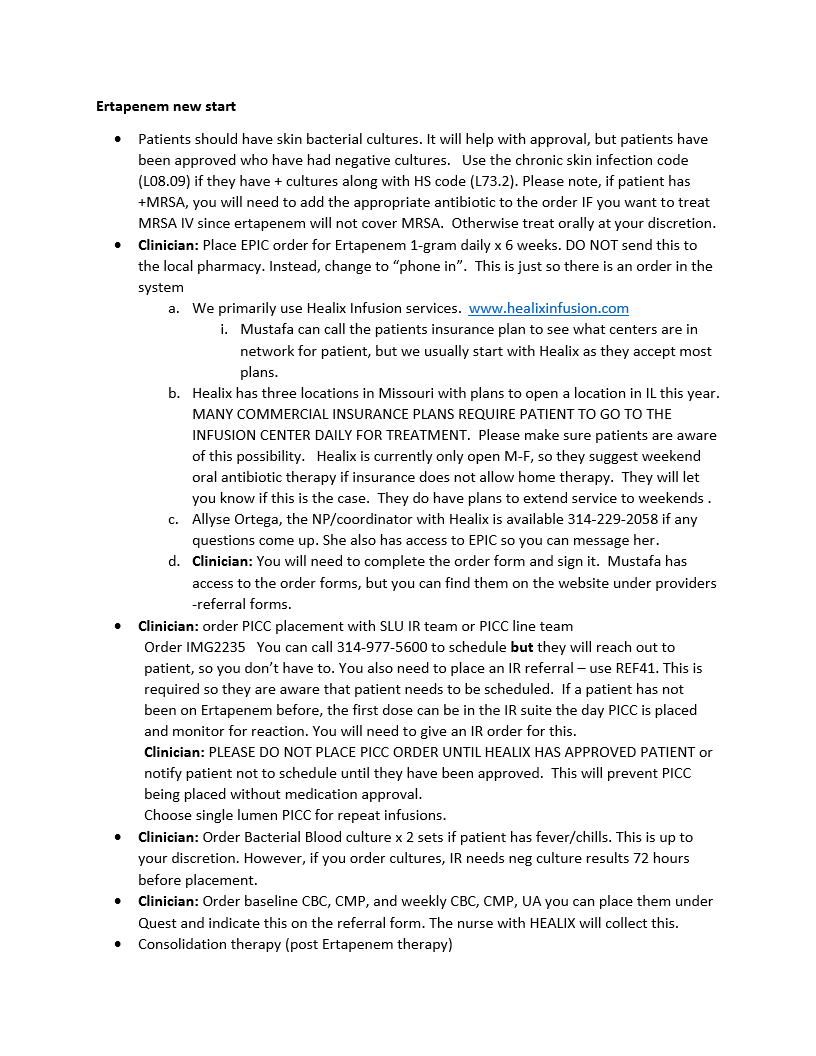
Ertapenem new start
• Patients should have skin bacterial cultures. It will help with approval, but patients have
been approved who have had negative cultures. Use the chronic skin infection code
(L08.09) if they have + cultures along with HS code (L73.2). Please note, if patient has
+MRSA, you will need to add the appropriate antibiotic to the order IF you want to treat
MRSA IV since ertapenem will not cover MRSA. Otherwise treat orally at your discretion.
• Clinician: Place EPIC order for Ertapenem 1-gram daily x 6 weeks. DO NOT send this to
the local pharmacy. Instead, change to “phone in”. This is just so there is an order in the
system
a. We primarily use Healix Infusion services. www.healixinfusion.com
i. Mustafa can call the patients insurance plan to see what centers are in
network for patient, but we usually start with Healix as they accept most
plans.
b. Healix has three locations in Missouri with plans to open a location in IL this year.
MANY COMMERCIAL INSURANCE PLANS REQUIRE PATIENT TO GO TO THE
INFUSION CENTER DAILY FOR TREATMENT. Please make sure patients are aware
of this possibility. Healix is currently only open M-F, so they suggest weekend
oral antibiotic therapy if insurance does not allow home therapy. They will let
you know if this is the case. They do have plans to extend service to weekends.
c. Allyse Ortega, the NP/coordinator with Healix is available 314-229-2058 if any
questions come up. She also has access to EPIC so you can message her.
d. Clinician: You will need to complete the order form and sign it. Mustafa has
access to the order forms, but you can find them on the website under providers
-referral forms.
• Clinician: order PICC placement with SLU IR team or PICC line team
Order IMG2235 You can call 314-977-5600 to schedule but they will reach out to
patient, so you don’t have to. You also need to place an IR referral - use REF41. This is
required so they are aware that patient needs to be scheduled. If a patient has not
been on Ertapenem before, the first dose can be in the IR suite the day PICC is placed
and monitor for reaction. You will need to give an IR order for this.
Clinician: PLEASE DO NOT PLACE PICC ORDER UNTIL HEALIX HAS APPROVED PATIENT or
notify patient not to schedule until they have been approved. This will prevent PICC
being placed without medication approval.
Choose single lumen PICC for repeat infusions.
• Clinician: Order Bacterial Blood culture x 2 sets if patient has fever/chills. This is up to
your discretion. However, if you order cultures, IR needs neg culture results 72 hours
before placement.
• Clinician: Order baseline CBC, CMP, and weekly CBC, CMP, UA you can place them under
Quest and indicate this on the referral form. The nurse with HEALIX will collect this.
• Consolidation therapy (post Ertapenem therapy)
Page 2
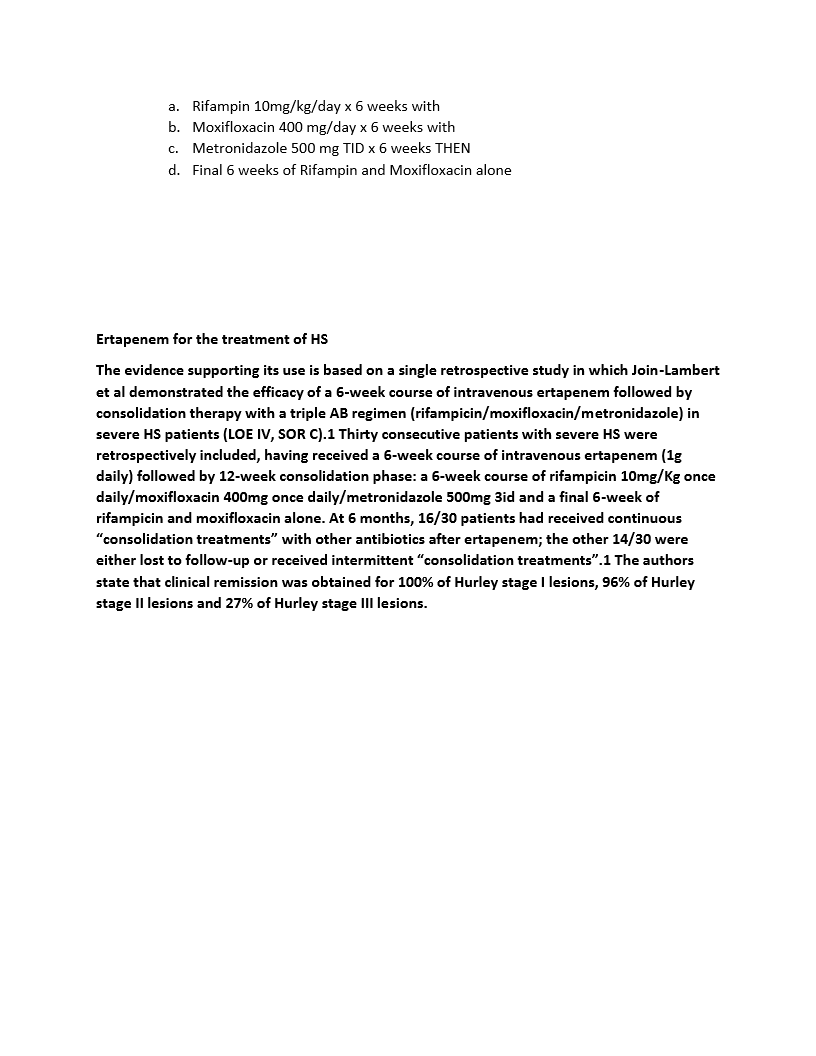
a. Rifampin 10mg/kg/day x 6 weeks with
b. Moxifloxacin 400 mg/day x 6 weeks with
c. Metronidazole 500 mg TID x 6 weeks THEN
d. Final 6 weeks of Rifampin and Moxifloxacin alone
Ertapenem for the treatment of HS
The evidence supporting its use is based on a single retrospective study in which Join-Lambert
et al demonstrated the efficacy of a 6-week course of intravenous ertapenem followed by
consolidation therapy with a triple AB regimen (rifampicin/moxifloxacin/metronidazole) in
severe HS patients (LOE IV, SOR C).1 Thirty consecutive patients with severe HS were
retrospectively included, having received a 6-week course of intravenous ertapenem (1g
daily) followed by 12-week consolidation phase: a 6-week course of rifampicin 10mg/Kg once
daily/ moxifloxacin 400mg once daily/metronidazole 500mg 3id and a final 6-week of
rifampicin and moxifloxacin alone. At 6 months, 16/30 patients had received continuous
”consolidation treatments” with other antibiotics after ertapenem; the other 14/30 were
either lost to follow-up or received intermittent “consolidation treatments”.1 The authors
state that clinical remission was obtained for 100% of Hurley stage I lesions, 96% of Hurley
stage Il lesions and 27% of Hurley stage Ill lesions.